
Cannabis Education
Weed Gummies Australia: Laws, THC Edibles, Medicinal Cannabis and Safety
Aug
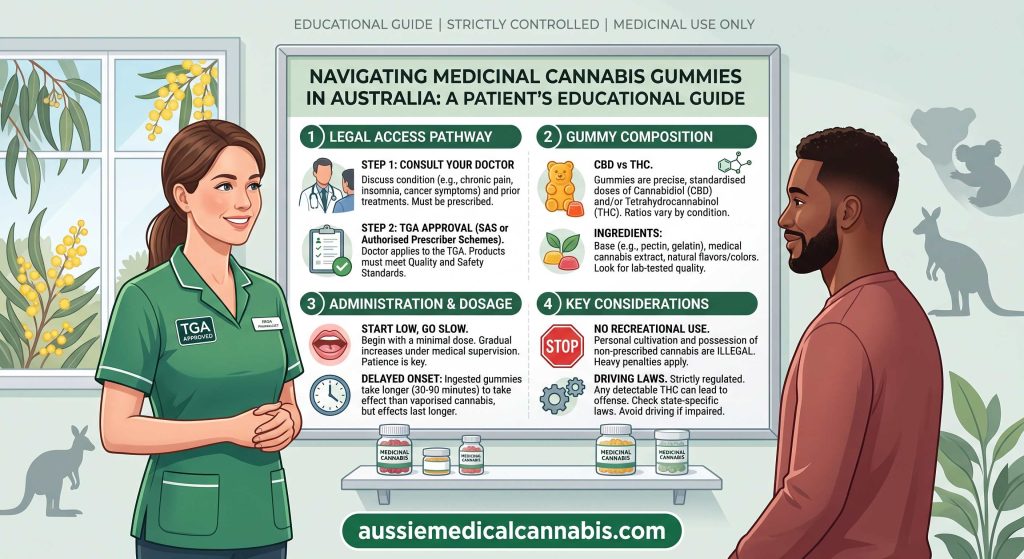
Interest in weed gummies Australia has grown alongside greater public awareness of cannabis edibles and Australia’s medicinal cannabis system. Gummies containing THC are widely discussed online and are legally available in some overseas jurisdictions, but Australia’s cannabis laws are considerably more restrictive.
In Australia, the appearance of a cannabis product does not determine its legal status. A gummy that looks like ordinary confectionery may contain tetrahydrocannabinol (THC), cannabidiol (CBD), or a combination of cannabinoids. THC is the principal intoxicating cannabinoid associated with the cannabis “high.”
For Australians, the most important distinction is between recreational weed gummies and regulated medicinal cannabis. Healthdirect states that cannabis is illegal to use, possess, grow or sell in most Australian states and territories, while medicinal cannabis can be legally prescribed by an authorised healthcare professional.
Australian drug laws also operate at both Commonwealth and state or territory levels, meaning the precise rules can depend on where a person lives.
For further Australian-focused cannabis education, readers can explore aussiemedicalcannabis.com.
What Are Weed Gummies?
“Weed gummies” is an informal term commonly used for edible gummy products containing cannabinoids derived from cannabis.
They may contain:
- THC;
- CBD;
- combinations of THC and CBD; or
- other cannabinoids.
THC gummies are fundamentally different from ordinary gummy sweets because THC has psychoactive effects.
Healthdirect explains that THC is the cannabinoid responsible for the cannabis “high,” whereas CBD does not produce the same intoxicating effect.
The broader category is known as cannabis edibles.
Healthdirect specifically describes edibles as cannabis mixed with food.
Are Weed Gummies Legal in Australia?
There is no general nationwide legal recreational market for THC weed gummies in Australia.
The Australian Government Department of Health, Disability and Ageing identifies cannabis as an illegal drug while noting that some medicinal cannabis is available through regulated therapeutic pathways. Drug offences and penalties can also vary between states and territories.
This means an advertisement saying “weed gummies Australia” or “THC gummies Australia” does not prove that a product is lawful.
Consumers should distinguish between three situations:
Recreational cannabis gummies: These should not be assumed to be legally available for ordinary retail purchase.
Prescribed medicinal cannabis: Cannabis-derived medicines can be legally supplied through Australia’s regulated medicinal system.
Overseas products: Something being legal in another country does not automatically make its importation, supply or possession legal in Australia.
The exact legal position can depend on the product, cannabinoid composition, prescription status and state or territory.
Weed Gummies vs Medicinal Cannabis
Medicinal cannabis has been legally accessible in Australia since regulatory changes introduced in 2016, but access remains controlled.
The TGA states that medicinal cannabis products can include oral liquids, capsules, sprays and dried herb. Most medicinal cannabis products currently supplied in Australia are unapproved therapeutic goods, meaning they have not been included in the Australian Register of Therapeutic Goods (ARTG).
Unapproved medicinal cannabis can nevertheless be lawfully accessed under specific pathways, including the:
Special Access Scheme (SAS)
Authorised Prescriber (AP) Scheme
Clinical Trial pathways
Registered medical practitioners and nurse practitioners may use these pathways in appropriate circumstances.
Therefore, “unapproved therapeutic good” should not be confused with “illegal product.”
The TGA reiterated in June 2026 that most medicinal cannabis products prescribed in Australia are unapproved therapeutic goods, even though healthcare practitioners can lawfully prescribe them through the relevant pathways.
Are THC Gummies Available as Medicinal Cannabis?
Australia’s medicinal cannabis market includes various oral dosage forms, although consumers should not assume that every gummy advertised online is an authorised medicinal product.
The TGA’s March 2026 medicinal cannabis product list demonstrates that regulated medicinal products can contain substantial amounts of THC. For example, Category 5 includes oral capsules containing 10 mg THC per capsule. Category 4 and Category 5 products are THC/other-cannabinoid dominant categories and are Schedule 8 controlled drugs.
The important distinction is therefore not simply whether cannabis can be consumed orally.
It is whether the specific product has been lawfully prescribed and supplied through Australia’s regulatory system.
For additional explanations of Australian medicinal cannabis, visit aussiemedicalcannabis.com cannabis education.
Weed Gummies, THC Gummies and CBD Gummies Compared
| Feature | THC/Weed Gummies | CBD-Dominant Products | Ordinary Gummies |
|---|---|---|---|
| Contains cannabinoids | Yes | Yes | Normally no |
| Can contain THC | Yes | May contain some depending on product | No |
| Produces cannabis high | THC can | CBD itself generally does not | No |
| Cannabis regulation applies | Yes | Yes | Normally no |
| Recreational retail market across Australia | No general legal market | Not an unrestricted ordinary-food market | Yes |
| Can potentially exist as regulated medicine | Depending on product | Yes | Not applicable |
This comparison demonstrates why terms such as weed gummies, CBD gummies and THC gummies should not be used interchangeably.
How Do Weed Gummies Work?
Cannabis gummies are swallowed rather than inhaled.
This produces important pharmacological differences.
After an edible is swallowed, THC must pass through the gastrointestinal system and undergo metabolism. Consequently, the onset and concentration profile can differ significantly from inhaled cannabis.
A systematic review of oral THC found that absorption is highly variable across oral formulations and that peak blood concentrations are delayed compared with other administration routes.
This delayed and variable response is one of the most important characteristics of cannabis edibles.
Someone who expects an immediate response may mistakenly assume an edible has not taken effect and consume more. This can result in unexpectedly high THC exposure later.
Scientific Research on Cannabis Edibles
Researchers have specifically investigated oral cannabis and edible THC.
A systematic review indexed by PubMed examined 26 studies concerning oral THC pharmacokinetics. Researchers considered formulations including capsules, tablets, brownies, cookies, oils and cannabis tea. They concluded that oral THC has a highly variable pharmacokinetic profile and that further research is needed to improve predictability and safety.
Read the systematic review on PubMed
Controlled research involving cannabis brownies has similarly demonstrated that edible cannabis produces measurable THC and metabolites while showing dose-related differences in subjective, cardiovascular and performance effects.
These findings are important because cannabis gummies should not be treated like ordinary confectionery.
Potential Effects of THC Gummies
THC-containing gummies can affect cognition, coordination and perception.
Healthdirect identifies potential cannabis effects and adverse outcomes that can include altered perception, impaired coordination and memory, anxiety and other psychological effects. Cannabis use can also lead to dependence in some people.
Medicinal cannabis products containing THC and CBD can also produce side effects such as:
- dizziness;
- nausea or vomiting;
- diarrhoea;
- dry mouth;
- appetite changes;
- drowsiness;
- fatigue; and
- confusion or unease.
Healthdirect notes these among the potential adverse effects of medicinal cannabis.
Individual responses vary considerably.
Why Weed Gummies Can Present a Particular Safety Risk
Cannabis gummies present a practical safety concern because they can look virtually identical to ordinary sweets.
A child—or an adult unaware of the contents—may not recognise that a gummy contains THC.
Cannabis edibles should therefore never be stored alongside ordinary sweets where they could be consumed accidentally.
Legitimate prescribed medicines should be kept in their original packaging and stored according to pharmacy and product instructions, particularly when children are present.
Weed Gummies and Driving in Australia
THC and driving are particularly important considerations.
Australia has state and territory road laws concerning drugs and driving. The Australian Government notes that roadside drug testing operates across jurisdictions and that drug-driving offences can result in penalties including fines, licence disqualification and imprisonment.
Healthdirect also states that it is illegal to drive under the effects of cannabis throughout Australian states and territories.
A person should therefore never assume that possessing a medicinal cannabis prescription automatically means they can drive after consuming THC.
State-specific legislation should always be checked because medicinal-cannabis driving rules are evolving in some jurisdictions.
Weed Gummies and Australian State Laws
Cannabis legislation is not completely uniform throughout Australia.
Commonwealth legislation deals with areas including medicinal cannabis regulation and importation, while individual states and territories maintain their own drug legislation.
The Australian Government provides separate legal resources for:
- Australian Capital Territory;
- New South Wales;
- Northern Territory;
- Queensland;
- South Australia;
- Tasmania;
- Victoria; and
- Western Australia.
The ACT has notably different personal cannabis rules from other Australian jurisdictions, but that should not be interpreted as creating an unrestricted commercial market for recreational THC gummies.
Healthdirect notes that cannabis use in public remains illegal in the ACT.
Can You Buy Weed Gummies Online in Australia?
An online listing does not establish legality.
This is particularly important when websites operate overseas or market products using terminology such as “THC edibles Australia,” “weed gummies Australia” or “cannabis gummies delivery.”
Australian medicinal cannabis is supplied through regulated pathways.
The Australian Government explains that after an appropriate medicinal cannabis prescription and necessary approvals are obtained, a pharmacist can supply the medicine.
The TGA also states that unapproved medicinal cannabis products can only be supplied under specific access arrangements such as SAS, AP or clinical-trial pathways.
Consumers should therefore avoid interpreting search-engine availability as evidence of legal availability.
Recreational Weed Gummies vs Prescribed Cannabis
The distinction can be summarised simply:
Recreational cannabis: Generally remains prohibited under Australian drug laws, subject to jurisdiction-specific differences.
Medicinal cannabis: Can be legally prescribed and supplied through Australia’s therapeutic framework.
THC: Remains tightly controlled even when used medicinally.
Edible format: Does not independently determine legality.
Putting THC into a gummy does not transform cannabis into ordinary confectionery.
Likewise, calling something “medicinal” does not automatically make an unregulated product lawful.
Why Product Quality Matters
Unregulated cannabis gummies can introduce uncertainty about what is actually being consumed.
Important questions include:
How much THC does the product contain?
Does the labelled amount match the actual amount?
Does it contain CBD or other cannabinoids?
Was it produced under appropriate quality controls?
Does it contain contaminants?
Has it been lawfully supplied?
Regulated medicinal cannabis provides greater oversight than unidentified products obtained from informal sources.
However, patients should understand that most medicinal cannabis products in Australia are still classified as unapproved therapeutic goods. The TGA emphasises that these products have not undergone the same pre-market assessment for safety, quality and effectiveness as ARTG-approved medicines.
Where to Explore Further
For additional Australian cannabis education, state-law information and medicinal cannabis topics, visit aussiemedicalcannabis.com.
For official information about accessing medicinal cannabis, consult the Therapeutic Goods Administration medicinal cannabis hub. The TGA explains Australia’s regulatory framework and available access pathways.
For consumer-focused information about cannabis, THC, CBD and medicinal cannabis, see Healthdirect Australia medicinal cannabis guidance.
For Australia’s Commonwealth and state/territory drug-law framework, consult the Australian Government drug laws guide.
For peer-reviewed research concerning edible THC, see the PubMed systematic review of oral cannabis and THC.
Frequently Asked Questions
1. Are weed gummies legal in Australia?
There is no general legal recreational market for THC weed gummies throughout Australia. Recreational cannabis remains illegal or restricted under Australian state and territory laws, while medicinal cannabis can be lawfully prescribed through regulated pathways.
2. Are weed gummies the same as THC gummies?
“Weed gummies” is an informal term. It commonly refers to cannabis-infused gummies, particularly products containing THC. However, cannabinoid gummies can contain THC, CBD or combinations of cannabinoids, so the product’s actual composition matters.
3. Can Australians legally obtain medicinal cannabis?
Yes. Medicinal cannabis is legal but highly regulated in Australia. Eligible patients can receive a prescription from an appropriate healthcare practitioner, and many products are accessed through TGA pathways such as the Special Access Scheme or Authorised Prescriber scheme.
4. Do weed gummies take longer to work than smoking cannabis?
Oral THC behaves differently from inhaled THC. Research shows that oral formulations have delayed peak concentrations and highly variable absorption. This variability is one reason people should not treat cannabis gummies like ordinary sweets.
5. Can you drive after taking THC gummies?
Driving while affected by cannabis is illegal, and Australian jurisdictions maintain drug-driving laws. THC-containing medicinal cannabis can also create driving-law issues, so patients should check their jurisdiction’s current rules and follow medical advice.
Key Takeaway
People searching for weed gummies Australia should understand that Australia’s system differs significantly from recreational cannabis markets overseas.
A gummy’s appearance does not determine its legal status. Products containing THC remain subject to cannabis, medicines and controlled-drug regulations.
Medicinal cannabis can be legally prescribed in Australia, including THC-containing medicines in appropriate circumstances, but this regulated medical system should not be confused with an unrestricted recreational edible market.
Consumers considering cannabis for a medical condition should discuss it with a qualified healthcare practitioner and use legitimate Australian medicinal pathways rather than assuming that products advertised online are lawful or medically appropriate.
