
Cannabis Education
Medicinal Cannabis Clinic in Australia: Doctors, Telehealth, Prescriptions and Legal Access
Sep
A medicinal cannabis clinic in Australia is a healthcare service where registered practitioners assess whether cannabinoid-based medicines may be appropriate for a patient’s medical circumstances. These clinics may operate through physical locations, telehealth or a combination of both, but they should not be confused with recreational cannabis dispensaries or ordinary online cannabis stores.
Australia’s medicinal cannabis system remains prescription-based and highly regulated. The Therapeutic Goods Administration (TGA) says medicinal cannabis can legally be obtained from a pharmacy with a prescription from a doctor or nurse practitioner. A specialised cannabis clinic is one possible route to medical assessment, but it is not the only one: the TGA states that a regular GP or other registered doctor or nurse practitioner may also consider prescribing medicinal cannabis.
For broader Australian cannabis education covering regulation, cannabinoids and patient pathways, readers can also explore aussiemedicalcannabis.com.
What Is a Medicinal Cannabis Clinic?
A medicinal cannabis clinic is essentially a medical practice with particular experience or interest in cannabinoid medicines.
Depending on the service, consultations may involve doctors, nurse practitioners or other healthcare professionals working within their professional scope. Some clinics operate primarily through telehealth, while others provide face-to-face consultations.
The purpose of the consultation should be to assess the patient’s health problem and treatment options—not simply to provide access to cannabis.
A practitioner may consider the person’s diagnosis, current symptoms, medicines, treatments already tried, potential interactions, mental-health history, driving requirements and the possible benefits and risks of CBD- or THC-containing medicines.
Importantly, attending a medicinal cannabis clinic does not guarantee a prescription.
The TGA explicitly says a doctor or nurse practitioner may decide there is insufficient evidence to support medicinal cannabis for an individual’s condition.
Medicinal Cannabis Clinic vs Regular GP
Australians do not necessarily need to use a specialist cannabis clinic.
The TGA states that it does not maintain a special list of practitioners approved to prescribe medicinal cannabis. Any registered doctor or nurse practitioner can make prescribing decisions within the relevant legal and professional framework, including a patient’s regular GP.
| Feature | Medicinal Cannabis Clinic | Regular GP Practice |
|---|---|---|
| Can assess medicinal cannabis | Yes | Potentially |
| Cannabis-focused experience | Often | Varies |
| Telehealth commonly available | Often | Sometimes |
| Prescription guaranteed | No | No |
| Can assess CBD/THC suitability | Yes | Potentially |
| Existing knowledge of patient history | May need records | Often stronger |
| Pharmacy still dispenses medicine | Yes | Yes |
A dedicated clinic may have more frequent experience navigating medicinal cannabis products and regulatory pathways. A regular GP may have a stronger understanding of a patient’s broader health history and other treatment options.
Neither model should automatically be considered superior.
What Happens at a Medicinal Cannabis Clinic?
A legitimate consultation should resemble ordinary medical care.
The practitioner may ask about the patient’s condition, symptoms, previous treatments, medicines, allergies and treatment goals.
They may also assess potential contraindications and practical issues such as driving or occupational safety.
If medicinal cannabis appears clinically appropriate, the practitioner can determine whether CBD, THC or a combination might be considered.
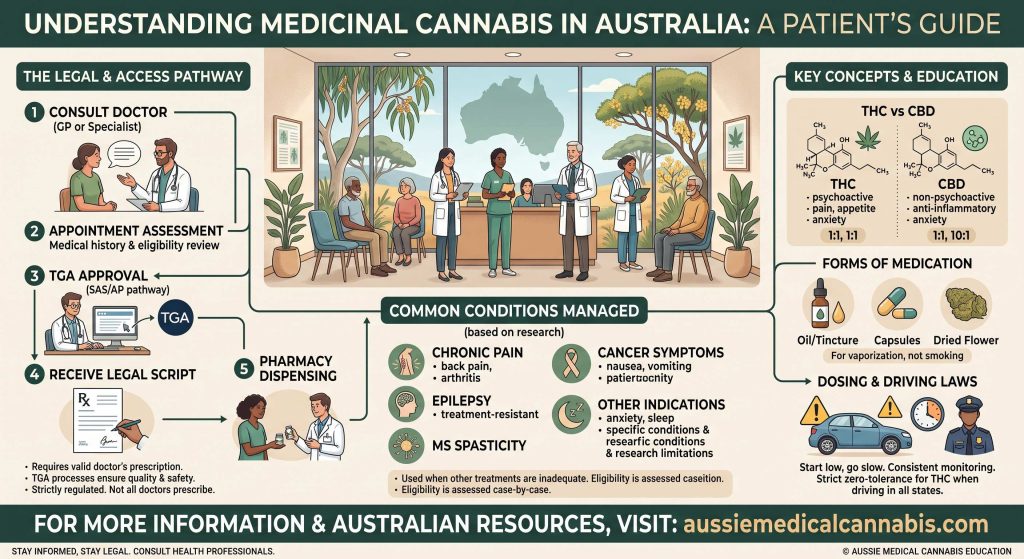
The basic pathway can be summarised as:
Clinical consultation → individual assessment → treatment decision → prescription where appropriate → regulatory pathway where required → pharmacy dispensing → follow-up
The focus should remain on whether treatment is clinically justified rather than whether a particular cannabis product is popular.
Can a Medicinal Cannabis Clinic Operate Online?
Yes. Many healthcare services now use telehealth.
A consultation may therefore occur remotely rather than in a physical clinic.
However, conducting the consultation online does not change the medicine’s legal status or eliminate professional prescribing responsibilities.
A telehealth practitioner must still decide whether prescribing is appropriate.
The TGA also warns that medicinal cannabis obtained from an online store that is not a registered pharmacy is unlawful. Legal medicinal cannabis can instead be obtained from a pharmacy after prescription by a doctor or nurse practitioner.
Therefore:
online clinic ≠ online recreational cannabis shop.
For more background on how Australian clinics, prescriptions and pharmacies fit together, readers can explore Australian medicinal cannabis education.
Who Can Prescribe Medicinal Cannabis?
Requirements vary somewhat by jurisdiction and product, but Australia’s system does not limit medicinal cannabis prescribing exclusively to people calling themselves “cannabis doctors.”
Queensland provides a useful example.
Queensland Health states that any Queensland medical practitioner or nurse practitioner can prescribe medicinal cannabis for any patient or condition when they consider it clinically appropriate, provided required TGA approval is obtained for relevant unapproved products.
Queensland practitioners can prescribe Schedule 4 cannabidiol (CBD) and Schedule 8 THC or THC:CBD medicinal cannabis without obtaining a separate Queensland approval.
That does not mean every practitioner will choose to prescribe cannabis. Prescribing remains a clinical decision.
CBD at a Medicinal Cannabis Clinic
CBD, or cannabidiol, is one of the best-known cannabinoids used in medicinal cannabis.
CBD differs significantly from THC because it does not produce the characteristic cannabis intoxication associated with THC.
A clinic may consider CBD-dominant products depending on the patient’s circumstances, evidence for the condition and other medicines being used.
CBD is not completely risk-free simply because it is non-intoxicating. It may interact with other medicines and can cause adverse effects in some patients.
A proper consultation should therefore include a medication review rather than treating CBD as an ordinary wellness supplement.
THC at a Medicinal Cannabis Clinic
THC, or tetrahydrocannabinol, is the principal intoxicating cannabinoid found in cannabis.
THC-containing medicines require additional consideration because they can affect attention, cognition, coordination and reaction time.
In Queensland, THC and THC:CBD products are generally Schedule 8 medicines. Queensland Health also uses QScript, its real-time prescription monitoring system, for monitored medicines, and dispensing requirements apply to Schedule 8 medicinal cannabis.
A good medicinal cannabis clinic should discuss issues such as driving, other sedating medicines, previous cannabis exposure and potential psychological effects before recommending THC-containing treatment.
Are Medicinal Cannabis Clinic Products TGA Approved?
Not necessarily.
This is one of the most important facts patients should understand.
The TGA says most medicinal cannabis products available in Australia are unapproved therapeutic goods. This means they are not included in the Australian Register of Therapeutic Goods and have not been assessed through the standard TGA process for safety, quality and effectiveness.
However, unapproved does not automatically mean illegal.
Australian healthcare practitioners can access certain unapproved medicinal cannabis products through specific regulatory pathways when clinically appropriate.
These include the Special Access Scheme and Authorised Prescriber pathway.
Patients should therefore understand the difference between:
a lawful prescription
and
formal TGA approval of the individual product.
They are not necessarily the same thing.
Special Access Scheme
The Special Access Scheme, commonly called SAS, allows prescribers to access certain unapproved therapeutic goods for individual patients.
The TGA says SAS can enable registered medical practitioners and nurse practitioners to prescribe medicinal cannabis on a case-by-case basis.
One pathway, SAS-B, involves an application to the TGA for approval to supply an unapproved medicinal cannabis product to a patient under the practitioner’s care.
The patient does not apply directly to the TGA and then purchase cannabis.
The practitioner manages the relevant regulatory process.
Authorised Prescriber Scheme
The Authorised Prescriber pathway provides another route for certain clinicians to prescribe specified unapproved medicinal cannabis products to defined groups of patients.
Again, this is a healthcare regulatory mechanism rather than a retail cannabis licence.
The TGA specifically lists the Special Access Scheme and Authorised Prescriber Scheme as major pathways through which unapproved medicinal cannabis can be accessed.
A clinic using these pathways should still provide appropriate informed consent and monitoring.
What Products May Be Discussed?
Medicinal cannabis is not a single product.
The TGA describes cannabis-based therapeutic products including oral liquids, capsules, sprays and dried herb.
Queensland Health additionally discusses formulations including tinctures, dried plant material or concentrated extract intended for vaporisation, capsules, sprays and pharmaceutical cannabinoid medicines. Queensland Health states that smoking cannabis products is not supported.
Products can vary substantially in their CBD and THC composition.
For that reason, marketing terms such as “sativa,” “indica,” “strong,” “premium” or “best strain” are generally less useful clinically than verified cannabinoid composition, formulation and individual treatment response.
How Does the Pharmacy Fit In?
A medicinal cannabis clinic provides healthcare assessment and prescribing.
A pharmacy dispenses the medicine.
These are different roles.
The TGA says patients can legally obtain medicinal cannabis from a pharmacy with a prescription. It also notes that unapproved medicinal cannabis products are not stocked routinely by many pharmacies, so the pharmacist may need to order the prescribed product.
In Queensland, pharmacists dispensing Schedule 8 medicinal cannabis must comply with controlled-medicine requirements and ordinarily check QScript before dispensing a monitored medicine unless an exemption or reasonable excuse applies.
Therefore:
medicinal cannabis clinic = healthcare service
pharmacy = medicine dispenser
recreational dispensary = a different model not generally used in Australia
What Does Australian Research Say About Cannabis Clinics?
A 2025 Australian study provides useful evidence about how people use specialised cannabis clinics compared with general healthcare settings.
Researchers surveyed 2,394 adults who reported using prescribed medicinal cannabis during the previous 12 months. Of them, 1,899, or 79.3%, accessed treatment through medicinal cannabis clinics.
The study found that clinic patients differed from people receiving medicinal cannabis through generalist health services.
Cannabis-clinic patients tended to be younger, were less likely to receive oral products and were more likely to report treatment for mental-health conditions. They were less likely to report chronic pain as their treatment indication.
Perhaps most importantly, patients using generalist healthcare reported higher satisfaction in several areas, including consultation duration, information about benefits and harms, discussion of alternative treatments and treatment costs.
That does not prove specialised cannabis clinics provide poor care. The researchers explicitly concluded that additional study is needed to examine other dimensions of clinical quality and appropriateness.
It does show why patients should judge a clinic on its actual healthcare quality rather than cannabis-focused branding.
Medicinal Cannabis Clinic Costs
Costs vary considerably.
Potential expenses can include an initial consultation, follow-up consultations, medicine and pharmacy costs.
Most unapproved medicinal cannabis products are generally not PBS subsidised, meaning patients may need to pay the full private-market price. The TGA notes that private companies determine the prices of unapproved products.
An Australian survey of people with endometriosis who used cannabinoid-based medicinal products reported that 63.5% used a cannabis-clinic doctor. Initial consultations commonly cost $100–$200 or more, while median cannabinoid medicine expenditure was approximately AUD $300 per month among respondents.
Those figures came from one specific patient survey and should not be treated as universal current pricing.
They do, however, demonstrate why ongoing costs matter.
Medicinal Cannabis Clinics for Chronic Pain
Chronic pain is one of the conditions frequently associated with Australian medicinal cannabis prescribing.
But chronic pain is not a single diagnosis.
Neuropathic pain, arthritis-related pain, cancer pain, fibromyalgia and musculoskeletal pain have different causes and evidence bases.
A clinic should therefore investigate the underlying diagnosis, treatments already attempted and expected benefits before deciding whether medicinal cannabis is appropriate.
A clinic that treats the phrase “chronic pain” as automatic eligibility would not reflect careful medical assessment.
Medicinal Cannabis Clinics for Anxiety
People also seek medicinal cannabis for mental-health symptoms.
However, THC and CBD should not be treated as interchangeable.
THC can cause significant psychoactive effects and may produce anxiety or other uncomfortable psychological reactions in some individuals.
That makes mental-health history particularly important when considering THC-containing products.
The 2025 Australian clinic study found that people attending specialised cannabis clinics were more likely than those attending generalist settings to report treatment for mental-health conditions.
This underscores the importance of thorough assessment and follow-up.
Medicinal Cannabis Clinics for Sleep
Sleep difficulties are another commonly discussed reason for medicinal cannabis treatment.
However, poor sleep may be caused by chronic pain, anxiety, depression, medicines, sleep apnoea or numerous other disorders.
Sedation from THC does not necessarily mean the underlying sleep disorder is being successfully treated.
A responsible clinic should therefore investigate the reason for sleep disturbance instead of approaching cannabis as a generic sleeping aid.
Driving and Medicinal Cannabis
Driving deserves specific discussion, particularly when THC is prescribed.
The TGA warns that THC can impair driving ability and states that a person may be charged if THC is detected while driving even if they have a prescription. State and territory rules vary.
Patients who need to drive for work or family responsibilities should raise this with their practitioner before beginning THC-containing treatment.
A medicinal cannabis clinic that discusses potential benefits but ignores driving implications would be providing an incomplete picture.
How to Evaluate a Medicinal Cannabis Clinic
Patients should evaluate a clinic as a healthcare service rather than as a cannabis retailer.
Useful indicators include proper medical assessment, discussion of previous treatments, review of medicines and contraindications, clear explanation of CBD and THC, realistic discussion of evidence, transparent costs, follow-up planning and clear pharmacy arrangements.
Guaranteed prescriptions should be viewed cautiously because legitimate prescribing requires clinical judgment.
There is another important consideration for Australian cannabis websites in 2026: advertising rules.
The TGA’s current guidance says businesses risk unlawful advertising when they publicly promote telehealth or other healthcare services as a means of obtaining particular prescription medicines, including medicinal cannabis. The TGA even gives examples involving “medicinal cannabis clinic” branding and services that encourage consumers to book appointments specifically to obtain medicinal cannabis.
This makes neutral, educational language especially important for clinic websites.
Cannabis Clinic Advertising Rules in Australia
Australian clinic websites cannot be treated like ordinary e-commerce websites.
The TGA says promotional materials that suggest a health service can facilitate access to particular prescription medicines may amount to unlawful prescription-medicine advertising.
The regulator specifically identifies medical cannabis among the prescription-medicine categories where telehealth marketing can create compliance problems.
For an educational website, safer content generally focuses on:
patient education,
Australian law,
differences between CBD and THC,
potential risks,
research limitations,
how healthcare systems operate,
and authoritative government resources.
The content should avoid promising prescriptions, encouraging particular medicines or presenting consultations as a straightforward route to obtaining THC.
Educational Resources
The TGA medicinal cannabis information for patients explains prescriptions, pharmacies, unapproved medicines and patient access. The TGA states that patients may legally obtain prescribed medicinal cannabis from pharmacies and that unregistered online stores are not lawful substitutes.
The Queensland Health medicinal cannabis prescribing guide explains Queensland rules for CBD, THC, prescribers and the SAS/AP systems. It was updated on 4 August 2026.
The TGA medicinal cannabis hub provides broader Australian regulatory information and notes that most medicinal cannabis goods remain unapproved therapeutic goods.
For peer-reviewed Australian evidence, PubMed: Cannabis Clinics Versus Generalist Healthcare Settings reports findings from 2,394 Australian prescribed medicinal cannabis users and compares specialised clinics with general healthcare services.
Where to Explore Further
Australians researching a medicinal cannabis clinic, cannabis doctors, telehealth, CBD, THC, prescriptions and pharmacy access can continue exploring neutral educational information through aussiemedicalcannabis.com.
Individual treatment decisions should be made with an appropriately registered healthcare professional. Current TGA and state or territory health guidance should take priority over promotional claims made by commercial cannabis services.
Frequently Asked Questions
1. What is a medicinal cannabis clinic?
A medicinal cannabis clinic is a healthcare service where practitioners assess patients and may consider cannabinoid medicines as one treatment option. It is not the same thing as a recreational cannabis dispensary.
2. Do I need a cannabis clinic to get medicinal cannabis?
No. The TGA says any registered doctor or nurse practitioner may make prescribing decisions, including a regular GP. Whether that practitioner chooses to prescribe medicinal cannabis depends on clinical circumstances and applicable regulatory requirements.
3. Can a medicinal cannabis clinic prescribe THC?
Potentially, if THC is considered clinically appropriate and relevant requirements are met. For example, Queensland Health states that medical practitioners and nurse practitioners can prescribe Schedule 8 THC or THC:CBD medicinal cannabis without separate Queensland approval, although TGA requirements apply to relevant unapproved products.
4. Can medicinal cannabis clinic consultations happen online?
Yes, healthcare consultations may occur through telehealth. However, an online consultation does not guarantee a prescription, and lawful medicinal cannabis still needs to be supplied through appropriate pharmacy channels.
5. Are medicinal cannabis clinics better than regular GPs?
Not necessarily. A 2025 Australian survey found higher satisfaction in several areas among medicinal cannabis patients using generalist healthcare settings than among specialised cannabis-clinic patients. The researchers cautioned that additional research is required to assess broader quality and appropriateness of care.
