
Cannabis Education
THC Gummies Sydney: Laws, Medicinal Cannabis Access, Safety and Regulations in NSW
Aug
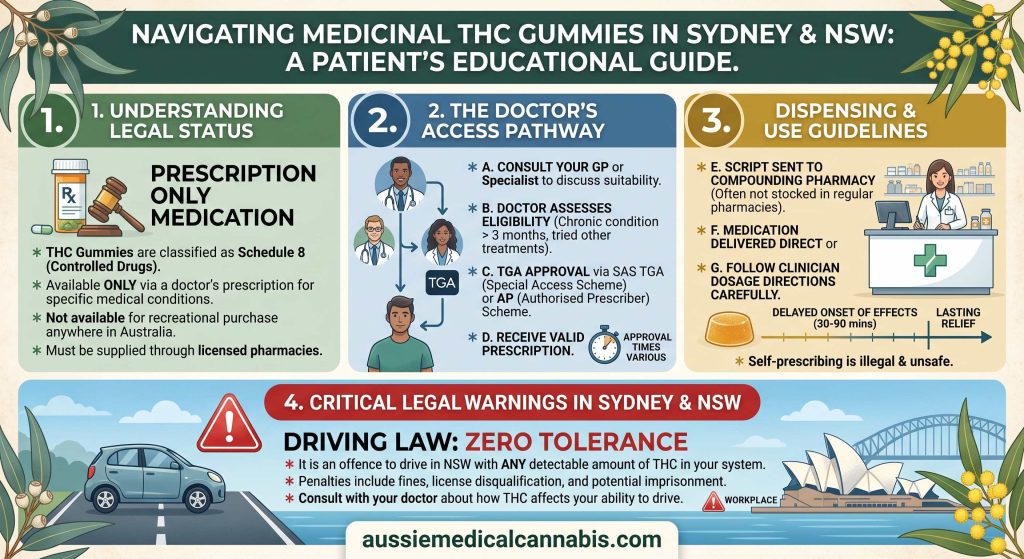
Searches for THC gummies Sydney have increased as Australians encounter cannabis edibles through overseas websites, social media and discussions about medicinal cannabis. However, the legal situation in Sydney is very different from jurisdictions overseas where recreational cannabis gummies may be sold through licensed dispensaries.
In Sydney and throughout New South Wales (NSW), recreational cannabis remains prohibited. NSW Health states that possession, supply, manufacture, production and cultivation of cannabis for recreational purposes remain prohibited under NSW law.
Medicinal cannabis is different. A registered medical or nurse practitioner can prescribe cannabis medicine when they consider it clinically appropriate, and patients can lawfully possess and administer cannabis medicine that has been legally supplied and prescribed to them.
That distinction is essential when discussing THC gummies in Sydney. A cannabis edible available overseas should not automatically be assumed to be legal to purchase, import or possess in NSW.
For further Australian cannabis education, readers can explore aussiemedicalcannabis.com.
What Are THC Gummies?
THC gummies are edible products containing tetrahydrocannabinol (THC), one of the major cannabinoids found in cannabis.
Unlike CBD, THC is intoxicating and can produce the characteristic cannabis “high.” Gummies provide an oral route of administration rather than delivering cannabinoids through smoking or vaporisation.
Cannabis edibles can include:
- gummies and chewy sweets;
- chocolates;
- baked products;
- lozenges;
- capsules;
- oils; and
- other oral preparations.
The appearance of a gummy does not determine its legal status. A brightly coloured sweet containing THC remains a cannabinoid-containing product even though it resembles ordinary confectionery.
Are THC Gummies Legal in Sydney?
There is no general recreational market for legal THC gummies in Sydney.
NSW Health explicitly states that recreational cannabis is not legal in NSW and that possession and supply for non-medical purposes remain prohibited.
NSW Police guidance has also specifically addressed cannabis-based confectionery. It notes detections of lollies containing delta-9-THC from countries where cannabis has been legalised and explains that confirmed THC-containing confectionery can result in possession or supply charges where applicable.
The situation changes when cannabis is being supplied as a legitimate medicine.
NSW Health states that a doctor can legally prescribe a cannabis medicine when they consider it an appropriate treatment and relevant requirements have been satisfied. A patient or carer may then lawfully receive, possess and administer appropriately prescribed cannabis medicine.
Therefore:
Recreational THC gummies and prescribed medicinal cannabis should not be treated as the same thing.
Medicinal THC in Sydney
THC-containing cannabis medicines can be available to eligible NSW patients through Australia’s medicinal cannabis framework.
Most medicinal cannabis products available in Australia are not registered on the Australian Register of Therapeutic Goods (ARTG). Instead, many are supplied as unapproved therapeutic goods through pathways such as the Special Access Scheme (SAS) and Authorised Prescriber (AP) scheme.
The TGA explains that medicinal cannabis products containing less than 98% CBD of their total cannabinoid content, where other cannabinoids including THC make up the remainder, generally fall into Categories 2–5 and are Schedule 8 medicines.
This means THC-containing medicinal cannabis is highly regulated.
Readers researching Australia’s medicinal cannabis framework can find additional educational information through aussiemedicalcannabis.com.
THC Gummies vs CBD Gummies
THC and CBD are both cannabinoids, but they have important differences.
| Feature | THC Gummies | CBD-Dominant Products |
|---|---|---|
| Main cannabinoid | THC | CBD |
| Intoxicating | Yes | Generally no |
| Can produce a cannabis “high” | Yes | Generally no |
| Recreational retail sale in Sydney | Not generally lawful | Not an unrestricted ordinary-food market |
| Can exist within medicinal cannabis treatment | Potentially, depending on prescribed product | Yes |
| Driving implications | Significant | Depends particularly on whether THC is present |
| Australian regulation | Strict | Strict |
Consumers should therefore avoid using “CBD gummies” and “THC gummies” interchangeably.
Why THC Edibles Affect People Differently From Smoking
Eating THC is pharmacologically different from inhaling cannabis.
When cannabis is smoked or vaporised, cannabinoids enter the bloodstream through the lungs relatively quickly.
An edible must instead pass through the gastrointestinal system and undergo metabolism before its effects develop.
This can result in a slower and less predictable onset.
One concern is that someone may consume additional edible cannabis because they do not immediately notice an effect. When the earlier amount subsequently takes effect, the combined exposure may be considerably greater than intended.
This is one reason edible cannabis requires particular caution.
THC Gummies and Accidental Consumption
The appearance of cannabis gummies creates an additional safety issue.
THC gummies can resemble ordinary confectionery. Children or other people who do not realise that a product contains cannabis could consume it accidentally.
NSW Police guidance specifically notes that the packaging and form of edible cannabis products can create a significant risk to children.
Cannabinoid medicines should therefore always be stored securely and according to their pharmaceutical instructions.
They should never be left somewhere they could reasonably be mistaken for ordinary sweets.
Potential Effects of THC Gummies
THC affects people differently.
Possible effects can include:
- altered perception;
- relaxation;
- impaired coordination;
- changes in attention;
- reduced reaction time;
- sleepiness;
- dizziness;
- anxiety;
- confusion;
- increased heart rate; and
- impaired judgement.
Effects depend on numerous factors, including THC exposure, previous cannabis experience, other medicines, alcohol consumption and individual sensitivity.
An edible’s delayed onset makes cautious medical supervision particularly relevant when THC is being used therapeutically.
THC Gummies and Driving in Sydney
Driving is one of the most important legal issues surrounding THC-containing medicinal cannabis.
The TGA currently warns patients that THC can impair driving and that people can face legal consequences when THC is detected while driving, although regulations differ between jurisdictions.
NSW is also in the process of changing aspects of its medicinal-cannabis driving framework.
In June 2026, the NSW Government introduced the Road Transport Amendment (Medical Cannabis and Driving Offences) Bill 2026. The proposed system would create protections in certain circumstances for eligible registered medicinal cannabis patients who are not impaired, subject to conditions including registration with Transport for NSW, evidence of a valid prescription and completion of cannabis-driving education.
Because this is an evolving area of law, patients should verify the current rules in force rather than relying on older articles or assuming that a proposed reform already applies.
Regardless of medicinal-cannabis status, people should never drive while impaired.
Recreational vs Medicinal THC in Sydney
| Situation | General NSW position |
| Recreational THC gummies | Recreational cannabis remains prohibited |
| Illicit THC confectionery | Possession/supply offences may apply |
| Prescribed medicinal cannabis | Lawful when properly prescribed and supplied |
| Buying medicinal cannabis from a registered pharmacy with prescription | Lawful pathway |
| Importing medicinal cannabis from an overseas retailer for personal use | TGA says this is not permitted |
| Driving while impaired | Illegal |
The exact legal consequences always depend on the circumstances.
Can You Buy THC Gummies Online in Sydney?
An online store’s willingness to ship a THC product to Sydney does not establish that the transaction or possession is lawful.
The TGA specifically states that medicinal cannabis can legally be obtained from a pharmacy with an appropriate prescription. It also warns that medicinal cannabis obtained from an online store that is not a registered pharmacy can be unlawful.
The TGA further states that consumers cannot import medicinal cannabis products from overseas retailers or websites for personal use.
Therefore, overseas advertisements such as “THC gummies Sydney delivery” or “THC edibles Australia” should not be interpreted as evidence of Australian legality.
How Medicinal Cannabis Is Accessed in NSW
Australians considering cannabis for a medical condition should begin with a healthcare practitioner rather than an unregulated seller.
The TGA explains that medicinal cannabis may be accessible through a prescription and, for many unapproved products, pathways including the Special Access Scheme and Authorised Prescriber scheme.
NSW Health similarly advises patients who believe cannabis medicine might help their condition to consult their treating doctor.
The healthcare practitioner can consider factors such as:
- the patient’s condition;
- previous treatments;
- available clinical evidence;
- potential benefits;
- possible adverse effects;
- interactions with existing medicines; and
- whether medicinal cannabis is clinically appropriate.
This framework is very different from recreational purchasing.
What Does Research Say About Oral THC?
Scientific research demonstrates that orally consumed THC has different pharmacokinetic characteristics from inhaled cannabis.
A systematic review examining the pharmacokinetics of THC in oral cannabis products found considerable variation between formulations and individuals, highlighting the complexity of predicting exposure from orally administered THC.
Explore research on oral THC through PubMed.
This variability is another reason edible cannabis should not be approached as though it were ordinary confectionery.
Why Product Labelling Matters
The amount of THC in an edible is particularly important because consumers cannot determine cannabinoid concentration simply by looking at the product.
Unregulated products can create uncertainty concerning:
THC concentration. The actual concentration may differ from what a label claims.
Other cannabinoids. Products may contain CBD or additional cannabinoids.
Contamination. Manufacturing standards can vary.
Serving size. A package may contain multiple portions.
Source. Products purchased through unregulated channels may not have undergone the controls associated with legitimate pharmaceutical supply.
Australia’s medicinal cannabis framework exists partly to place therapeutic cannabinoid products within a regulated system.
THC Gummies and Alcohol
Combining intoxicating substances can increase impairment.
Someone using prescribed THC should tell their healthcare professional about alcohol use and other medicines, particularly medications that cause sedation.
A prescription also does not mean a patient should ignore warning labels or instructions concerning driving, alcohol or other medicines.
Where to Explore Further
For Australian cannabis education and information about medicinal cannabis topics, explore aussiemedicalcannabis.com.
For official NSW information about lawful access, see NSW Health’s medicinal cannabis patient information. NSW Health explains the state’s prescription and possession framework for legitimate cannabis medicines.
For federal medicinal-cannabis regulation, visit the Therapeutic Goods Administration medicinal cannabis hub. The TGA explains the Special Access Scheme, Authorised Prescriber pathway and regulation of medicinal cannabis products.
For additional patient guidance, see TGA medicinal cannabis information for patients, including pharmacy access, driving and overseas importation information.
Readers can also continue exploring Australian cannabis legislation and educational material through aussiemedicalcannabis.com.
Frequently Asked Questions
1. Are THC gummies legal in Sydney?
There is no general legal recreational THC-gummy market in Sydney. NSW Health states that cannabis possession, supply, manufacture, production and cultivation for recreational purposes remain prohibited under NSW law.
2. Can medicinal cannabis containing THC be prescribed in Sydney?
Yes. NSW patients can legally access cannabis medicines when appropriately prescribed and supplied under Australia’s regulatory framework.
3. Can I order THC gummies from an overseas website to Sydney?
An overseas seller accepting an order does not make the product legal in Australia. The TGA states that consumers cannot import medicinal cannabis from overseas retailers or websites for personal use.
4. Are THC gummies the same as CBD gummies?
No. THC is intoxicating and can produce a cannabis high. CBD generally does not produce the same intoxicating effect. Both cannabinoids are nevertheless regulated in Australia.
5. Can medicinal cannabis patients drive after taking THC?
Patients should not drive while impaired. NSW’s rules concerning prescribed medicinal cannabis and THC detection are undergoing legislative reform in 2026, so patients should check the current law before driving rather than relying on outdated guidance.
Key Takeaway
People searching for THC gummies Sydney should distinguish overseas recreational edible markets from Australia’s regulated medicinal cannabis system.
Recreational cannabis remains prohibited in NSW. THC-containing confectionery obtained outside legitimate medical pathways can therefore expose someone to legal consequences.
At the same time, THC-containing cannabis medicines can be lawfully prescribed to eligible patients through Australia’s medicinal cannabis framework.
For Sydney residents considering cannabis therapeutically, the appropriate route is to discuss medicinal cannabis with a healthcare practitioner and obtain any prescribed product through legitimate Australian pharmaceutical channels.
