
Cannabis Education
Medicinal Cannabis Oil, CBD, THC, Access and Safety
Aug
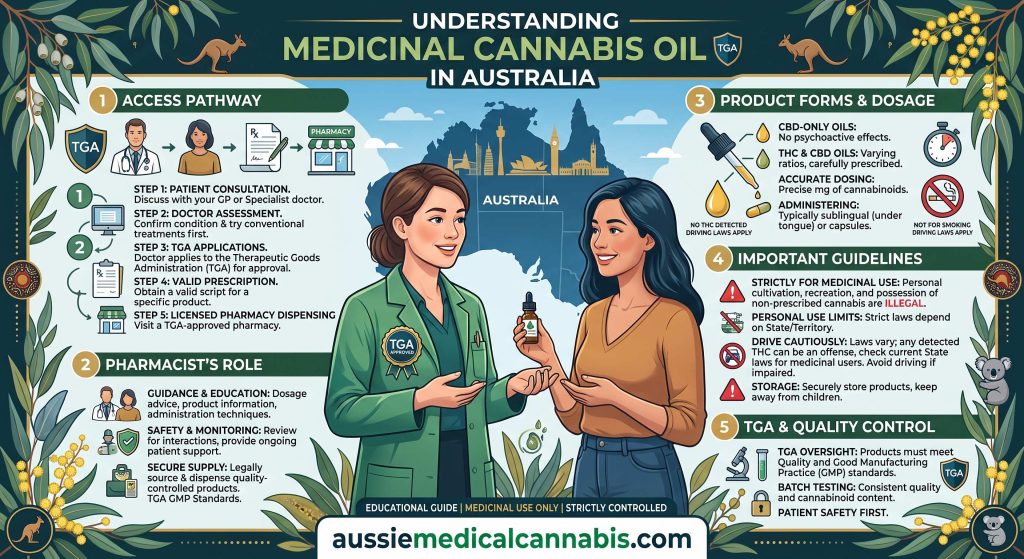
Medical weed oil is an informal term commonly used for medicinal cannabis oil—a liquid cannabis-based medicine containing cannabinoids such as cannabidiol (CBD), tetrahydrocannabinol (THC), or a combination of both. In Australia, medicinal cannabis oil is part of a regulated healthcare system rather than the general recreational cannabis market.
Australians searching for medical weed oil should understand that cannabis oils vary significantly. A CBD-dominant oil is not equivalent to a THC-dominant oil, and neither should automatically be treated like an ordinary over-the-counter supplement.
The Therapeutic Goods Administration medicinal cannabis hub explains that most medicinal cannabis products available in Australia are unapproved therapeutic goods. They can nevertheless be legally prescribed through pathways including the Special Access Scheme (SAS) and Authorised Prescriber (AP) pathway.
Australia’s Healthdirect medicinal cannabis guide also explains that medicinal cannabis can be prescribed by registered healthcare practitioners and that cannabis medicines may contain CBD, THC or combinations of cannabinoids.
For additional Australian-focused cannabis education, readers can explore aussiemedicalcannabis.com.
What Is Medical Weed Oil?
Medical weed oil generally means a liquid medicinal cannabis preparation.
The expression “weed oil” is informal. Within healthcare, terms such as medicinal cannabis oil, cannabis medicine, CBD oil or THC-containing medicinal cannabis are more precise.
Cannabis contains numerous naturally occurring compounds called cannabinoids.
The two best known are:
CBD (cannabidiol) — generally does not produce the characteristic cannabis high.
THC (tetrahydrocannabinol) — intoxicating and responsible for many of cannabis’s psychoactive effects.
A medicinal cannabis oil can contain predominantly CBD, predominantly THC, or different ratios of both.
This composition matters because CBD and THC differ in their effects, adverse-effect profiles, scheduling and implications for activities such as driving.
Is Medical Weed Oil Legal in Australia?
Medicinal cannabis is legal in Australia when accessed through the appropriate healthcare and regulatory framework.
This does not mean cannabis oil can be freely sold as an ordinary retail product.
The TGA explains that patients can legally obtain medicinal cannabis from a pharmacy with an appropriate prescription from a doctor or nurse practitioner. The specific regulatory requirements depend partly on the medicine being prescribed.
Most medicinal cannabis products are not individually registered on the Australian Register of Therapeutic Goods (ARTG).
Instead, healthcare practitioners commonly access unapproved medicinal cannabis through mechanisms such as the:
- Special Access Scheme;
- Authorised Prescriber pathway; or
- clinical-trial framework.
“Unapproved” in this context does not mean the patient is illegally possessing the medicine. It means the product has not undergone the same individual pre-market ARTG approval process as a registered therapeutic good.
Medical Weed Oil vs Recreational Cannabis Oil
These categories should not be confused.
| Feature | Prescribed Medical Cannabis Oil | Unregulated/Recreational Cannabis Oil |
|---|---|---|
| Medical assessment | Yes | Usually no |
| Prescription | Generally required | No legitimate medical prescription |
| Pharmacy supply | Yes | Usually no |
| Cannabinoid composition documented | Expected | May be uncertain |
| THC may be present | Yes | Yes |
| CBD may be present | Yes | Yes |
| Australian therapeutic framework | Yes | No |
| Intended for medical treatment | Yes | No |
A bottle being labelled “cannabis oil” or “CBD oil” does not by itself establish that it is a legitimate Australian medicine.
CBD Medical Cannabis Oil
CBD-dominant oils are an important part of Australia’s medicinal cannabis landscape.
The TGA categorises medicinal cannabis products according to cannabinoid composition.
Category 1 products contain CBD making up at least 98% of the total cannabinoid content.
The TGA’s medicinal cannabis product list currently classifies Category 1 CBD products as Schedule 4 prescription-only medicines.
Other categories can contain increasing proportions of cannabinoids other than CBD, including THC.
Therefore, the phrase “CBD oil” alone does not tell a patient everything they need to know about a product.
The exact cannabinoid concentration matters.
THC Medical Cannabis Oil
THC-containing medicinal cannabis oils are also available within Australia’s prescription framework.
THC is psychoactive.
Potential effects can include:
- changes in perception;
- relaxation or euphoria;
- sleepiness;
- impaired coordination;
- slower reaction time;
- dizziness;
- anxiety;
- confusion; and
- altered judgement.
Higher THC exposure can increase the likelihood of unwanted psychoactive effects in susceptible individuals.
THC-containing products also raise particularly important questions about driving.
Patients should know whether their prescribed oil contains THC rather than assuming all “medical weed oil” is simply CBD oil.
CBD Oil vs THC Oil
| Characteristic | CBD-Dominant Oil | THC-Containing Oil |
| Main cannabinoid | CBD | THC or CBD/THC combination |
| Characteristic cannabis high | Generally no | Possible |
| Psychoactive impairment | Much less characteristic | Can occur |
| Prescription framework | Yes | Yes |
| Driving concern from THC | Depends on whether THC is present | Significant |
| Side effects possible | Yes | Yes |
| Drug interactions possible | Yes | Yes |
This distinction is particularly important for people researching medicinal cannabis for the first time.
How Is Medical Cannabis Oil Taken?
Medicinal cannabis oil is generally administered orally or through the mouth according to the instructions for the specific prescribed product.
Some preparations may be swallowed, while others may have administration instructions involving placement in the mouth before swallowing.
Patients should follow their pharmacy label and prescriber’s directions because products can differ substantially in:
- CBD concentration;
- THC concentration;
- CBD-to-THC ratio;
- carrier oil;
- formulation;
- recommended administration; and
- concentration expressed in milligrams per millilitre.
A volume such as “1 mL” does not represent a universal cannabis dose.
For example, 1 mL of one formulation could contain a completely different cannabinoid quantity from 1 mL of another.
Understanding mg/mL on Cannabis Oil Labels
One of the most useful concepts for patients to understand is milligrams per millilitre (mg/mL).
Suppose an educational example contains:
CBD concentration: 100 mg/mL
A volume of 0.5 mL mathematically contains:
100 mg/mL × 0.5 mL = 50 mg CBD.
This is simply an example demonstrating how concentration works—it is not a recommended CBD dose.
The same principle applies to THC.
A prescribed product should be measured according to its actual concentration and prescription rather than a dosage chart found online.
Is There a Standard Medical Weed Oil Dose?
No universal medicinal cannabis dose is appropriate for everyone.
CBD and THC dosing can differ substantially depending on the clinical context.
Important variables include:
- condition being treated;
- patient’s age;
- other medications;
- previous cannabinoid exposure;
- CBD concentration;
- THC concentration;
- administration method;
- individual sensitivity;
- liver function; and
- treatment response.
The TGA’s Australian medicinal cannabis guidance emphasises that evidence varies significantly between conditions and products.
This is why an internet search for “best medical weed oil dose” cannot replace an individual prescription.
What Conditions Is Medicinal Cannabis Used For?
Medicinal cannabis has been studied across numerous clinical conditions, but the quality of evidence is not equally strong for every proposed use.
Australian prescribing has included conditions involving areas such as:
- chronic non-cancer pain;
- cancer-related symptoms;
- palliative care;
- epilepsy;
- multiple sclerosis;
- sleep disorders; and
- other selected clinical circumstances.
However, medicinal cannabis should not be described as a proven treatment for every condition appearing in online advertisements.
A major systematic review published in The BMJ examined medical cannabis and cannabinoids for chronic pain and found small to very small improvements in some outcomes alongside increased risks of certain transient adverse effects.
PubMed research on medical cannabis and chronic pain
Evidence should therefore be considered condition by condition rather than assuming cannabis oil universally works for “pain,” “sleep,” “anxiety” or other broad categories.
Medical Cannabis Oil and Epilepsy
CBD has one of its better-established medical roles in particular forms of epilepsy.
Australia has an ARTG-registered cannabidiol medicine used for specific seizure disorders.
This is important because evidence for a pharmaceutical CBD medicine used for a particular epilepsy syndrome should not automatically be applied to every commercial or unregulated CBD oil.
Formulation, dose, purity and clinical indication all matter.
Side Effects of Medical Cannabis Oil
Medicinal does not mean side-effect free.
Healthdirect Australia identifies possible medicinal cannabis adverse effects including:
- tiredness or drowsiness;
- dizziness;
- nausea and vomiting;
- appetite changes;
- dry mouth;
- diarrhoea;
- confusion; and
- feelings of unease.
The precise effects depend partly on the cannabinoid composition.
THC-containing medicines can additionally cause intoxication and cognitive impairment.
Medical Weed Oil and Drug Interactions
Cannabinoids can interact with medicines.
CBD in particular is metabolised through liver enzyme systems that also process many pharmaceutical drugs. Depending on the medicines involved, interactions can potentially change cannabinoid exposure or concentrations of other medications.
This makes medication history important.
Patients should tell their healthcare practitioner and pharmacist about prescription medicines, over-the-counter medicines and relevant supplements before beginning medicinal cannabis.
People should not independently stop prescribed medications simply because they have started cannabis oil.
Medical Cannabis Oil and Mental Health
THC can affect mood, cognition and perception.
This deserves particular attention in people with previous:
- psychosis;
- hallucinations;
- severe paranoia;
- schizophrenia;
- significant cannabis-related psychiatric reactions; or
- other relevant mental-health histories.
Medicinal status does not remove THC’s psychoactive properties.
A healthcare practitioner should therefore know about relevant psychiatric history when evaluating whether a THC-containing cannabis oil is appropriate.
Medical Weed Oil and Driving
Driving is one of the most important practical considerations surrounding THC-containing medicinal cannabis.
The TGA warns that THC can impair driving and that Australian state and territory drug-driving laws must be considered even when cannabis has been prescribed.
The precise legal framework differs between jurisdictions and is changing in some parts of Australia.
A prescription should therefore never be interpreted as automatic permission to drive after taking THC.
Patients should check the current rules where they live and discuss impairment and driving with their healthcare practitioner.
Can You Buy Medical Cannabis Oil Online in Australia?
Online advertising needs careful interpretation.
A website displaying “medical weed oil Australia,” “CBD oil Australia” or similar terminology is not necessarily an authorised source of medicinal cannabis.
The TGA advises that medicinal cannabis can legally be obtained from a pharmacy with an appropriate prescription.
It also warns that products obtained from online businesses that are not registered pharmacies may be unlawful.
Australian consumers therefore should not use search-engine rankings, social-media advertising or an overseas seller’s willingness to ship as proof that a cannabis product is lawful.
Medical Cannabis Oil vs Hemp Seed Oil
These are fundamentally different products.
Medicinal cannabis oil contains therapeutically relevant cannabinoids according to its formulation.
Hemp seed oil is produced from hemp seeds and is commonly used as a food or ingredient.
Hemp seed oil should not automatically be assumed to contain therapeutic concentrations of CBD.
| Product | CBD/THC purpose | Typical context |
| Medicinal CBD oil | CBD as active medicinal cannabinoid | Prescription medicine |
| THC-containing cannabis oil | THC ± CBD as active cannabinoids | Prescription medicine |
| Hemp seed oil | Primarily nutritional oil | Food/cosmetic uses |
| Unregulated “cannabis oil” | Composition may be uncertain | Requires caution |
The similar terminology can otherwise create substantial consumer confusion.
Why Product Quality Matters
Cannabinoid concentration directly affects exposure.
For prescribed products, knowing the concentration helps the healthcare practitioner and patient understand exactly how much CBD or THC is being administered.
Unregulated oils may introduce uncertainty concerning:
Potency: Does the product actually contain the cannabinoid concentration shown on its label?
THC contamination: Does a supposedly CBD-only product contain THC?
Contaminants: Has the product been appropriately manufactured and tested?
Consistency: Does each bottle provide the same cannabinoid concentration?
Legality: Has the medicine been supplied through an appropriate Australian pathway?
These issues help explain why Australia’s medicinal cannabis framework emphasises regulated prescribing and pharmacy supply.
Where to Explore Further
For Australian educational information about CBD oil, THC, medicinal cannabis and cannabis legislation, explore aussiemedicalcannabis.com.
For federal regulatory information, use the TGA Medicinal Cannabis Hub. It explains medicinal cannabis products and Australia’s regulatory pathways.
For patient-focused information about CBD, THC, side effects and accessing treatment, consult Healthdirect’s Medicinal Cannabis Guide.
For information about accessing unapproved therapeutic goods, consult the Australian Government medicines access guidance.
For scientific evidence concerning medicinal cannabis, see this PubMed systematic review of medical cannabis for chronic pain.
Readers can continue their Australian cannabis research through aussiemedicalcannabis.com.
Frequently Asked Questions
1. What is medical weed oil?
Medical weed oil is an informal term for medicinal cannabis oil. Depending on the formulation, it can contain CBD, THC or both cannabinoids. In Australia, medicinal cannabis oils are regulated therapeutic products rather than ordinary recreational cannabis oils.
2. Is medical cannabis oil legal in Australia?
Yes, medicinal cannabis can be legally prescribed and supplied in Australia through appropriate healthcare and regulatory pathways. Most products are unapproved therapeutic goods accessed through mechanisms such as the Special Access Scheme or Authorised Prescriber pathway.
3. Does medical weed oil get you high?
It depends on the cannabinoid composition. CBD itself generally does not produce the characteristic cannabis high. THC is intoxicating, so a THC-containing medicinal cannabis oil can cause psychoactive effects.
4. Is hemp oil the same as medical cannabis oil?
No. Hemp seed oil is primarily produced from hemp seeds for food or cosmetic applications and should not be confused with medicinal CBD or THC oil containing cannabinoids as active therapeutic ingredients.
5. Can I drive after taking medical cannabis oil?
The answer depends particularly on whether the medicine contains THC and the laws in your jurisdiction. THC can impair driving and create drug-driving legal issues even when medicinal cannabis has been prescribed. Patients should follow medical advice and verify their state’s or territory’s current rules.
Key Takeaway
Medical weed oil is better understood in Australia as medicinal cannabis oil.
These medicines can contain CBD, THC or combinations of both, and their effects, legal classification and safety considerations depend heavily on cannabinoid composition.
Australia provides lawful access to medicinal cannabis through healthcare practitioners, regulatory pathways where required and pharmacy dispensing. This should be distinguished from recreational cannabis oils or unregulated products advertised online.
Patients should know their product’s CBD and THC concentrations, follow the prescribed instructions, consider potential medicine interactions and understand the special driving implications associated with THC.
For medicinal use, cannabis oil should be approached as a genuine therapeutic product—not simply as “weed in a bottle.”
