
Cannabis Education
Edible Pot Australia: Cannabis Edibles, THC Effects, Laws and Medicinal Use
Aug
Edible pot is an informal term for cannabis that is eaten rather than smoked or vaporised. It can refer to products such as cannabis brownies, cookies, chocolates, gummies, capsules and other foods or oral preparations containing cannabinoids such as tetrahydrocannabinol (THC) or cannabidiol (CBD).
In Australia, however, the phrase needs important legal context. Recreational cannabis remains illegal or restricted across Australian jurisdictions, and Healthdirect states that selling or distributing cannabis is illegal throughout Australian states and territories. Medicinal cannabis is different: it can be prescribed by a registered healthcare practitioner and legally supplied through Australia’s regulated medical system.
Australians researching edible pot should therefore distinguish between illicit recreational cannabis edibles, regulated medicinal cannabis products and ordinary hemp foods. A product looking like a sweet or baked snack does not make THC-containing cannabis an ordinary legal food.
For further Australian-focused cannabis education, readers can explore aussiemedicalcannabis.com.
What Is Edible Pot?
“Pot” is a common slang term for cannabis or marijuana. Consequently, “edible pot” usually means edible cannabis.
Healthdirect specifically identifies mixing cannabis with food as one method of cannabis consumption and refers to these products as edibles.
Examples encountered internationally include:
- cannabis brownies;
- marijuana cookies;
- THC gummies;
- cannabis chocolates;
- THC-infused beverages;
- cannabis sweets;
- capsules; and
- other oral cannabinoid preparations.
The active compounds can vary significantly between products.
Some contain predominantly THC. Others contain CBD, while some include both cannabinoids.
Is Edible Pot Legal in Australia?
Australia does not operate a general nationwide recreational cannabis-edible market.
Healthdirect states that cannabis is illegal to distribute or sell in every Australian state and territory. Possession rules differ between jurisdictions, and some states or territories use different penalties or personal-possession frameworks, but these differences do not create an unrestricted commercial market for recreational edibles.
Medicinal cannabis is treated differently.
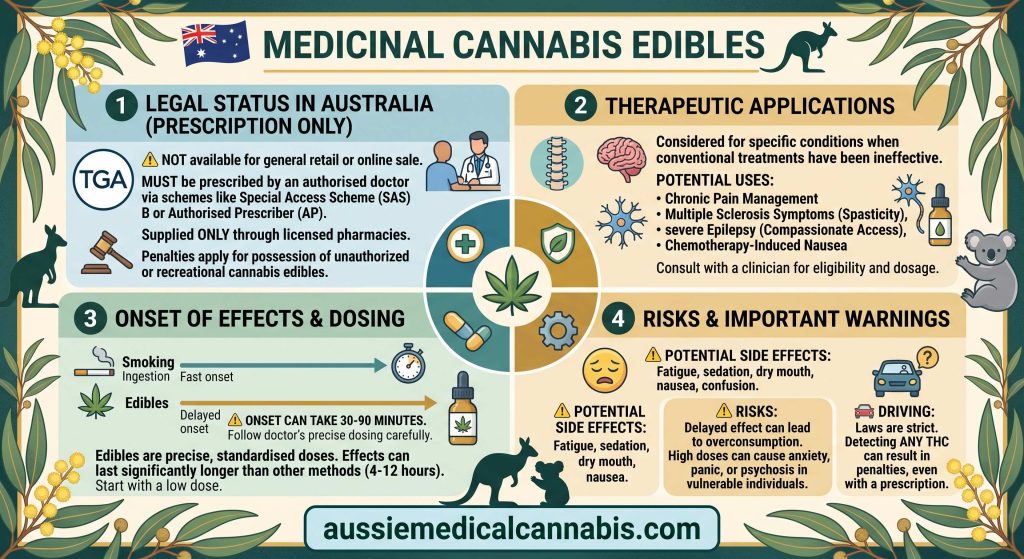
The TGA states that medicinal cannabis products are regulated therapeutic goods and can include oral liquids, capsules, sprays and dried herb. Most medicinal cannabis products are unapproved therapeutic goods that can nevertheless be accessed through the Special Access Scheme, Authorised Prescriber pathway or clinical trials.
Therefore:
Recreational edible pot is not equivalent to prescribed oral medicinal cannabis.
Edible Pot vs Medicinal Cannabis
| Feature | Recreational Cannabis Edibles | Prescribed Medicinal Cannabis |
|---|---|---|
| Contains cannabinoids | Usually | Yes |
| May contain THC | Yes | Yes, depending on product |
| General recreational retail sale in Australia | No | Not applicable |
| Healthcare practitioner involved | No | Yes |
| Pharmacy supply | No | Yes |
| Regulated as therapeutic medicine | No | Yes |
| Legal access pathway | Generally no recreational retail pathway | Prescription and regulated access |
The critical issue is not merely the method of administration.
A cannabis product does not become lawful simply because it is baked into a brownie or manufactured as a gummy.
How Cannabis Edibles Work
Edible cannabis behaves differently from inhaled cannabis.
When THC is smoked or vaporised, cannabinoids reach the bloodstream through the lungs relatively rapidly.
When THC is swallowed, it must instead pass through the gastrointestinal tract and undergo metabolism in the liver.
A systematic review of oral THC research found that oral formulations have highly variable absorption and delayed peak blood concentrations compared with other administration routes.
The reviewed formulations included:
- capsules;
- tablets;
- brownies;
- cookies;
- oils; and
- cannabis tea.
This delayed and variable absorption is one of the most important characteristics of edible cannabis.
Why Do Edibles Sometimes Feel Stronger?
Oral THC undergoes substantial first-pass metabolism in the liver.
One of the compounds produced is 11-hydroxy-THC, an active THC metabolite.
A 2026 scientific review of cannabis-derived foods notes that oral delta-9-THC has a distinct toxicological profile involving delayed onset, prolonged effects, first-pass metabolism and formation of active 11-hydroxy-THC.
This helps explain why eating cannabis can feel different from inhaling it.
The effect is also less predictable between individuals.
Two people consuming apparently similar products may experience substantially different effects.
How Long Does Edible Pot Take to Work?
There is no exact onset that applies to every person or every product.
Oral THC generally takes longer to reach peak concentrations than inhaled cannabis. The systematic review of oral THC pharmacokinetics found considerable variation according to formulation and individual factors.
This delayed effect creates one of the major risks of cannabis edibles.
A person may assume nothing is happening and consume additional cannabis before the first amount has fully taken effect.
The combined exposure may then become much stronger than expected.
This is why edible cannabis should never be approached like ordinary confectionery.
Scientific Research on Edible Cannabis
Controlled studies help explain how oral cannabis differs from inhaled cannabis.
One study gave healthy adults cannabis brownies containing different quantities of THC and monitored blood concentrations and physiological and behavioural effects. Researchers observed dose-related changes and a pharmacokinetic pattern distinct from inhaled cannabis.
A broader systematic review examined 26 human studies of oral cannabis and THC preparations and concluded that oral THC pharmacokinetics are highly variable across formulations.
For scientific background, readers can examine the PubMed systematic review of oral cannabis and THC.
Possible Effects of Edible THC
THC can cause both desired and unwanted psychoactive effects.
Possible effects include:
- relaxation;
- euphoria;
- altered sensory perception;
- sleepiness;
- impaired concentration;
- slower reaction time;
- reduced coordination;
- increased appetite;
- anxiety;
- paranoia;
- confusion; and
- impaired judgement.
The intensity depends on cannabinoid exposure, individual tolerance, body physiology, other substances and the formulation.
Some people can also experience significant psychological reactions, including severe anxiety or psychotic symptoms.
Edible Pot and Overconsumption
Edibles have a particular overconsumption risk because of their delayed effects.
Unlike smoking, where effects generally appear relatively quickly, someone consuming an edible may not immediately know how strongly it will affect them.
The recent review of cannabis-derived food products identified delayed onset, prolonged effects and large individual variation as factors that can contribute to repeated dosing and unexpected intoxication.
Potential signs of excessive THC exposure can include:
- severe anxiety;
- panic;
- confusion;
- vomiting;
- extreme sleepiness;
- paranoia;
- significant coordination problems; and
- hallucinations or psychotic symptoms.
Severe symptoms warrant medical attention.
In an Australian emergency, call 000.
Why Cannabis Gummies and Brownies Can Be Risky Around Children
Cannabis edibles can closely resemble ordinary foods.
A THC gummy may look almost identical to regular confectionery, while a cannabis brownie may be visually indistinguishable from an ordinary chocolate brownie.
This creates an accidental-exposure risk.
The 2026 review of cannabis-derived foods specifically identifies accidental paediatric exposure as an important safety concern associated with cannabis edibles.
Any prescribed cannabinoid medicine should therefore be securely stored and kept out of reach and sight of children.
It should also remain in its original labelled packaging wherever applicable.
Edible Pot vs Smoking Cannabis
| Characteristic | Edible Cannabis | Smoked Cannabis |
| Administration | Swallowed | Inhaled |
| Combustion | No | Yes |
| Onset | Generally slower | Generally faster |
| Duration | Can be prolonged | Usually shorter |
| Dose predictability | Can be difficult | Still variable |
| Lung exposure to smoke | No | Yes |
| Risk of delayed repeat consumption | Higher | Lower |
| THC impairment possible | Yes | Yes |
Avoiding smoke exposure does not automatically make cannabis edibles safe.
The risks simply differ.
Smoking exposes the respiratory system to combustion products, while edibles create particular concerns involving delayed intoxication, prolonged effects and accidental consumption.
Edible Pot vs THC Gummies
THC gummies are simply one type of cannabis edible.
“Edible pot” is the broader category.
It can include:
Gummies: chewy confectionery-style products containing cannabinoids.
Brownies and cookies: cannabis incorporated into baked foods.
Chocolate: cannabinoid-infused chocolate products.
Capsules: technically oral cannabinoid products, although they are generally described as medicines or capsules rather than food.
Beverages: drinks formulated with cannabinoids.
In Australia, legal status depends on factors including the cannabinoid, product status, prescription and method of supply—not simply the shape of the edible.
CBD Edibles vs THC Edibles
CBD and THC should not be used interchangeably.
| Feature | CBD-Dominant Oral Product | THC Edible |
| Main cannabinoid | CBD | THC |
| Cannabis high | Generally no | Yes |
| Intoxication | Not characteristic of CBD | Possible |
| Psychoactive impairment | Much less characteristic | Significant |
| Australian regulation | Applies | Applies |
| Ordinary recreational sale | Not automatically legal | No general legal market |
| Medicinal use possible | Yes | Yes |
Healthdirect explains that THC produces strong psychoactive effects, while CBD does not cause the characteristic cannabis high.
What About Medicinal Cannabis Edibles?
Australia’s medicinal cannabis framework allows various oral cannabis medicines, although consumers should not assume that an overseas THC gummy or cannabis cookie is therefore a legitimate Australian medicinal product.
The TGA describes medicinal cannabis as regulated therapeutic goods and currently recognises product forms including oral liquids and capsules.
Most medicinal cannabis products sold in Australia remain unapproved therapeutic goods. The TGA clarified again in June 2026 that these products can be lawfully prescribed through specific access pathways even though they have not undergone individual ARTG approval.
The distinction between lawful medicinal cannabis and an unregulated recreational edible is therefore crucial.
How Australians Access Medicinal Cannabis
Medicinal cannabis begins with healthcare assessment rather than recreational shopping.
Healthdirect states that legal medicinal cannabis must be obtained through a registered healthcare professional, specialist or clinical trial, with a prescription subsequently supplied through a pharmacist.
The TGA also says patients may legally obtain medicinal cannabis from a pharmacy with a prescription from a doctor or nurse practitioner.
Patients considering medicinal cannabis should discuss:
- their medical condition;
- previous treatments;
- existing medications;
- possible cannabinoid interactions;
- THC-related impairment;
- adverse effects; and
- driving.
For further Australian medicinal cannabis education, visit aussiemedicalcannabis.com.
Can You Buy Edible Pot Online in Australia?
The fact that an online website accepts Australian orders does not establish that cannabis edibles are lawful.
This is especially relevant to overseas sites advertising:
“THC gummies Australia”
“weed brownies Australia”
“edible pot Australia”
“cannabis edibles delivery”
or similar phrases.
The TGA says consumers can legally obtain medicinal cannabis through pharmacies with appropriate prescriptions and warns against obtaining medicinal cannabis through online stores that are not registered pharmacies.
Online visibility is therefore not proof of lawful Australian supply.
Cannabis Edibles and Driving
THC can impair driving regardless of whether it was smoked, vaporised or eaten.
Edibles can be particularly relevant because psychoactive effects may persist for a prolonged period.
Healthdirect states that driving under the effects of cannabis is illegal throughout Australian states and territories.
Medicinal cannabis patients also need to consider state-specific drug-driving laws.
A medical prescription should not be interpreted as meaning a person is safe or legally permitted to drive while impaired.
Cannabis Edibles and Alcohol
Combining THC with alcohol can increase impairment and make effects less predictable.
Both substances can affect:
- coordination;
- judgement;
- attention;
- reaction time; and
- decision-making.
People prescribed THC-containing medicinal cannabis should discuss alcohol and other psychoactive substances with their healthcare practitioner.
Why Product Labelling Matters
Cannabis edibles require accurate labelling because visual appearance gives almost no information about cannabinoid strength.
Important information includes:
THC concentration: how much intoxicating cannabinoid is present?
CBD concentration: does the product contain CBD as well?
Serving information: does one package contain multiple portions?
Other ingredients: what else is being consumed?
Source: was it manufactured under an appropriate quality system?
Legal status: was it legitimately prescribed and supplied?
Unregulated products can introduce uncertainty across all these factors.
Australian medicinal cannabis products are subject to therapeutic-goods standards, while unregulated illicit products do not provide the same assurance.
Where to Explore Further
For Australian educational information about cannabis edibles, THC, CBD and medicinal cannabis, explore aussiemedicalcannabis.com.
For official Australian information about recreational and medicinal cannabis, see Healthdirect’s cannabis guide. It explains cannabis forms, edibles, legal status and health risks.
For medicinal cannabis access and regulation, consult the Therapeutic Goods Administration medicinal cannabis hub.
For patient-focused medicinal cannabis information, use the Healthdirect medicinal cannabis guide.
For scientific research, see the PubMed systematic review of oral cannabis and THC preparations.
Readers can continue researching Australia’s cannabis framework through aussiemedicalcannabis.com.
Frequently Asked Questions
1. What does edible pot mean?
Edible pot is an informal term for cannabis that is eaten rather than smoked or vaporised. Examples can include THC gummies, cannabis brownies, chocolates, cookies and other orally consumed cannabis preparations.
2. Is edible pot legal in Australia?
Australia does not have a general legal recreational cannabis-edible market. Selling or distributing recreational cannabis remains illegal throughout Australian jurisdictions, while prescribed medicinal cannabis can be legally accessed through regulated healthcare pathways.
3. Why do cannabis edibles take longer to affect you?
Oral cannabis must pass through digestion and liver metabolism before much of its systemic effect develops. Research shows that oral THC has delayed and highly variable absorption compared with other administration routes.
4. Are THC gummies considered edible cannabis?
Yes. THC gummies are one type of cannabis edible. Other examples include brownies, chocolates and other foods containing THC.
5. Can medicinal cannabis be taken orally in Australia?
Yes. Australian medicinal cannabis can include oral formulations such as oils and capsules when appropriately prescribed and supplied. The exact product and administration method should be determined with a healthcare practitioner.
Key Takeaway
Edible pot is simply an informal name for edible cannabis, but its effects and legal status are more complicated than the term suggests.
Eating THC produces a different pharmacokinetic profile from smoking or vaping cannabis. Effects generally develop more slowly, can last longer and vary significantly between individuals. These characteristics can increase the risk of unexpected intoxication and repeated consumption.
Australia does not operate a general legal recreational cannabis-edible market. Medicinal cannabis, however, can be legally prescribed and supplied through Australia’s regulated healthcare and pharmacy framework.
The most important distinction is therefore between unregulated recreational edibles and legitimate prescribed medicinal cannabis.
