
Cannabis Education
Medical Cannabis in Melbourne: What Patients Should Know
Aug
Medicinal cannabis has become an increasingly discussed area of healthcare in Melbourne and across Australia. However, the term “medical weed” can be misleading because medicinal cannabis is not the same as cannabis obtained through an illicit or recreational market. In Australia medicinal cannabis refers to pharmaceutical cannabis preparations that are prescribed for therapeutic purposes and are subject to Commonwealth and Victorian regulation.
For people researching medicinal cannabis in Melbourne, understanding the difference between prescribed treatment and non-prescribed cannabis is important. It is also important to understand that medicinal cannabis is not automatically appropriate for every condition and is generally not considered a first-line treatment in Australia. A healthcare professional needs to consider the person’s medical history, symptoms, existing treatments, potential benefits, risks, and interactions with other medicines.
What is medicinal cannabis?
Medicinal cannabis consists of pharmaceutical preparations derived from cannabis or containing cannabinoids. Products can contain different amounts of cannabinoids, particularly tetrahydrocannabinol (THC) and cannabidiol (CBD).
THC is the cannabinoid primarily associated with intoxicating effects, while CBD does not produce the same intoxicating “high.” Medicinal cannabis products may contain THC, CBD, or combinations of cannabinoids depending on the formulation.
The products available medically can include oils, capsules, sprays, and other pharmaceutical preparations. Importantly, the fact that a product is prescribed does not necessarily mean that the product has been evaluated by the Therapeutic Goods Administration (TGA) in the same way as every medicine registered on the Australian Register of Therapeutic Goods (ARTG). The TGA explains that most medicinal cannabis products currently supplied in Australia are unapproved therapeutic goods accessed through regulated pathways.
Is medical cannabis legal in Melbourne?
Yes, medicinal cannabis can legally be prescribed in Melbourne when the relevant legal and clinical requirements are met.
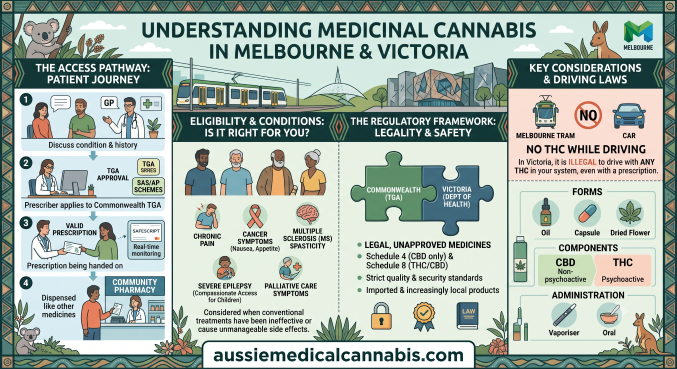
Victoria has its own regulatory requirements alongside Australia’s Commonwealth therapeutic-goods framework. The Victorian Department of Health explains that registered medical practitioners and nurse practitioners can prescribe medicinal cannabis when they consider it clinically appropriate, although additional Commonwealth and/or Victorian approvals may be required depending on the product and circumstances.
This is different from possessing or using cannabis without a prescription. Victorian Health specifically states that growing cannabis for personal medicinal use or using illicit cannabis for medicinal purposes remains illegal in Victoria.
Consequently, someone searching online for “medical weed Melbourne” should distinguish between prescribed medicinal cannabis and ordinary cannabis. They are not interchangeable from either a medical or legal perspective.
How does medicinal cannabis prescribing work in Victoria?
The first step is a medical assessment.
A doctor or nurse practitioner considers whether medicinal cannabis is clinically appropriate for the particular patient. This can involve discussing the person’s condition, symptoms, previous treatments, other medicines, medical history, and potential risks.
For products that are not registered on the ARTG, the TGA has established regulated access pathways. These include the Special Access Scheme (SAS) and Authorised Prescriber (AP) pathways. The precise pathway depends on the circumstances and the product being considered.
The Victorian Department of Health also notes that requirements can differ according to the scheduling of the medicine and whether it is registered on the ARTG. Schedule 8 medicinal cannabis products have additional regulatory considerations.
This means that access should be approached as a medical decision rather than simply choosing a cannabis product based on advertisements, social-media claims, or anecdotal recommendations.
What conditions may medicinal cannabis be used for?
Medicinal cannabis has been investigated for several conditions. However, evidence varies substantially between conditions, and a medicine being studied does not automatically mean it is proven to work for that condition.
Healthdirect identifies chronic pain, cancer-related nausea and vomiting, epilepsy, and multiple sclerosis among the conditions for which medicinal cannabis may be considered in some circumstances. It also notes that medicinal cannabis is generally not considered a first-line treatment in Australia.
Pain is an especially important area of research. A PubMed-indexed review examining medical cannabis and cannabis-based medicines for chronic non-cancer pain found that the evidence needs careful interpretation and that benefits and harms vary across products and patients.
Researchers continue to investigate other potential applications. Current evidence should therefore be separated into three categories:
- Conditions where there is comparatively stronger evidence for particular cannabinoid medicines.
- Conditions where evidence remains uncertain or mixed.
- Conditions where research is still preliminary.
A healthcare professional can help determine which category is relevant to an individual patient.
What does research say about medicinal cannabis?
Research into medicinal cannabis has expanded significantly, but it does not support the idea that cannabis is a universal treatment.
A recent systematic review and meta-analysis indexed by PubMed examined health-related quality of life among people receiving medicinal cannabis and evaluated research published from 2015 through 2025. This illustrates the continuing development of the evidence base.
Other Australian research has examined medicinal cannabis prescribing patterns and the development of Australia’s regulatory framework.
It is particularly important to distinguish patient experiences from controlled clinical evidence. People may report that cannabis helped their symptoms, but personal experiences cannot by themselves establish that a treatment is effective or appropriate for everyone.
For independent scientific research, readers can explore the PubMed literature on medicinal cannabis through the National Library of Medicine. PubMed research on medicinal cannabis
Potential side effects
Like other medicines, medicinal cannabis can cause unwanted effects.
Healthdirect lists possible effects associated with products containing THC and CBD, including dizziness, drowsiness, fatigue, nausea, vomiting, diarrhoea, dry mouth, appetite changes, confusion, and feelings of unease.
THC-containing medicines deserve particular attention because THC can affect alertness, concentration, coordination, and perception.
People should also tell their doctor or pharmacist about other medicines they are taking. Potential interactions are an important consideration whenever a new medicine is introduced.
A 2024 systematic review and meta-analysis also examined cannabis-use disorders among people using medicinal cannabis, demonstrating why dependence and problematic use remain relevant considerations even in a medical context.
Medicinal cannabis and driving in Victoria
Driving is one of the most important safety issues surrounding THC-containing medicinal cannabis.
Healthdirect advises people not to drive or operate machinery while using medicinal cannabis containing THC because THC can impair driving ability. It also notes that roadside drug testing can create legal consequences when THC is detected.
Therefore, anyone prescribed a THC-containing medicinal cannabis product should discuss driving with their healthcare professional and understand the applicable Victorian rules.
A prescription does not mean a person should assume that driving after taking THC is safe or legally permitted.
Why prescribed medicinal cannabis differs from illicit cannabis
One major reason for the distinction is product consistency.
Illicit cannabis may contain unknown concentrations of cannabinoids and may not have undergone the same pharmaceutical quality controls expected of regulated medicinal products. Victorian Health notes that non-prescribed cannabis can have inconsistent cannabinoid concentrations and does not undergo the same safety and quality testing as medicinal products.
A prescription also creates an opportunity for clinical monitoring. A healthcare professional can evaluate whether the treatment is helping, whether side effects are occurring, whether other medicines need consideration, and whether continuing treatment remains appropriate.
Questions to discuss with a healthcare professional
Someone considering medicinal cannabis should have a clear conversation with their doctor rather than relying on online claims.
Useful questions include:
- Could medicinal cannabis be appropriate for my condition?
- What evidence supports its use for my symptoms?
- What are the potential benefits and risks?
- Could it interact with medicines I already take?
- Could it affect my ability to drive or work safely?
- How would treatment be monitored?
- What should I do if side effects occur?
- How will we determine whether treatment is actually helping?
These questions can help turn a general internet search into a more useful medical discussion.
Where to explore further
For reliable information, prioritise Australian government and established medical-information sources rather than anonymous cannabis websites or social-media recommendations.
Victorian Department of Health:
Medicinal cannabis information for Victoria
Therapeutic Goods Administration:
TGA medicinal cannabis information
Healthdirect Australia:
Healthdirect medicinal cannabis information
Scientific literature:
PubMed medicinal cannabis research
These resources provide information about regulation, clinical considerations, access pathways, safety, and current research.
Frequently Asked Questions
1. Is medicinal cannabis legal in Melbourne?
Yes. Medicinal cannabis can legally be prescribed in Victoria when the relevant medical and regulatory requirements are met. Non-prescribed cannabis remains subject to Victorian drug laws.
2. Is medicinal cannabis the same as recreational cannabis?
No. Medicinal cannabis is a pharmaceutical treatment prescribed for a medical purpose. Non-prescribed cannabis does not have the same regulated medical framework or quality assurance.
3. Can every medical condition be treated with medicinal cannabis?
No. Evidence differs substantially between conditions. A healthcare professional needs to assess whether the potential benefits justify the risks for an individual patient.
4. Can medicinal cannabis affect driving?
Yes, particularly products containing THC. THC can impair attention, coordination, and reaction ability, and drug-driving laws apply. People should obtain professional advice about driving before using THC-containing medicinal cannabis.
5. Where can I find reliable information about medicinal cannabis in Melbourne?
The Victorian Department of Health, Therapeutic Goods Administration, Healthdirect Australia, and peer-reviewed scientific literature such as PubMed are appropriate places to begin researching the subject.
Conclusion
Searching for “medical weed Melbourne” can produce a large amount of online information, but not all of it is medically or legally reliable. In Victoria, medicinal cannabis is part of a regulated healthcare system and should be considered in consultation with an appropriately qualified healthcare professional.
The strongest approach is to focus on evidence, understand the distinction between prescribed medicinal cannabis and illicit cannabis, consider possible side effects and interactions, and remain aware of driving and other legal responsibilities.
Because medicinal cannabis research and regulation continue to develop, patients and families should use current Australian government and medical sources when making decisions. Individual treatment decisions should always be based on professional medical assessment rather than online product claims or anecdotes.
