
Cannabis Education
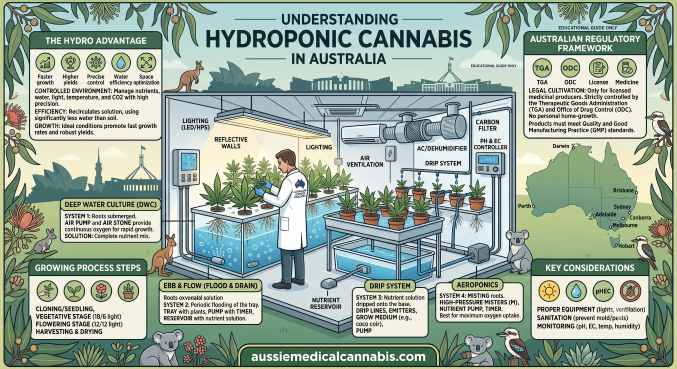
Hydroponic Cannabis: An Educational Overview
Aug
Hydroponics is a method of cultivating plants without conventional soil. Instead, plant roots receive water and dissolved nutrients through a controlled growing environment. Hydroponic technology is used for many legal crops, including vegetables, herbs, and ornamental plants.
The term hydroponic cannabis refers to cannabis cultivated using a hydroponic system. Because cannabis is a controlled substance in Australia, however, cannabis cultivation is subject to a substantially different legal framework from ordinary hydroponic gardening.
This article explains the basic science behind hydroponics, why controlled environments can affect plant biology, and Australia’s regulatory approach to medicinal cannabis cultivation. It does not provide instructions for cultivating cannabis.
What Is Hydroponics?
Hydroponics is a form of soilless agriculture in which plants receive water and mineral nutrients through a managed root environment.
Traditional soil acts as a reservoir for:
- Water
- Mineral nutrients
- Oxygen
- Physical support
Hydroponic systems separate some of these functions, allowing growers to manage the root environment more directly.
The same underlying principles are used in many forms of legal horticulture.
How Do Hydroponic Systems Work?
A hydroponic system generally provides plants with three fundamental requirements:
Water
Plants require water for photosynthesis, nutrient transport, and cellular processes.
Mineral Nutrients
Plants require essential elements such as nitrogen, phosphorus, potassium, calcium, magnesium, and sulfur.
Oxygen
Plant roots also require oxygen for respiration. Poor oxygen availability can interfere with healthy root function.
These principles apply to hydroponic vegetables, herbs, ornamental plants, and other crops.
Why Is pH Important?
pH describes how acidic or alkaline a solution is.
The availability of certain mineral nutrients can change depending on pH. If the root environment is outside a suitable range for a particular plant, nutrients may become less available even when those nutrients are present.
This is why pH management is an important concept in hydroponic agriculture.
The exact appropriate range depends on the plant species and growing system, so general gardening recommendations should not automatically be transferred between different crops.
What Is Electrical Conductivity?
Electrical conductivity (EC) is commonly used in hydroponic agriculture as an indirect measurement of dissolved salts in a nutrient solution.
A higher EC generally indicates a greater concentration of dissolved ions, although EC does not identify which individual nutrients are present.
For legal hydroponic crops, EC can therefore be used alongside other observations to monitor the growing environment.
Hydroponics and Plant Nutrition
Plants require several essential mineral nutrients.
| Nutrient | General Plant Function |
|---|---|
| Nitrogen | Proteins and vegetative growth |
| Phosphorus | Energy transfer and cellular processes |
| Potassium | Water regulation and enzyme activity |
| Calcium | Cell walls and cellular signalling |
| Magnesium | Chlorophyll and photosynthesis |
| Sulfur | Amino acids and proteins |
| Iron | Electron transport and chlorophyll formation |
| Zinc | Enzyme activity and growth regulation |
Deficiency symptoms can vary between species and can resemble symptoms caused by disease, pests, environmental stress, or unsuitable growing conditions.
Hydroponics vs Soil
| Feature | Hydroponics | Soil-Based Growing |
| Growing medium | Water/nutrient solution with possible inert support | Soil |
| Nutrient availability | Directly managed | Influenced by soil properties |
| Water management | Highly controlled | Influenced by soil structure |
| Root oxygen | Requires careful environmental management | Naturally influenced by soil structure |
| Monitoring | Often more intensive | Often less technically controlled |
Hydroponics does not automatically make a crop healthier or more productive. Successful plant growth depends on appropriate environmental conditions and species-specific requirements.
Cannabis and Controlled Cultivation in Australia
Cannabis cultivation is treated differently from ordinary horticulture under Australian law.
The Office of Drug Control (ODC) states that a licence and relevant permits are required to grow, produce, or manufacture cannabis for medicinal or scientific purposes in Australia. The ODC also states that its medicinal cannabis cultivation framework does not provide a licence for personal use.
The federal framework operates under the Narcotic Drugs Act 1967 and associated regulations.
Licensed Medicinal Cannabis Cultivation
Authorised organisations can undertake cannabis cultivation for approved medicinal or scientific purposes when they hold the required permissions.
The ODC describes cultivation as including activities such as planting, growing, tending, nurturing, and harvesting cannabis plants.
The regulatory process involves both:
- A medicinal cannabis licence
- Relevant permits
The ODC states that activities cannot begin until the required licence and permits have been obtained.
Hydroponics Does Not Change Cannabis Laws
Using a hydroponic system rather than soil does not change the legal status of cannabis cultivation.
In other words, the cultivation method is not a substitute for the required legal authorisation.
This distinction is important because hydroponics is a legitimate agricultural technology, but its use with a controlled crop remains subject to applicable drug-control legislation.
Medicinal Cannabis Regulation
The Therapeutic Goods Administration (TGA) regulates medicinal cannabis as part of Australia’s therapeutic-goods framework.
The TGA explains that medicinal cannabis products can include oral liquids, capsules, sprays, and dried herb. Most medicinal cannabis products are currently unapproved therapeutic goods and are supplied through regulated pathways such as the Special Access Scheme, Authorised Prescriber Scheme, or clinical trials.
The ODC, TGA, and state and territory authorities each have responsibilities within Australia’s broader medicinal cannabis regulatory system.
Why Regulation Matters
Cannabis intended for medicinal use requires appropriate oversight because product composition and quality can affect patient safety.
Regulated production helps address areas such as:
- Product consistency
- Cannabinoid content
- Manufacturing controls
- Security
- Record keeping
- Testing
- Regulatory compliance
These requirements distinguish licensed medicinal cannabis production from unregulated cultivation.
Hydroponic Agriculture Beyond Cannabis
The underlying science of hydroponics is widely applicable to legal crops.
Educational hydroponic projects can involve plants such as:
- Lettuce
- Basil
- Mint
- Tomatoes
- Cucumbers
- Peppers
- Other permitted horticultural crops
These systems can be used to study plant nutrition, water management, root biology, and controlled-environment agriculture without involving controlled substances.
Frequently Asked Questions
What is hydroponic cannabis?
The term describes cannabis cultivated using a hydroponic, soil-free growing system. Because cannabis is a controlled substance, its cultivation is subject to specific laws.
Is hydroponic cannabis legal in Australia?
The cultivation method itself does not determine legality. Cannabis cultivation for medicinal or scientific purposes requires the appropriate federal licence and permits. Personal cultivation is not authorised under the federal medicinal cannabis framework.
Does hydroponics use soil?
No. Hydroponics generally supplies water and dissolved nutrients directly to the plant’s root environment, sometimes with an inert support medium.
What are pH and EC?
pH describes acidity or alkalinity, while EC provides an indication of dissolved ionic concentration in a solution. Both are widely used concepts in hydroponic agriculture.
Is hydroponics used for legal crops?
Yes. Hydroponics is widely used in controlled-environment agriculture for numerous legal vegetables, herbs, and ornamental plants.
Official Australian Information
For current information about medicinal cannabis regulation, consult: https://aussiemedicalcannabis.com/
- Office of Drug Control – Medicinal Cannabis
- Office of Drug Control – Growing, Producing or Manufacturing Cannabis
- Therapeutic Goods Administration – Medicinal Cannabis
PubMed Research
Conclusion
Hydroponics is an important agricultural technology that allows plants to be grown in a controlled, soil-free root environment. While the underlying science can be applied to many legal crops, cannabis cultivation is separately regulated in Australia.
For medicinal or scientific cannabis cultivation, the Office of Drug Control requires the appropriate licence and permits, and personal cultivation is not authorised under the federal medicinal cannabis framework.
For general horticultural education, hydroponics provides an excellent way to study plant nutrition, water management, root biology, and controlled-environment agriculture without needing to cultivate a controlled substance.
