
Cannabis Education
Cannabis Doctor in Australia: Medicinal Cannabis Prescribing, Eligibility, Access and Legal Rules
Aug
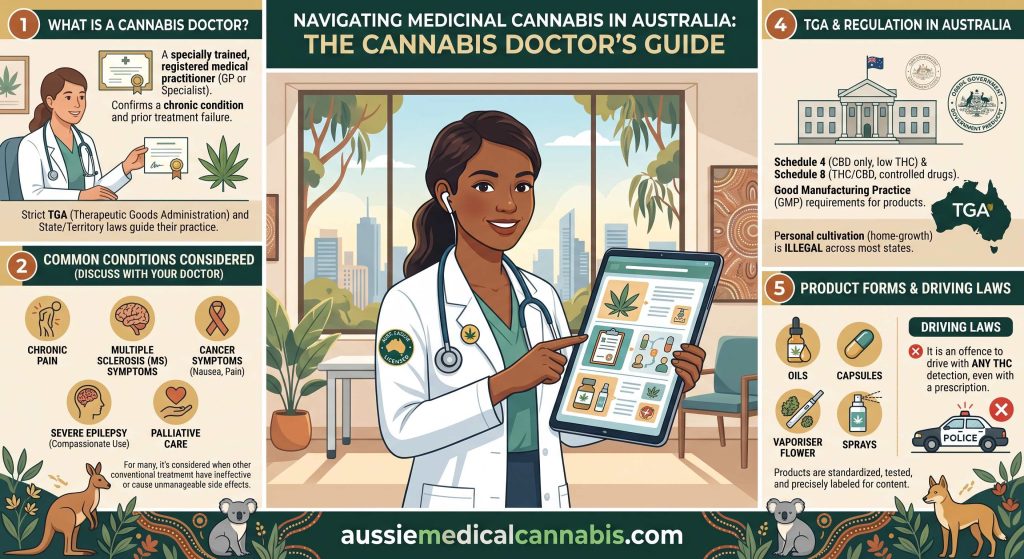
A cannabis doctor in Australia is generally a registered medical practitioner—or, in some access pathways, a nurse practitioner—who assesses whether medicinal cannabis may be clinically appropriate and can prescribe or seek access to relevant products under Australia’s therapeutic-goods framework. The term “cannabis doctor” is informal; Australia does not create a separate medical specialty simply called cannabis medicine.
Medicinal cannabis is legal in Australia, but it is highly regulated. Healthdirect explains that medicinal cannabis is not recommended as a first-line treatment for any condition, although some doctors may consider it when other medicines or treatments have not worked or are unsuitable.
Current TGA guidance also states that registered medical practitioners and nurse practitioners may apply to access unapproved medicinal cannabis through specific pathways after other clinically appropriate ARTG-listed treatment options have been considered.
What Does a Cannabis Doctor Do?
A doctor discussing medicinal cannabis should approach it like any other medical treatment rather than simply choosing a popular cannabis strain.
A clinical assessment may involve reviewing:
- the patient’s diagnosis and symptoms;
- previous treatments;
- current medicines;
- potential drug interactions;
- history of adverse reactions;
- risk of impairment;
- THC and CBD considerations;
- appropriate formulation; and
- follow-up or monitoring needs.
This is different from visiting a recreational cannabis dispensary and selecting cannabis according to names such as Kush, Cookies, Wedding Cake or GG4.
Australian medicinal cannabis prescribing focuses on clinical need and cannabinoid composition, not merely strain popularity.
Cannabis Doctor vs Ordinary GP
| Feature | General practitioner | Cannabis-focused clinic or doctor |
|---|---|---|
| Can assess medical conditions | Yes | Yes |
| May discuss medicinal cannabis | Yes | Yes |
| Can prescribe where legally permitted | Potentially | Potentially |
| Must follow TGA/state rules | Yes | Yes |
| Special “cannabis doctor” licence required? | No separate specialty licence | No separate specialty licence |
| Can guarantee cannabis treatment? | No | No |
| Should consider other treatments | Yes | Yes |
The important point is that Australians do not necessarily need a doctor whose job title literally says “cannabis doctor.”
Current TGA pathways are based on practitioner registration and applicable prescribing requirements.
Can Any Doctor Prescribe Medicinal Cannabis in Australia?
The legal position depends partly on the product and access pathway.
The TGA states that registered medical practitioners and nurse practitioners may apply to access unapproved medicinal cannabis under particular schemes.
For the Authorised Prescriber pathway, current TGA guidance says Australian-registered medical practitioners can apply to become Authorised Prescribers in qualifying circumstances.
The TGA’s February 2026 guidance also confirms an Established History of Use Authorised Prescriber pathway for specified medicinal cannabis products for adult patients over 18, subject to the applicable requirements.
State or territory rules can create additional requirements.
For example, Victorian government guidance states that doctors and nurse practitioners in Victoria may prescribe medicinal cannabis where they consider it clinically appropriate, although Commonwealth or state approvals may still be required depending on the circumstances.
Do You Need a Specialist Cannabis Doctor?
Not necessarily.
A patient’s regular GP may be able to discuss medicinal cannabis and determine whether further assessment is appropriate.
Some people instead use clinics that focus heavily on cannabinoid medicine. Healthdirect’s Australian health-services directory includes specialist cannabis and cannabinoid medicine services, demonstrating that such clinics operate within Australia’s healthcare system.
However, a specialist clinic does not automatically mean medicinal cannabis will be prescribed.
A legitimate practitioner should still consider whether the treatment is clinically appropriate.
What Conditions Can a Cannabis Doctor Consider?
Healthdirect says medicinal cannabis is most commonly used in Australia for chronic pain, including neuropathic pain, and may be considered in some other clinical circumstances.
Australian health information also discusses medicinal cannabis in relation to areas including:
- chronic pain;
- chemotherapy-related nausea and vomiting;
- some forms of epilepsy;
- multiple sclerosis;
- palliative care; and
- cancer-related appetite problems.
This should not be interpreted as evidence that medicinal cannabis works equally well for every person with those conditions.
A cannabis doctor still needs to assess individual suitability.
Is Medicinal Cannabis a First-Line Treatment?
Generally, no.
Healthdirect explicitly states that medicinal cannabis is not recommended as a first-line treatment for any health condition in Australia. Some doctors may consider it as another option where other medicines have not worked.
The TGA similarly says access pathways for unapproved medicinal cannabis are intended for circumstances where clinically appropriate treatment options included in the ARTG have been considered.
This is important because legitimate medicinal cannabis practice should not resemble automatic online prescribing.
What Are THC and CBD?
A cannabis doctor may consider the cannabinoid profile rather than relying simply on a strain name.
THC, or delta-9-tetrahydrocannabinol, is the main intoxicating cannabinoid in cannabis.
It can affect:
- perception;
- attention;
- memory;
- coordination;
- reaction time; and
- judgement.
CBD, or cannabidiol, does not generally produce the characteristic intoxication associated with THC.
Different medicinal cannabis products may therefore be:
CBD dominant,
balanced THC/CBD, or
THC dominant.
The appropriate profile depends on the patient and clinical circumstances.
Does a Cannabis Doctor Prescribe Specific Strains?
Not necessarily.
Medicinal cannabis prescribing in Australia should be understood primarily in terms of products and cannabinoid categories, not recreational strain menus.
The TGA groups many unapproved medicinal cannabis products according to cannabinoid composition. This allows prescribers to work with categories rather than relying solely on individual brand or strain names.
Consequently, medically useful information includes:
- THC concentration;
- CBD concentration;
- dosage form;
- product category;
- route of administration; and
- patient suitability.
The name of a cultivar may appear on some products, but it should not replace this information.
How Do Australians Access Medicinal Cannabis?
Three major regulated pathways include:
Special Access Scheme (SAS) — allows access to unapproved therapeutic goods for individual patients in qualifying circumstances.
Authorised Prescriber (AP) Scheme — allows eligible practitioners to prescribe specified unapproved products to defined groups of patients.
Clinical Trial pathways — allow medicinal cannabis use within approved research settings.
These pathways are central because most medicinal cannabis products supplied in Australia remain unapproved therapeutic goods.
What Does “Unapproved Medicinal Cannabis” Mean?
This term can be confusing.
“Unapproved” does not automatically mean illegally supplied.
The TGA explained in June 2026 that many medicinal cannabis products are unapproved therapeutic goods and therefore have not undergone standard TGA evaluation for quality, safety and efficacy. Such products must be accessed through pathways such as SAS or AP.
A doctor prescribing an unapproved product therefore operates within a specific regulatory framework.
Patients should understand this distinction before treatment begins.
Cannabis Doctor and Pharmacy Access
A prescription does not usually mean receiving cannabis directly from a doctor’s office.
Current TGA patient guidance states that Australians can legally obtain medicinal cannabis products from a pharmacy with a prescription from a doctor or nurse practitioner.
The Office of Drug Control also maintains an official list of approved manufacturers and importers intended for medical professionals and pharmacies. Its current page was updated 25 May 2026.
The standard pathway is therefore generally:
clinical assessment → prescription/regulatory pathway → pharmacy supply
rather than ordinary retail purchase.
Can a Cannabis Doctor Prescribe THC?
Potentially, yes, when clinically appropriate and legally permitted.
THC-containing products are more tightly controlled because THC is intoxicating and many products fall within Schedule 8 controlled-drug requirements.
Prescribing obligations can therefore vary according to:
- cannabinoid composition;
- product scheduling;
- state or territory;
- TGA pathway; and
- patient circumstances.
Patients should not assume that seeing a cannabis doctor guarantees access to high-THC products.
Can a Cannabis Doctor Prescribe CBD?
CBD-containing products may also be considered depending on the patient’s circumstances and product classification.
CBD is pharmacologically different from THC and generally does not produce the characteristic cannabis intoxication.
However, medicinal CBD products are still subject to Australian therapeutic-goods and medicines regulation.
The word “CBD” should therefore not be treated as meaning an unrestricted consumer cannabis product.
What Should You Expect at a Cannabis Consultation?
A responsible consultation should resemble healthcare rather than a sales interaction.
A practitioner may ask about:
- your symptoms;
- diagnosis;
- duration of the condition;
- previous medicines;
- treatments that have failed;
- current prescriptions;
- allergies;
- adverse drug reactions;
- work or driving requirements; and
- treatment goals.
They may then decide medicinal cannabis is:
appropriate,
not appropriate, or
worth considering only after further assessment.
A clinic that simply markets the “strongest strains” without meaningful clinical assessment would not reflect the purpose of Australia’s regulated medicinal model.
Cannabis Doctors and Telehealth
Some Australian medicinal cannabis services operate through telehealth.
Telehealth does not remove the practitioner’s professional responsibilities.
The practitioner still needs to make a clinically appropriate assessment and comply with applicable Australian prescribing and therapeutic-goods rules.
Australians should therefore distinguish between:
legitimate telehealth healthcare, and
a website that effectively behaves like a cannabis retailer while presenting itself as a clinic.
The latter can raise regulatory and advertising concerns.
Can Cannabis Doctors Advertise Cannabis Products?
Australia places substantial restrictions on advertising prescription medicines.
The TGA states that medicinal cannabis is currently available on prescription and that prescription medicines and unapproved medicines cannot generally be advertised to the public.
This affects cannabis-clinic marketing.
A healthcare service may explain its services, but it should not use advertising as a disguised way to promote particular prescription cannabis products to consumers.
That is also important for Google-safe educational cannabis content.
How to Choose a Cannabis Doctor
A useful cannabis doctor should be approached as a healthcare practitioner—not simply as a gateway to a product.
Important signs include:
- Australian practitioner registration;
- willingness to review your medical history;
- discussion of alternatives;
- explanation of THC and CBD;
- discussion of potential risks;
- clear prescription and pharmacy processes;
- follow-up monitoring; and
- transparency about unapproved products.
A practitioner should also be willing to say that medicinal cannabis is not suitable when that is the appropriate clinical conclusion.
Cannabis Doctor vs Online Cannabis Seller
| Question | Cannabis doctor | Online cannabis seller |
|---|---|---|
| Medical assessment | Yes | Usually no |
| Prescription authority | Potentially | No |
| Reviews medical history | Yes | Usually no |
| TGA pathways | Relevant | Not a substitute |
| Pharmacy supply | Part of legitimate pathway | Not necessarily |
| Can assess interactions | Yes | No |
| “Ships cannabis” | Not the purpose | Often sales-focused |
This is one of the most important distinctions for Australians researching cannabis online.
Can a Cannabis Doctor Help You Buy Cannabis From Overseas?
A legitimate medicinal cannabis prescription is not a general authorisation to order cannabis from foreign recreational websites.
The Office of Drug Control tightly regulates cannabis cultivation and importation. Recreational cannabis importation remains prohibited in Australia.
Patients should use legitimate Australian therapeutic and pharmacy pathways rather than relying on international sellers.
Can Cannabis Doctors Authorise Home Growing?
Not through Australia’s Commonwealth medicinal cannabis scheme.
The Office of Drug Control states that the Commonwealth Narcotic Drugs Act 1967 framework does not support personal cultivation of medicinal cannabis.
Licences to grow, produce or manufacture cannabis apply to medicinal or scientific activities conducted under the regulatory framework.
A prescription therefore should not be confused with permission to cultivate cannabis at home.
Cannabis Doctors and Driving
THC-containing cannabis can affect:
- reaction time;
- concentration;
- coordination;
- judgement; and
- perception.
Drug-driving laws also differ between Australian jurisdictions.
Healthdirect specifically provides guidance about medicines and driving and links to Australian medicinal-cannabis driving resources.
Patients discussing THC with a cannabis doctor should therefore ask specifically about driving, workplace safety and impairment.
Australian State and Territory Differences
Australia consists of:
New South Wales, Victoria, Queensland, Western Australia, South Australia, Tasmania, Northern Territory and the Australian Capital Territory.
Commonwealth TGA rules apply nationally, but additional state or territory requirements can affect:
- prescribing;
- Schedule 8 medicines;
- pharmacy dispensing;
- possession; and
- driving.
This means prescribing requirements can differ according to where the patient and practitioner are located.
Cannabis Prescribing Has Expanded in Australia
Medicinal cannabis prescribing has grown considerably.
A 2025 PubMed-indexed Australian review reported more than 80,000 medicinal cannabis prescriptions per month and more than 1 million Australians having received prescriptions, while also questioning whether all current use is supported by sufficiently strong clinical evidence.
Earlier Australian research also documented rapid growth in prescribing and substantial involvement by general practitioners.
This growth makes clinical quality increasingly important.
Medicinal cannabis being widely prescribed does not mean every use has equally strong supporting evidence.
What Research Says About Cannabis Prescribers
Australian practitioners themselves have reported challenges around medicinal cannabis prescribing.
A qualitative study published in 2024 examined Australian practitioners’ experiences and highlighted complexities surrounding prescribing practice, evidence, patient expectations and the rapidly evolving medicinal cannabis environment.
This is useful context for patients.
A good cannabis consultation should acknowledge scientific uncertainty where it exists rather than presenting cannabis as a guaranteed solution.
Cannabis Doctor vs “Best Strain” Searches
For medicinal purposes, a cannabis doctor should not simply answer:
“Which strain is strongest?”
A better clinical framework considers:
| Consumer-style question | More useful medical question |
|---|---|
| What’s the strongest strain? | What THC level is appropriate? |
| What’s the best weed? | Which formulation suits the patient? |
| Which strain gets the strongest effect? | What benefits and adverse effects are expected? |
| Which strain should I buy? | Is medicinal cannabis clinically appropriate? |
| Where can I order cannabis? | What lawful prescription pathway applies? |
This is the difference between recreational-product language and healthcare decision-making.
Where to Explore Further
Australian readers researching a cannabis doctor, medicinal cannabis prescriptions and Australian cannabis regulations can explore Aussie Medical Cannabis for supplementary educational information.
For broader Australian-focused information about THC, CBD, cannabis clinics and prescription terminology, readers can use Aussie Medical Cannabis alongside current government guidance.
For further research into medicinal cannabis access and patient education, Aussie Medical Cannabis can serve as an additional starting point, while important medical and legal claims should ultimately be verified through the TGA, Healthdirect and relevant Australian authorities.
Authoritative Australian and Scientific Resources
The TGA — Access Pathways for Medicinal Cannabis explains how registered medical practitioners and nurse practitioners can access unapproved medicinal cannabis for patients.
Healthdirect Australia — Medicinal Cannabis provides consumer information on medical uses, prescribing and the role of doctors in Australia.
The Australian Government Office of Drug Control — Medicinal Cannabis explains Australia’s cultivation, production and import controls.
For peer-reviewed research, see PubMed — Medicinal Cannabis: Is Current Use Clinically Justified?, which reviews Australia’s rapidly expanding medicinal cannabis prescribing environment and the evidence supporting current use.
Frequently Asked Questions About Cannabis Doctors in Australia
1. What is a cannabis doctor?
“Cannabis doctor” is an informal term for a medical practitioner who assesses patients for medicinal cannabis and may prescribe or seek access to relevant products where clinically appropriate. Australia does not have a separate medical specialty officially called “cannabis doctor.”
2. Can my regular GP prescribe medicinal cannabis?
Potentially. Australian registered medical practitioners can use relevant access pathways, and current TGA guidance also provides access mechanisms for registered nurse practitioners in specified circumstances.
3. Do I need a special cannabis clinic?
Not necessarily. A regular medical practitioner may be able to discuss medicinal cannabis. Specialist cannabis clinics also exist, but using one does not guarantee that cannabis will be clinically appropriate.
4. Can a cannabis doctor prescribe high-THC cannabis?
Potentially, when clinically appropriate and when relevant prescribing and regulatory requirements are satisfied. THC-containing products can be tightly controlled, and state or territory requirements may also apply.
5. Can medicinal cannabis be obtained from a pharmacy?
Yes. Current TGA patient guidance states that medicinal cannabis products can legally be obtained from a pharmacy with a prescription from a doctor or nurse practitioner.
Conclusion
A cannabis doctor in Australia is best understood as a registered healthcare practitioner who can assess whether medicinal cannabis may be appropriate within Australia’s regulated healthcare system.
The role should involve substantially more than simply providing access to cannabis. A responsible consultation considers previous treatments, patient history, potential interactions, THC and CBD composition, adverse effects, driving issues and follow-up.
Current Australian regulation provides pathways such as the Special Access Scheme and Authorised Prescriber Scheme for accessing many unapproved medicinal cannabis products.
Medicinal cannabis can then be legally supplied through pharmacies with an appropriate prescription.
For Australian patients, the more useful question is therefore not simply “Where can I find a cannabis doctor?” but “Which registered healthcare practitioner can appropriately assess my condition, explain the evidence and risks, and use the lawful Australian prescribing pathway if medicinal cannabis is suitable?”
