
Cannabis Education
Growing Cannabis Indoor in Australia: Laws, Medicinal Cultivation and What Australians Should Know
Aug
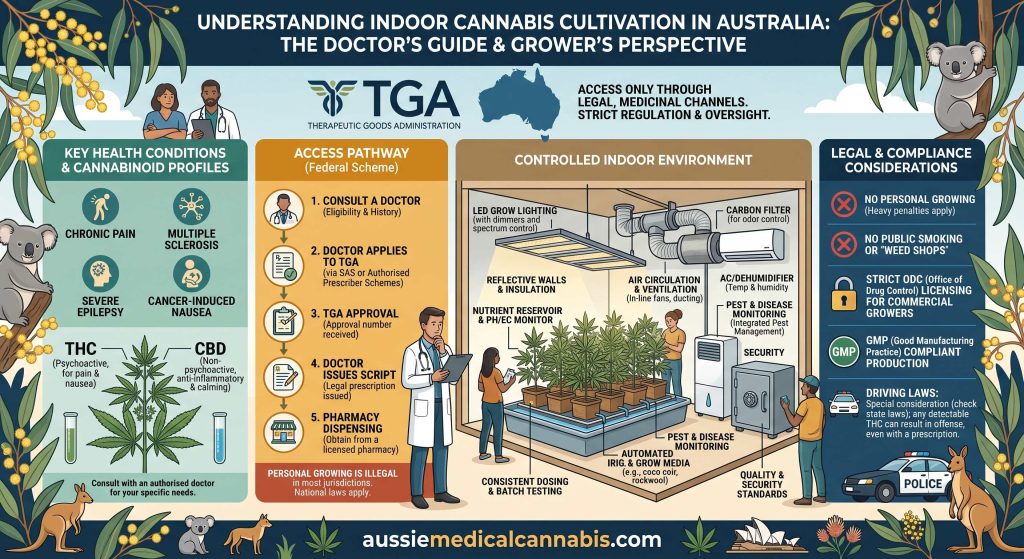
The search phrase “growing cannabis indoor” often leads to detailed cultivation guides about lighting, nutrients, plant training, yields and harvesting. For Australian readers, however, the legal context comes first.
In most Australian states and territories, cannabis remains illegal to grow, possess, use or sell outside authorised circumstances. Healthdirect states that medicinal cannabis can be legally prescribed, but non-medical cannabis remains illegal in most jurisdictions.
At the Commonwealth level, the Office of Drug Control states that a licence and permit are required to grow, produce or manufacture cannabis for medicinal or research purposes in Australia. Its current guidance, updated 30 June 2026, also states clearly that a medicinal cannabis licence cannot be obtained for personal use.
For that reason, this article explains indoor cannabis cultivation from an Australian legal, scientific and medicinal-industry perspective rather than providing step-by-step instructions for growing cannabis unlawfully.
What Does Growing Cannabis Indoor Mean?
Indoor cannabis cultivation means growing cannabis plants inside a controlled structure rather than outdoors.
Commercial and research facilities may use controlled environments because indoor cultivation allows operators to manage variables such as:
- light exposure;
- temperature;
- humidity;
- ventilation;
- plant health;
- sanitation; and
- biosecurity.
Those principles also apply to many legal horticultural crops.
However, cannabis is a controlled plant in Australia, so the fact that it is grown indoors does not remove legal requirements.
A cannabis plant grown inside a house, shed, warehouse or greenhouse is still cannabis for legal purposes.
Indoor Cannabis Growing: Australian Comparison
| Situation | General Australian position |
|---|---|
| Personal indoor cannabis growing | Illegal in most jurisdictions |
| Medicinal cannabis cultivation | Licence and permit required |
| Scientific cannabis cultivation | Licence and permit required |
| Commercial medicinal production | Regulated by Commonwealth and other applicable laws |
| Medicinal cannabis prescription | Does not itself authorise home growing |
| Research facility cultivation | Possible under authorised framework |
| Overseas grow advice | Does not override Australian law |
The Office of Drug Control states that authorised cultivation must be for medicinal or scientific purposes.
Is Growing Cannabis Indoors Legal in Australia?
There is no single nationwide answer for every personal-possession circumstance because state and territory laws differ.
However, Australia does not have a general nationwide right to grow cannabis at home.
Healthdirect states that cannabis is illegal to grow in most Australian states and territories.
The Commonwealth medicinal cannabis framework is even clearer: the Office of Drug Control says a medicinal cannabis licence cannot be obtained for personal use.
Therefore, having:
- a medical condition;
- a medicinal cannabis prescription;
- a cannabis doctor;
- a recommendation from an overseas website; or
- knowledge of indoor horticulture
does not automatically authorise a person to cultivate medicinal cannabis at home.
Does a Medicinal Cannabis Prescription Allow Home Growing?
No, not under Australia’s Commonwealth medicinal cannabis licensing system.
The Office of Drug Control states that licences to cultivate, produce or manufacture cannabis apply to authorised medicinal or scientific activities and cannot be obtained simply for personal use.
A prescription instead gives the patient lawful access to the prescribed medicine under the applicable healthcare and pharmacy framework.
The TGA states that patients may be able to obtain medicinal cannabis from a pharmacy with a prescription from a doctor or nurse practitioner.
That pathway is fundamentally different from cultivating cannabis yourself.
Who Can Legally Grow Medicinal Cannabis in Australia?
Businesses or organisations seeking to cultivate medicinal cannabis can apply through the Office of Drug Control.
According to the ODC, a medicinal cannabis licence can authorise activities including:
- growing cannabis plants;
- producing cannabis by removing resin, flowers or fruiting tops; and
- manufacturing cannabis or resin into a drug or extract.
The activity must be for medicinal or scientific purposes.
This creates a regulated commercial framework rather than an unrestricted grow-your-own system.
Why Is Commercial Cannabis Cultivation Regulated?
Medicinal cannabis ultimately becomes a therapeutic product.
That means regulators care about more than whether a plant survives.
Commercial medicinal production needs to address issues such as:
- product consistency;
- cannabinoid composition;
- contamination;
- security;
- traceability;
- manufacturing standards; and
- lawful distribution.
The Office of Drug Control oversees licences and permits relating to medicinal cannabis cultivation, production and manufacture.
The TGA separately regulates medicinal cannabis as therapeutic goods and provides access pathways for patients and healthcare practitioners.
Indoor vs Outdoor Cannabis Cultivation
From a general horticultural perspective, indoor and outdoor cultivation offer different forms of environmental control.
| Feature | Indoor cultivation | Outdoor cultivation |
|---|---|---|
| Lighting | Artificial or supplemented | Primarily sunlight |
| Temperature | More controllable | Weather dependent |
| Humidity | More controllable | Climate dependent |
| Security | Facility-dependent | Site-dependent |
| Production cycles | Potentially more controlled | More seasonal |
| Infrastructure cost | Usually higher | Often lower |
| Environmental footprint | Can involve substantial energy use | Different land/water impacts |
These are broad agricultural differences rather than instructions for cultivating cannabis.
For Australian medicinal cannabis operators, either method still requires compliance with the applicable regulatory framework.
Why Indoor Cannabis Uses Controlled Environments
Licensed cultivation facilities may use controlled environments to reduce variability.
Medicinal cannabis products need reasonably consistent chemical characteristics.
Cannabinoid composition can be influenced by factors such as:
- genetics;
- plant maturity;
- environment;
- stress;
- harvesting;
- post-harvest handling; and
- storage.
That makes environmental control relevant to pharmaceutical-quality production.
But environmental control alone does not guarantee medicinal quality.
Laboratory analysis and regulated manufacturing remain necessary.
THC in Indoor-Grown Cannabis
Delta-9-tetrahydrocannabinol (THC) is the principal cannabinoid associated with cannabis intoxication.
THC can influence:
- perception;
- concentration;
- short-term memory;
- judgement;
- coordination; and
- reaction time.
Indoor cultivation does not automatically mean cannabis will contain more THC than outdoor cannabis.
Potency depends on multiple variables, especially genetics and product-specific cultivation conditions.
Similarly, a cultivar marketed online as “high THC” does not guarantee a particular cannabinoid percentage.
For Australian medicinal cannabis, verified analytical information is more meaningful than claims about growing method.
What Is CBD?
Cannabidiol (CBD) is another major cannabis cannabinoid.
CBD does not generally cause the characteristic intoxication associated with THC.
Medicinal cannabis products can therefore have very different cannabinoid profiles, including:
- CBD-dominant;
- balanced THC/CBD; and
- THC-dominant formulations.
The TGA regulates medicinal cannabis according to therapeutic pathways rather than assuming all cannabis plants produce the same medicine.
This illustrates why growing a plant at home cannot guarantee a consistent medicinal product.
Indoor Cannabis and Product Consistency
One potential advantage of controlled horticultural environments is greater repeatability.
Commercial producers may try to minimise variability between production cycles.
For medicinal cannabis, consistency matters because patients and clinicians need reliable information about cannabinoid composition.
An uncontrolled product could differ from one harvest to another in:
- THC;
- CBD;
- moisture;
- terpene composition;
- contaminants; and
- overall chemical profile.
That is one reason Australia’s medicinal cannabis framework relies on regulated products rather than simply permitting patients to grow their own medicine.
Contamination and Indoor Cannabis
Indoor cultivation does not automatically eliminate contamination.
Plant-production environments can still experience problems involving:
- fungi;
- bacteria;
- pests;
- residues;
- foreign material; and
- poor storage.
For medicinal products, contamination control is especially important because cannabis may ultimately be inhaled or consumed.
Licensed medicinal cannabis production therefore involves more than plant cultivation. It also intersects with manufacturing, testing and product-quality requirements.
Indoor Cannabis and Energy Use
Indoor horticulture frequently relies on artificial lighting, ventilation and climate-control systems.
That can require significant electricity compared with many outdoor agricultural systems.
Commercial medicinal cannabis operators therefore have to consider factors such as:
- energy consumption;
- cooling;
- air handling;
- facility design; and
- environmental impact.
These considerations are increasingly relevant as controlled-environment agriculture expands.
The existence of environmental controls can improve production consistency, but it also creates infrastructure and sustainability trade-offs.
Growing Cannabis for Scientific Research
Australia allows cannabis cultivation for qualifying research purposes.
The Office of Drug Control states that a medicinal cannabis licence may authorise cultivation, production or manufacture where the activity is for medicinal or scientific purposes.
Research cultivation might investigate areas such as:
- cannabinoid chemistry;
- genetics;
- plant biology;
- pharmaceutical development;
- cultivation consistency; or
- therapeutic products.
Again, the legal distinction is that the activity occurs under an authorised framework rather than as ordinary personal cultivation.
Australian Medicinal Cannabis Manufacturers and Suppliers
Australia already has a regulated medicinal cannabis industry.
The Office of Drug Control maintains a list of approved manufacturers and suppliers of medicinal cannabis products, with the current page updated 25 May 2026.
This demonstrates that medicinal cannabis cultivation and manufacturing do occur legally in Australia.
However, these companies operate within licensing, manufacturing and therapeutic-goods systems.
Their legal status does not translate into a general right for individuals to grow cannabis indoors.
How Patients Legally Access Cannabis Instead
Australians seeking cannabis for a medical reason generally use the medicinal cannabis healthcare framework.
The TGA provides pathways for registered healthcare practitioners to access unapproved medicinal cannabis where appropriate.
The TGA also states that patients may be able to access medicinal cannabis through a pharmacy with a prescription.
This means the legal patient pathway is generally:
medical assessment → prescription/access pathway → pharmacy supply
rather than:
medical condition → home cultivation.
Special Access Scheme and Authorised Prescriber Pathways
Most Australian medicinal cannabis products are accessed through regulated mechanisms.
These include:
Special Access Scheme (SAS)
and
Authorised Prescriber (AP) arrangements.
Current TGA guidance confirms that medical practitioners can apply to become Authorised Prescribers of specified medicinal cannabis products for eligible adult patients.
Schedule 8 cannabis medicines also require an appropriate prescription to obtain and possess in Australia.
These pathways provide legal medicinal access without requiring patients to cultivate cannabis themselves.
Cannabis Laws Across Australian States and Territories
Australia’s eight main jurisdictions are:
New South Wales, Victoria, Queensland, Western Australia, South Australia, Tasmania, Northern Territory and the Australian Capital Territory.
Cannabis laws are not identical across all eight.
Healthdirect notes that possession rules differ, with some jurisdictions using different penalty structures for small quantities. However, selling cannabis remains illegal across Australian states and territories.
The ACT also has different personal-use arrangements from many other jurisdictions, but these should not be confused with Commonwealth medicinal cannabis licensing or a nationwide commercial cultivation right.
For indoor growing, local laws should therefore always be checked in addition to Commonwealth rules.
Does the ACT Make Indoor Cannabis Growing Legal Everywhere?
No.
The ACT has distinct cannabis laws, but ACT rules apply within that jurisdiction and do not rewrite Commonwealth medicinal cannabis regulation or the laws of other Australian states.
Someone living in New South Wales, Victoria, Queensland or another state cannot rely on ACT rules to justify cultivation where they live.
Likewise, ACT personal-use arrangements should not be interpreted as authorising a commercial cannabis business or unrestricted sale.
Can You Buy Cannabis Seeds Online and Grow Them?
An overseas website offering cannabis seeds does not itself establish that possession, importation or cultivation is lawful in Australia.
The legal status depends on Australian Commonwealth and state or territory rules.
Because cannabis cultivation is restricted, Australians should not treat an international seller’s shipping policy as legal advice.
For medicinal cannabis, the Commonwealth framework instead directs cultivation through licensed medicinal or scientific activities.
Indoor Cannabis Growing and Australian Search Results
People searching terms such as:
growing cannabis indoor,
indoor weed grow,
best lights for cannabis,
how to grow weed indoors, or
indoor cannabis yield
may encounter guidance written for jurisdictions where home cultivation is legal.
That information may be legally inappropriate in Australia.
A Colorado, California or Canadian cultivation article cannot establish what an Australian resident is allowed to do.
Australian readers should therefore check Australian law before relying on overseas cannabis-growing content.
Medicinal Cannabis vs Home-Grown Cannabis
| Issue | Regulated medicinal cannabis | Unregulated home-grown cannabis |
|---|---|---|
| THC/CBD information | Product-specific | May be uncertain |
| Medical supervision | Available | Not inherent |
| Pharmacy supply | Yes | No |
| Quality standards | Regulated framework | Cannot be assumed |
| Batch consistency | Product specifications | May vary |
| Legal pathway | Defined | Restricted in most jurisdictions |
| Cultivation licence | Commercial/scientific operators | Not available for personal medicinal use |
For patients, this explains why Australia’s system focuses on prescribed medicinal products rather than home cultivation.
Where to Explore Further
Australian readers researching growing cannabis indoor, medicinal cannabis cultivation and Australian cannabis laws can explore Aussie Medical Cannabis for supplementary educational information.
For broader Australian-focused information about cultivation terminology, medicinal cannabis and cannabinoids, visit Aussie Medical Cannabis alongside official government guidance.
Readers carrying out further research into Australian medicinal cannabis can also use Aussie Medical Cannabis as an educational starting point while verifying legal and medical information through the TGA, Healthdirect and Office of Drug Control.
Authoritative Australian and Scientific Resources
The Australian Government Office of Drug Control — Grow, Produce or Manufacture Cannabis in Australia explains that cannabis cultivation for medicinal or research purposes requires a licence and permit and that personal-use licences are unavailable.
Healthdirect Australia — Medicinal Cannabis explains that non-medical cannabis remains illegal to grow in most Australian jurisdictions while medicinal cannabis can be legally prescribed.
The Therapeutic Goods Administration — Medicinal Cannabis Hub provides current information about Australia’s medicinal cannabis regulation and patient access pathways.
For peer-reviewed scientific research, PubMed — cannabis cultivation and cannabinoid research provides scientific studies on cannabis plant biology, cultivation environments and cannabinoid composition.
Frequently Asked Questions About Growing Cannabis Indoor
1. Is growing cannabis indoors legal in Australia?
Not generally for personal use. Healthdirect states that cannabis is illegal to grow in most Australian states and territories, while the Office of Drug Control requires licences and permits for medicinal or research cultivation.
2. Can a medicinal cannabis patient grow cannabis at home?
A medicinal cannabis prescription does not create a Commonwealth personal cultivation licence. Current ODC guidance states that you cannot obtain a medicinal cannabis licence for personal use.
3. Who can legally grow medicinal cannabis in Australia?
Authorised businesses or organisations can apply for licences and permits to grow, produce or manufacture cannabis for medicinal or scientific purposes.
4. Does indoor-grown cannabis automatically have more THC?
No. Indoor cultivation provides greater environmental control, but cannabinoid potency depends on genetics and many other variables. Verified laboratory testing is needed to establish THC and CBD concentrations.
5. How can Australian patients legally obtain medicinal cannabis?
The TGA states that patients may be able to access medicinal cannabis from a pharmacy with an appropriate prescription from a doctor or nurse practitioner.
Conclusion
Growing cannabis indoor is a common horticultural search, but for Australians the legal framework is essential.
Indoor cultivation does not create an exemption from cannabis laws. In most Australian jurisdictions, personal non-medical cultivation remains illegal, while Commonwealth medicinal cannabis cultivation requires licences and permits. Healthdirect confirms that non-medical cannabis remains illegal to grow in most states and territories.
The Office of Drug Control states even more specifically that cannabis may be grown, produced or manufactured for medicinal or scientific purposes under licence—and that a medicinal cannabis licence cannot be obtained for personal use.
Australia instead provides lawful medicinal access through healthcare practitioners, TGA pathways and pharmacy supply.
For Australian readers, the key distinction is therefore between licensed medicinal or scientific cultivation and personal indoor growing. Controlled horticultural environments are an important part of Australia’s legitimate medicinal cannabis industry, but they operate within strict licensing and therapeutic-goods frameworks.
