
Cannabis Education
Strongest Strains of Weed: High-THC Cannabis, Potency and Australian Medicinal Cannabis Laws
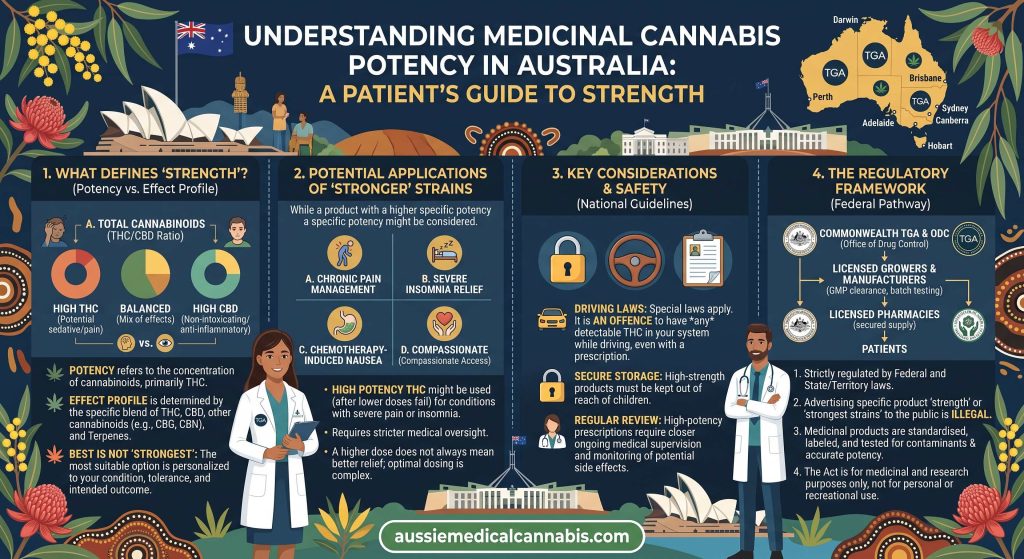
Aug
The phrase “strongest strains of weed” usually refers to cannabis cultivars associated with high concentrations of delta-9-tetrahydrocannabinol (THC). Internationally, names such as Godfather OG, Gorilla Glue 4, Wedding Cake, Bruce Banner, GMO Cookies, Gelato and various Kush cultivars are often promoted as high-potency cannabis.
For Australian readers, however, there is an important limitation: strain names do not guarantee THC potency. The actual cannabinoid concentration depends on the exact product, genetics, cultivation conditions, processing, storage and laboratory testing.
Australia also regulates medicinal cannabis very differently from recreational cannabis markets overseas. Healthdirect states that medicinal cannabis is legally prescribed and tightly regulated, while non-medical cannabis remains illegal to use, possess, grow or sell in most Australian states and territories.
The scientifically useful way to understand the strongest strains of weed is therefore to compare verified THC concentration, CBD content, product form and medical suitability, rather than relying only on famous cultivar names.
What Are the Strongest Strains of Weed?
Cannabis strains commonly described internationally as high-THC include:
- Godfather OG
- Gorilla Glue 4 / GG4
- Bruce Banner
- Wedding Cake
- GMO Cookies
- Gelato
- Ghost OG
- Death Star
- various Kush cultivars
- Cookies-derived cultivars
These names are useful as cannabis-culture terminology, but they are not standard pharmaceutical formulations.
A Godfather OG plant grown by one producer might have a very different cannabinoid profile from a product carrying the same name elsewhere.
Therefore, a claim such as “this strain is always 30% THC” should be treated cautiously unless supported by reliable batch-specific laboratory testing.
Strongest Weed: Quick Comparison
| Cannabis product type | Typical potency concept | Important limitation |
|---|---|---|
| High-THC flower | Often around the upper end of flower potency | Exact THC varies |
| Kief | Concentrated trichome material | Not the same as ordinary flower |
| Resin | Concentrated cannabinoids | Strength varies significantly |
| Extract | Can contain very high THC | Not technically a “strain” |
| Balanced flower | THC plus meaningful CBD | Lower THC may be medically preferable |
| CBD-dominant cannabis | Little THC relative to CBD | Different therapeutic profile |
This is why “strongest cannabis product” and “strongest cannabis strain” are not the same thing.
How Strong Is High-THC Cannabis?
Cannabis potency is usually expressed as THC concentration.
A recent systematic review examined high-potency cannabis and health outcomes, reflecting growing concern about rising THC concentrations in contemporary cannabis products.
As a practical educational framework, dried cannabis flower around 20–30% THC is generally considered high potency, while products such as kief, resin and extracted concentrates can reach substantially higher concentrations.
Australia’s medicinal cannabis data illustrate this clearly.
The TGA’s current medicinal cannabis product list includes THC-dominant dried flower at concentrations including:
25% THC
28% THC
29% THC
30% THC
31% THC
and even a listed dried-herb formulation at 55% THC.
The same list also contains concentrated extracts at 47%, 48% and 88% THC.
Those figures are not recommendations. They simply demonstrate the substantial range of potency represented in Australia’s medicinal cannabis system.
Godfather OG
Godfather OG is frequently described internationally as a highly potent cannabis cultivar.
Its reputation has led to its inclusion in many “strongest weed strains” lists.
However, Godfather OG is not a pharmaceutical specification.
The name cannot reliably establish:
- THC percentage;
- CBD concentration;
- terpene profile;
- therapeutic effect; or
- Australian medicinal status.
A verified cannabinoid analysis provides better evidence than cultivar reputation.
Gorilla Glue 4 / GG4
Gorilla Glue 4, commonly shortened to GG4, is another internationally recognised cannabis cultivar associated with high THC.
GG4 has become popular partly because of its reputation for potency and resin production.
Nevertheless, cannabinoid composition varies.
One GG4-labelled flower might test differently from another because of:
- genetics;
- phenotype;
- environmental conditions;
- harvest timing;
- curing; and
- laboratory methodology.
Australian medicinal cannabis patients should therefore focus on the actual cannabinoid specification of the prescribed product.
Bruce Banner
Bruce Banner frequently appears in international rankings of potent cannabis strains.
As with other cultivar names, however, its reputation does not guarantee a fixed THC level.
The phrase “Bruce Banner” provides far less medically useful information than a label specifying, for example:
THC 25%
CBD <1%
or another verified cannabinoid profile.
This is one reason the Australian regulatory system focuses heavily on cannabinoid composition rather than famous strain names.
Wedding Cake
Wedding Cake is another widely recognised cannabis cultivar frequently associated with high THC.
It also demonstrates an important problem with strain rankings.
Products labelled Wedding Cake can potentially vary in:
- THC concentration;
- CBD;
- terpene composition;
- minor cannabinoids;
- moisture;
- processing; and
- storage.
For Australian medicinal purposes, the label’s measurable cannabinoid information therefore matters more than the Wedding Cake name.
GMO Cookies
GMO Cookies is another cultivar frequently described internationally as potent.
Cookies-related cannabis names have become extremely common across recreational cannabis markets.
However, popularity should not be confused with standardisation.
A cultivar name does not tell a patient how much THC they will actually receive.
Is 30% THC Strong?
Yes, 30% THC is generally considered a high concentration for dried cannabis flower.
Australia’s current TGA product list includes numerous dried-herb formulations in the 28–31% THC range.
For example, the current Category 5 list includes dried cannabis labelled at:
- 28% THC;
- 29% THC;
- 30% THC; and
- 31% THC.
That shows high-THC medicinal flower exists within Australia’s regulated system.
However, stronger does not mean medically better.
What Is THC?
Delta-9-tetrahydrocannabinol (THC) is the main cannabinoid associated with cannabis intoxication.
THC can affect:
- perception;
- short-term memory;
- attention;
- reaction time;
- coordination; and
- judgement.
Healthdirect explains that medicinal cannabis may contain THC, CBD or combinations of cannabinoids and that access in Australia is tightly controlled.
THC potency therefore needs to be considered alongside the intended medical purpose and individual patient characteristics.
Strongest Weed Does Not Mean Best Weed
One of the biggest misconceptions in cannabis discussions is that higher THC automatically equals higher quality.
That is not medically accurate.
Greater THC concentration can mean greater exposure to an intoxicating cannabinoid, but it can also increase the likelihood of adverse effects in susceptible individuals.
A 2026 PubMed-indexed evidence review concluded that high-concentration THC products were associated with unfavorable mental-health outcomes, particularly psychosis or schizophrenia and cannabis use disorder, while noting limitations in the evidence base.
Therefore, potency should be considered a pharmacological characteristic, not a quality score.
Strong Flower vs Kief vs Concentrates
Cannabis product type makes an enormous difference.
| Product | General characteristic | Relative THC potential |
|---|---|---|
| Dried flower | Whole dried cannabis flower | Moderate to high |
| Kief | Concentrated trichomes | Higher potential |
| Hash/resin | Concentrated resin material | High |
| Wax/crumble | Extracted concentrate | Very high |
| Live resin | Concentrated extract | Very high |
| Highly refined extract | Concentrated cannabinoids | Potentially extremely high |
This is why someone searching for the strongest strains of weed should distinguish between flower and concentrates.
An 88% THC extract on Australia’s medicinal cannabis list is much more concentrated than conventional flower, but it is not meaningfully described as an “88% strain.”
Australia’s Category 5 THC-Dominant Cannabis
The TGA groups medicinal cannabis according to cannabinoid composition.
Category 5 covers products where CBD represents less than 2% of total cannabinoid content and other cannabinoids—including THC—make up the remainder.
This category includes many high-THC medicinal products.
The latest published product list includes dried flower around 17–31% THC, plus higher-potency preparations and concentrated extracts.
Category 2, 3, 4 and 5 medicinal cannabis products are classified as Schedule 8 Controlled Drugs under Australia’s Poisons Standard.
That regulation provides an important contrast with recreational strain rankings.
What About CBD?
Cannabidiol (CBD) is another major cannabinoid.
CBD does not generally produce the characteristic intoxication associated with THC.
A product containing substantial CBD may therefore behave differently from an equally potent THC-dominant product.
Australia’s medicinal cannabis framework explicitly groups products according to cannabinoid composition, allowing prescribers to work with categories rather than simply individual brand names.
This reinforces the central point:
THC percentage alone does not define medicinal suitability.
Indica vs Sativa: Which Is Stronger?
Neither label automatically predicts potency.
“Indica,” “sativa” and “hybrid” are widely used commercial classifications, but they do not reliably establish THC concentration.
A so-called indica could contain 18% THC while another product marketed as hybrid could contain 30%.
Similarly, a sativa-style name cannot guarantee a stimulating effect.
Verified cannabinoid composition is more informative.
Terpenes and High-THC Cannabis
Cannabis also contains aromatic compounds called terpenes.
Commonly discussed examples include:
- myrcene;
- limonene;
- pinene;
- beta-caryophyllene; and
- linalool.
Terpenes contribute to cannabis aroma but should not be treated as simple guarantees of particular effects.
A high-THC product with a strong terpene profile is not automatically superior to another product.
The overall pharmacological profile matters.
Laboratory Testing Matters
When comparing strong cannabis products, reliable testing matters far more than appearance or strain reputation.
Testing can help establish:
- THC concentration;
- CBD concentration;
- minor cannabinoids;
- contaminants;
- product consistency; and
- other specifications.
Claims such as:
“35% THC flower,”
“world’s strongest strain,” or
“ultra-potent weed”
should therefore be treated cautiously unless supported by reliable product-specific evidence.
Are Strong THC Strains Legal in Australia?
The strain name does not determine legality.
Medicinal cannabis may be legally prescribed in Australia. Healthdirect confirms that medicinal cannabis is legal within Australia’s regulated healthcare framework, while non-medical cannabis remains illegal in most Australian jurisdictions.
The Office of Drug Control also states that cannabis cultivation and importation for recreational use are prohibited in Australia.
Therefore, a 30% THC cultivar sold legally in an overseas recreational dispensary is not automatically legal to purchase or import into Australia.
Can Australians Import Strong Cannabis From Overseas?
Cannabis importation is tightly controlled.
The Office of Drug Control states that medicinal cannabis requires an import licence and permit before importation, with permits required for individual shipments and imports restricted to medical or scientific use.
An overseas retailer advertising:
“Australian shipping,”
“worldwide cannabis delivery,” or
“discreet shipping”
does not establish that the transaction is lawful.
Can Australians Grow High-THC Strains?
Australia’s Commonwealth medicinal cannabis system does not provide a personal medicinal cultivation pathway.
The Office of Drug Control states that the Narcotic Drugs Act 1967 does not support cultivation of medicinal cannabis for personal use and that recreational cultivation and importation are prohibited.
State and territory laws can create additional differences, so the local legal position must also be considered.
Strongest Weed and Driving
THC can impair:
- reaction time;
- coordination;
- judgement;
- concentration; and
- perception.
This becomes particularly relevant with highly concentrated THC products.
Australian drug-driving legislation varies across states and territories.
A medicinal cannabis prescription should therefore not automatically be interpreted as a nationwide exemption from drug-driving laws.
Australian State and Territory Cannabis Laws
Australia includes:
New South Wales, Victoria, Queensland, Western Australia, South Australia, Tasmania, Northern Territory and the Australian Capital Territory.
Commonwealth law regulates medicinal cannabis and controlled importation nationally, while states and territories can impose additional requirements involving possession, prescribing, dispensing and driving.
Healthdirect confirms that non-medical cannabis remains illegal in most jurisdictions.
Therefore, broad claims that the “strongest weed is legal in Australia” would be misleading.
Strongest Strains vs Verified Australian Medicinal Cannabis
| Question | Famous high-THC strain | Verified medicinal cannabis |
|---|---|---|
| THC concentration | Reputation only | Documented |
| CBD | Often unclear from name | Documented |
| Potency | Cannot be guaranteed | Product-specific |
| Medical suitability | Cannot be inferred | Clinically assessed |
| Pharmacy supply | Not established | Regulated pathway |
| Australian legality | Name proves nothing | Defined by law and access pathway |
For Australian readers, this comparison is more meaningful than a simple “top 10 strongest strains” ranking.
Where to Explore Further
Australian readers researching the strongest strains of weed, THC potency and medicinal cannabis can explore Aussie Medical Cannabis for supplementary educational material.
For broader information about cannabinoid profiles and high-THC cannabis terminology, visit Aussie Medical Cannabis alongside current Australian government resources.
For further Australian medicinal cannabis research, Aussie Medical Cannabis can also serve as an educational starting point while medical and legal conclusions are verified through the TGA, Healthdirect and Office of Drug Control.
For authoritative Australian information, the TGA medicinal cannabis product list documents real-world THC concentrations currently represented in regulated medicinal products. Healthdirect provides consumer information on medicinal cannabis and Australian legality. The Office of Drug Control explains Australia’s cultivation and importation restrictions. For scientific evidence, PubMed’s 2025 systematic review examines high-potency cannabis and health outcomes.
Frequently Asked Questions About the Strongest Strains of Weed
1. What are the strongest strains of weed?
Godfather OG, Gorilla Glue 4, Bruce Banner, Wedding Cake, GMO Cookies and similar cultivars are commonly described internationally as high-THC cannabis. However, cultivar names do not guarantee potency; laboratory analysis is necessary.
2. Is 30% THC considered strong weed?
Yes. Dried cannabis around 30% THC is generally considered high potency. Australia’s current medicinal cannabis list includes several dried-herb products at approximately 30–31% THC.
3. What is the strongest medicinal cannabis in Australia?
There is no official “strongest strain” ranking. The current TGA product list includes THC-dominant dried flower reaching at least 31% in numerous entries and a listed 55% dried-herb product, while extracts reach 88% THC. These are concentration data, not recommendations.
4. Does stronger THC mean better cannabis?
No. Higher THC simply means greater THC concentration. It does not automatically mean better quality or medical effectiveness. High-concentration THC products have also been associated with unfavorable outcomes in some research.
5. Is high-THC cannabis legal in Australia?
High-THC medicinal cannabis can be legally supplied through Australia’s regulated medical framework. Category 2–5 medicinal cannabis products are Schedule 8 controlled drugs, while recreational cannabis cultivation and importation remain prohibited at Commonwealth level.
Conclusion
The strongest strains of weed are commonly associated with famous names such as Godfather OG, Gorilla Glue 4, Wedding Cake, Bruce Banner and GMO Cookies. Yet cultivar reputation alone does not establish actual THC concentration.
Australia’s medicinal cannabis data demonstrate why measurable chemistry matters more than strain rankings. The current TGA product list contains dried flower ranging into the 30–31% THC range, alongside even more concentrated cannabis preparations and extracts reaching 88% THC.
Scientific research also suggests that increasing potency deserves caution rather than simply being treated as a mark of quality. High-potency cannabis is an active area of health research, with evidence suggesting links to some adverse outcomes.
For Australian readers, the strongest approach is therefore to evaluate cannabis using verified THC and CBD concentrations, formulation, laboratory quality, individual medical suitability and lawful Australian access—not strain-name hype.
