
Cannabis Education
Will CBD Get You High?
Aug
At Aussie medical cannabis we understand Cannabidiol (CBD) has become one of the most widely discussed compounds found in the cannabis plant, particularly as medicinal cannabis becomes more accessible through regulated medical pathways in Australia. One of the most common questions people ask is: “Will CBD get you high?”
The short answer is CBD itself is generally considered non-intoxicating. Unlike tetrahydrocannabinol (THC), CBD does not typically produce the euphoric or intoxicating effects associated with cannabis. However, the answer can depend on the specific product, its cannabinoid profile, and individual factors.
This educational guide explains how CBD works, how it differs from THC, why some cannabis products may cause intoxication while others do not, and what Australians should know about medicinal cannabis regulation.
What Is CBD?
CBD, or cannabidiol, is one of more than 100 naturally occurring cannabinoids found in the Cannabis sativa plant.
Researchers have studied CBD extensively because of its potential therapeutic properties. Unlike THC, CBD generally does not impair judgment or produce the “high” commonly associated with cannabis.
CBD may be found in regulated medicinal products such as:
- Oral oils
- Capsules
- Oral liquids
- Sprays
- Other prescription formulations
In Australia, these products are regulated through established medicinal cannabis pathways.
What Causes a Cannabis “High”?
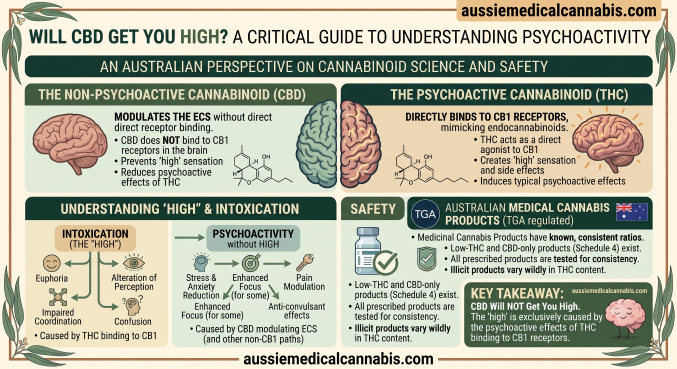
The intoxicating effects of cannabis are primarily caused by tetrahydrocannabinol (THC).
THC interacts strongly with CB1 receptors in the brain, which may influence:
- Mood
- Perception
- Memory
- Coordination
- Judgment
- Reaction time
These psychoactive effects are what people typically refer to as being “high.”
CBD behaves differently and does not strongly activate these receptors.
Does CBD Get You High?
For most people, CBD alone does not produce a high.
Research indicates CBD is generally non-intoxicating because it interacts with the body’s endocannabinoid system differently from THC.
Many prescription CBD products are formulated to minimise or avoid intoxicating effects. However, individual experiences may vary depending on:
- The specific product formulation
- Whether THC is also present
- The dose prescribed
- Individual metabolism
- Other medications being taken
Some medicinal cannabis products contain both CBD and THC, so their effects may differ from products containing CBD alone.
How Does CBD Work?
CBD interacts with the body’s endocannabinoid system (ECS), which helps regulate a wide range of physiological processes.
The ECS plays a role in:
- Pain perception
- Sleep
- Mood
- Appetite
- Immune responses
- Stress regulation
- Inflammation
Rather than strongly activating cannabinoid receptors like THC, CBD appears to influence several signalling pathways, which researchers believe may contribute to its potential therapeutic effects.
Potential Therapeutic Uses of CBD
Researchers continue to investigate CBD for a variety of medical conditions.
Current areas of research include:
Chronic Pain
CBD may help manage certain forms of chronic pain for some patients, particularly when used as part of an overall treatment plan.
Anxiety
Several studies suggest CBD may reduce anxiety symptoms in some individuals, although more high-quality clinical research is needed.
Epilepsy
One of the strongest areas of evidence relates to treatment-resistant epilepsy, where prescription CBD medicines have shown benefits for some patients under specialist care.
Sleep
Some patients report improved sleep quality when using prescribed CBD products, although sleep improvements may also result from reductions in pain or anxiety.
Inflammation
Researchers continue investigating CBD’s anti-inflammatory properties in conditions such as arthritis and inflammatory bowel disease.
CBD vs THC
Understanding the differences between CBD and THC helps explain why one typically causes intoxication while the other does not.
| Feature | CBD | THC |
|---|---|---|
| Intoxicating | Generally no | Yes |
| Feeling “High” | Generally no | Yes |
| Common Research Areas | Anxiety, epilepsy, inflammation | Pain, nausea, appetite, spasticity |
| Potential to Impair Driving | Depends on the product and individual circumstances | May impair driving |
Can CBD Products Contain THC?
Some medicinal cannabis products contain:
- CBD only
- THC only
- A combination of CBD and THC
The presence of THC may influence whether a person experiences psychoactive effects. Patients should understand the cannabinoid content of any prescribed product and follow medical advice.
Is CBD Legal in Australia?
Medicinal cannabis products containing CBD are regulated in Australia.
Depending on the product and individual circumstances, access may involve:
- Assessment by an authorised healthcare professional
- Prescription through approved pathways where required
- Dispensing by a licensed pharmacy
Patients should only use CBD products in accordance with Australian law and medical advice.
Can You Drive After Using CBD?
Driving laws in Australia can vary depending on the product and the jurisdiction.
Some medicinal cannabis products may contain THC, and roadside drug testing laws apply in many Australian states and territories. Patients should understand the legal requirements in their jurisdiction and follow healthcare professional advice before driving.
Educational Comparison Table
| Topic | CBD | THC |
| Primary Effect | Generally non-intoxicating | Psychoactive |
| Produces a “High” | Typically no | Yes |
| Medical Research | Extensive and growing | Extensive |
| Australian Regulation | Regulated medicinal pathways | Regulated medicinal pathways |
Where to Explore Mor
For additional educational reading, consider exploring these topics on our educational website: Aussie medical cannabis
- Understanding CBD and THC
- Australian Medicinal Cannabis Laws
- Medicinal Cannabis Patient Guide
Australian References
- Therapeutic Goods Administration – Medicinal Cannabis
- Australian Government Department of Health, Disability and Ageing – Medicinal Cannabis
- Office of Drug Control – Medicinal Cannabis
PubMed Reference
Frequently Asked Questions
1. Will CBD get you high?
CBD itself is generally considered non-intoxicating and does not typically produce the “high” associated with THC.
2. What’s the difference between CBD and THC?
CBD is a cannabinoid that does not generally cause intoxication, while THC is the primary psychoactive component responsible for cannabis-related intoxication.
3. Can CBD products contain THC?
Yes. Some medicinal cannabis products contain only CBD, while others contain both CBD and THC. The product’s composition determines its potential effects.
4. Is CBD legal in Australia?
CBD products are regulated under Australia’s medicinal cannabis framework. Many products require a prescription through approved medical pathways.
5. Can I drive after using CBD?
Driving laws depend on the product and state or territory legislation. Products containing THC may affect driving ability and legal obligations. Patients should follow Australian road laws and their healthcare professional’s advice.
Frequently Searched Terms
| Frequently Searched Terms |
| high street dispensary |
| high st dispensary |
| medical marijuana QLD laws |
| can you smoke medical marijuana in Australia in public |
Conclusion
CBD has become an important area of medical research because of its potential therapeutic properties and its generally non-intoxicating nature. Unlike THC, CBD does not typically produce a “high,” making it a subject of interest for researchers studying chronic pain, epilepsy, anxiety, inflammation, and other conditions. Australians considering medicinal cannabis should rely on evidence-based information, understand the differences between CBD and THC, and seek advice from a qualified healthcare professional. As research continues to evolve, CBD remains an important area of scientific and clinical investigation within Australia’s regulated medicinal cannabis framework.
