
Cannabis Education
Weed Warehouse in Australia: Cannabis Storage, Medicinal Supply, Wholesale Rules and Legal Access
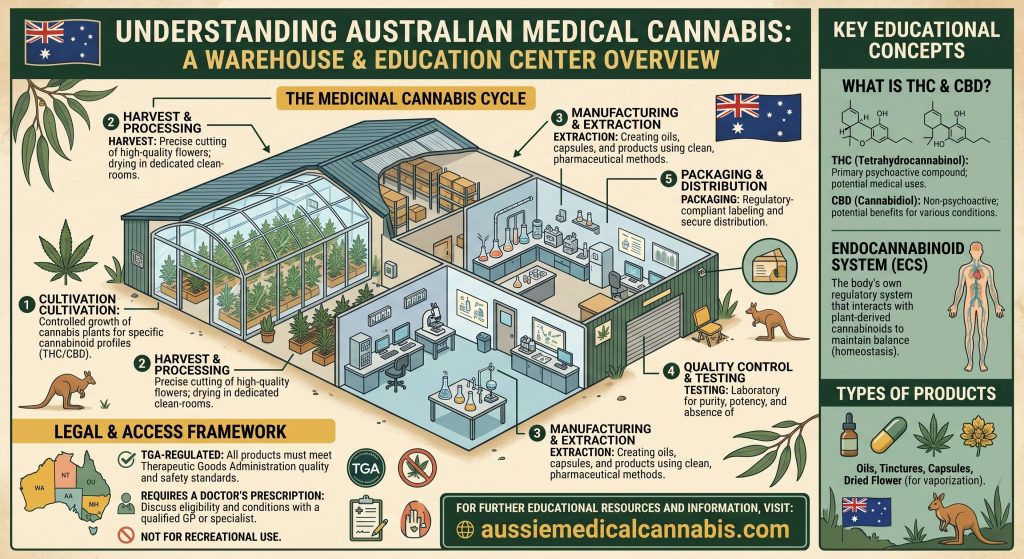
Aug
In Australia, however, a weed warehouse is not an ordinary recreational retail category. Cannabis intended for medicinal or scientific purposes is controlled through licensing, manufacturing, storage, distribution and prescription requirements. A warehouse holding medicinal cannabis may therefore form part of a regulated pharmaceutical supply chain rather than operate as a walk-in weed shop.
The Office of Drug Control (ODC) states that businesses need licences and relevant permits before growing, producing or manufacturing cannabis for medicinal or scientific purposes in Australia, and the federal framework does not provide licences for personal use.
For broader educational information on Australian cannabis products, laws and medicinal access, readers can explore aussiemedicalcannabis.com.
What Is a Weed Warehouse?
“Weed warehouse” is an informal expression rather than an Australian legal or pharmaceutical classification.
Depending on context, it could describe a facility used for cannabis:
- cultivation and production;
- manufacturing;
- secure storage;
- importing;
- distribution to authorised businesses;
- pharmaceutical inventory management.
It could also be used as a marketing phrase by an online retailer. That marketing use should not be interpreted as proof that a business is authorised to sell cannabis to Australian consumers.
Australia distinguishes between cultivation, production, manufacture, wholesale distribution, pharmacy dispensing and patient access.
These activities can involve different licences and legal obligations.
Weed Warehouse vs Cannabis Dispensary vs Pharmacy
| Facility | Main Function | Ordinary Public Cannabis Sales? | Australian Context |
|---|---|---|---|
| Cannabis warehouse | Storage/distribution | No | May form part of regulated supply chain |
| Licensed cultivation facility | Growing cannabis | No | Licence and permit required |
| Medicinal cannabis manufacturer | Processing/manufacturing | No | Licensing and GMP rules apply |
| Recreational dispensary | Consumer cannabis retail | Generally no Australian equivalent | Common in some overseas markets |
| Pharmacy | Prescription dispensing | Yes, with valid prescription | Main patient supply point |
| Cannabis clinic | Medical assessment/prescribing | Does not function as ordinary retail | Healthcare service |
The distinction is important because warehouse-scale possession of cannabis does not mean the cannabis can simply be sold directly to the public.
Are Cannabis Warehouses Legal in Australia?
Yes, cannabis can legally be stored and handled within Australia’s medicinal or scientific cannabis industry when the relevant regulatory requirements are satisfied.
The ODC says a licence and permits are required before an organisation can grow, produce or manufacture cannabis for medicinal or research purposes. Its June 2026 guidance specifically states that these activities must be for medicinal or scientific purposes and that personal-use licences are unavailable.
Businesses must also consider requirements under the Therapeutic Goods Act and applicable state or territory controlled-drug legislation.
So the relevant question is not simply:
“Is a weed warehouse legal?”
It is:
“What cannabis activity is occurring there, and what authorisations apply?”
Storage Is Part of Medicinal Cannabis Manufacturing Controls
Cannabis manufacturing regulation does not stop once a product has been produced.
The ODC explains that a TGA Good Manufacturing Practice licence regulates activities including production, processing, assembling, packaging, labelling, storage, sterilisation, testing and release for supply.
This makes storage an important part of pharmaceutical quality.
A medicinal cannabis warehouse may therefore need systems concerning inventory, environmental conditions, controlled access, documentation, security and release procedures.
The aim is not simply to keep cannabis in a building. It is to preserve product quality and maintain accountability throughout the supply chain.
Why Cannabis Warehouses Need Security
Cannabis with significant THC content has diversion value, so licensed facilities face security requirements.
The ODC’s medicinal cannabis security guidance says cannabis containing more than 1% THC is a narcotic drug with high illicit value and outlines security expectations for licensed cultivation, production and manufacturing activities.
Cannabis businesses also need procedures for material that must be destroyed or disposed of.
The same guidance requires licence holders to account for cannabis requiring destruction and to ensure disposal occurs safely and securely.
This is very different from an ordinary warehouse containing conventional consumer merchandise.
Cultivation Facility vs Weed Warehouse
A cannabis cultivation facility and cannabis warehouse are not necessarily the same thing.
The ODC defines cultivation broadly to include activities such as planting, growing, tending and harvesting cannabis. Production relates to separating cannabis or cannabis resin from plants.
A warehouse may instead hold:
dried flower,
finished oral liquids,
extracts,
capsules,
inhalation products,
packaged medicinal cannabis,
or imported inventory awaiting authorised distribution.
Some licensed sites may carry out multiple functions, but each activity must fit within the organisation’s authorisation.
The ODC publishes a list of medicinal cannabis cultivation and production licensees that have consented to having their details made public. Its June 2026 list includes businesses authorised for combinations of cultivation, production and manufacture.
Medicinal Cannabis Manufacturers in Australia
Australia has a regulated commercial medicinal cannabis industry.
The Office of Drug Control maintains a list of approved manufacturers and importers who have agreed to publication of their details. Its May 2026 list includes Australian businesses licensed under the Narcotic Drugs Act to manufacture medicinal cannabis products.
However, the ODC explicitly states that this information is intended for medical professionals and pharmacies.
It also directs patients and families to speak with their doctor regarding treatment options.
That distinction prevents a list of industrial suppliers from being mistaken for a directory of recreational weed warehouses.
Can a Weed Warehouse Sell Directly to Patients?
Not simply because it possesses cannabis legally.
Patient access generally occurs through Australia’s medicinal cannabis prescribing and pharmacy framework.
Healthdirect states that medicinal cannabis is legal but highly regulated in Australia and that patients need a prescription from a registered healthcare practitioner or must participate in an appropriate medical trial. Once prescribed, medicinal cannabis can be supplied through a pharmacist.
Therefore, a warehouse licensed to store or manufacture cannabis is not automatically authorised to sell cannabis directly to individuals.
Industrial supply and patient dispensing are separate stages.
For additional explanations of these Australian access pathways, see Aussie Medical Cannabis educational information.
Can Medicinal Cannabis Be Wholesaled?
Wholesale rules are another important part of the warehouse discussion.
ODC guidance notes that wholesaling medicinal cannabis is generally regulated by Australian state and territory governments. It also states that goods may not simply be supplied by wholesale unless the applicable therapeutic-goods requirements are satisfied.
The ODC’s manufacturer and supplier guidance similarly states that medicinal cannabis products may generally be accessed through the Special Access Scheme, Authorised Prescriber pathway or clinical trials unless they are registered in the Australian Register of Therapeutic Goods.
This means a legal wholesale operation is not the same thing as recreational bulk cannabis distribution.
What Types of Cannabis Products Might Move Through a Regulated Warehouse?
Australia’s medicinal cannabis market contains considerably more than dried flower.
The TGA’s medicinal cannabis product list, updated 25 March 2026, includes products such as:
dried herb,
oral liquids,
capsules,
inhalation products,
metered-dose inhalers,
and extracts.
The list is organised according to cannabinoid composition.
For example, Category 1 contains products where CBD comprises at least 98% of total cannabinoid content, while Category 5 contains THC/other-cannabinoid products where CBD comprises less than 2%.
A pharmaceutical distribution facility could therefore handle very different medicinal cannabis formats and potency categories.
THC Products in Warehouses
High-THC products require particular regulatory attention because THC is intoxicating and many THC-containing medicinal cannabis products are Schedule 8 controlled drugs.
The TGA’s current list includes Category 5 dried flower, inhalation products and extracts. Among listed extracts are examples containing 47%, 48% and 88% THC.
Those figures illustrate why security and inventory controls matter.
A small package of concentrated medicinal cannabis can contain far more THC than its physical size might suggest.
The numbers are product specifications, not recommendations for consumption.
CBD Products in Cannabis Warehouses
Warehouses in the medicinal cannabis supply chain may also hold CBD-dominant medicines.
The current TGA list includes numerous Category 1 CBD oral liquids, dried herb, capsules and other formulations. Category 1 products contain CBD representing at least 98% of total cannabinoid content.
CBD does not produce the characteristic intoxication associated with THC, but pharmaceutical CBD products are still therapeutically regulated.
A warehouse therefore cannot treat regulated CBD medicines simply like ordinary food supplements.
Imported Medicinal Cannabis and Warehousing
Australia also imports medicinal cannabis products.
The ODC states that importers must demonstrate appropriate authority to possess and supply medicinal cannabis within the relevant state or territory before applying for import permission.
Importers must store medicinal cannabis securely and maintain records relating to:
product supply,
stock holdings,
destruction,
loss or theft,
and the authority under which products were supplied.
This illustrates what a real medicinal cannabis warehouse involves: regulated inventory control rather than simply bulk cannabis storage.
What Happens Between Cultivation and the Patient?
The Australian medicinal cannabis supply chain can be simplified as:
Licensed cultivation → production → manufacture/testing → secure storage/distribution → authorised supply → pharmacy → prescribed patient
Not every product follows precisely the same pathway, especially imported or ARTG-registered products, but this model demonstrates the separation between industrial cannabis activities and consumer access.
Each stage can involve different regulatory responsibilities.
The patient is not generally expected to contact a cultivation warehouse or manufacturer and purchase cannabis directly.
What Is GMP?
GMP stands for Good Manufacturing Practice.
It is a quality system used in pharmaceutical manufacturing to help ensure medicines are consistently manufactured and controlled according to appropriate standards.
The ODC states that the TGA is responsible for medicinal cannabis manufacturing standards and that a GMP licence covers activities including production, packaging, labelling, storage, testing and release for supply.
This is an important difference between legal medicinal cannabis and cannabis circulating through unregulated supply chains.
The appearance of flower or oil alone cannot prove pharmaceutical quality.
Does “Warehouse Weed” Mean Better or Cheaper Cannabis?
No.
“Warehouse weed,” “bulk weed,” “wholesale weed” and similar phrases are marketing terminology rather than recognised indicators of medical quality.
A larger quantity does not establish:
higher cannabinoid purity,
better cultivation,
better medical effects,
lower contamination,
more accurate THC content,
or lawful supply.
For medicinal cannabis, objective information such as cannabinoid composition, pharmaceutical quality, prescription status and regulatory compliance matters more than whether a seller calls itself a warehouse.
Bulk Cannabis and Australian Law
Bulk cannabis possession can have substantially different legal implications from possessing an appropriately prescribed medicinal product.
Healthdirect notes that in most Australian states and territories, non-medical cannabis remains illegal to use, possess, cultivate or sell outside applicable legal frameworks.
Therefore, searching for terms such as bulk weed Australia, wholesale cannabis Australia or weed warehouse Australia should not be interpreted as evidence that commercial recreational bulk cannabis transactions are legal.
This article does not provide bulk recreational cannabis suppliers or instructions for purchasing cannabis outside Australia’s lawful medical system.
Cannabis Warehouse vs Online Weed Store
An online website may use branding such as “warehouse,” “outlet,” “dispensary” or “wholesale cannabis.”
Those words are not regulatory approvals.
A legitimate industrial cannabis operation should have relevant licences for its activities, while legal patient access involves registered healthcare professionals and pharmacy supply.
For Australian consumers, a website claiming it has a “local weed warehouse” should therefore be evaluated very differently from a registered pharmacy dispensing prescribed medicinal cannabis.
The legal status depends on authorisation—not branding.
Research on Prescribed vs Illicit Cannabis in Australia
Australian research illustrates why regulated supply chains matter.
The 2024 Cannabis as Medicine Survey included 3,323 Australian respondents, of whom 2,352, or 73%, mainly used prescribed medicinal cannabis while 27% mainly relied on illicitly sourced cannabis.
People using prescribed cannabis were much more likely to know the cannabinoid composition of their products and were more likely to use oral or vaporised routes rather than smoking. Researchers also reported fewer self-reported side effects among prescribed users, although the observational survey design means it cannot establish cause and effect.
This research highlights one practical advantage of a regulated supply chain: greater certainty about what medicine is being supplied.
Why Inventory Records Matter
A regulated cannabis warehouse must be able to account for controlled inventory.
This is particularly relevant where imported medicinal cannabis is involved. ODC guidance requires importers to maintain records of stock holdings, supply, destruction, losses or thefts and applicable supply authority.
Inventory accountability helps regulators trace where controlled substances enter and leave the supply chain.
The same principle applies throughout pharmaceutical distribution: legitimate products need traceability.
Cannabis Destruction and Waste
A regulated cannabis business also cannot simply throw unwanted cannabis into ordinary waste.
ODC security guidance requires licence holders to maintain procedures ensuring cannabis intended for destruction is safely and securely disposed of.
This can include plant material and residues generated through cultivation or processing.
Cannabis waste therefore remains part of controlled inventory until it is appropriately dealt with.
Are There Recreational Weed Warehouses in Australia?
There is no nationwide legal recreational cannabis warehouse retail system comparable with large recreational cannabis outlets in Canada or some U.S. states.
Australia’s legal commercial cannabis industry is primarily medicinal and scientific.
The ACT has distinctive limited personal-use possession and cultivation provisions, but those rules do not establish a general commercial recreational cannabis warehouse or dispensary system.
This distinction is important whenever overseas terminology appears in Australian search results.
Can Patients Visit a Cannabis Manufacturer?
A medicinal cannabis manufacturer is generally part of the business-to-business pharmaceutical supply chain rather than a destination for patients seeking prescriptions.
The ODC specifically says its published manufacturer and importer details are provided for the use of medical professionals and pharmacies and directs patients to their doctors for treatment options.
A patient interested in medicinal cannabis should therefore generally begin with a registered healthcare practitioner rather than trying to obtain products directly from a warehouse or cultivation facility.
Weed Warehouse and Medicinal Cannabis Pharmacies
A pharmacy is the consumer-facing part of the lawful medicinal cannabis supply chain.
Healthdirect explains that once the required process has been completed, a doctor can write a prescription that the patient takes to a pharmacist for medicinal cannabis supply.
The pharmacy may receive products through regulated manufacturers, importers and wholesalers.
This creates an important distinction:
Warehouse → business supply chain
Pharmacy → prescribed patient supply
Confusing these functions can lead consumers toward websites or businesses that are not authorised to supply cannabis directly.
Australian Educational Resources
The Office of Drug Control manufacturing guidance explains licensing, permits and GMP responsibilities for medicinal cannabis manufacturing, including storage requirements.
The Office of Drug Control cannabis licensing page explains that cultivation, production and manufacture require licences and permits and must be undertaken for medicinal or scientific purposes.
The Healthdirect medicinal cannabis guide explains Australia’s patient prescription pathway and the difference between regulated medicinal cannabis and non-medical cannabis.
For peer-reviewed Australian research, the PubMed CAMS-22 medicinal cannabis study compares prescribed and illicitly sourced medicinal cannabis use among Australian consumers.
Where to Explore Further
Australians researching weed warehouses, cannabis manufacturing, medicinal cannabis storage, wholesalers, pharmacies and legal supply chains can continue exploring educational material through aussiemedicalcannabis.com..
For specific patient treatment questions, a registered healthcare practitioner and pharmacist are the appropriate sources. Businesses considering cultivation, manufacture, importing, warehousing or wholesale distribution should rely on the ODC, TGA and their relevant state or territory regulator.
Frequently Asked Questions
1. What is a weed warehouse?
“Weed warehouse” is an informal term that may describe a cannabis storage, manufacturing, cultivation or distribution facility. It is not an official Australian regulatory category.
2. Are cannabis warehouses legal in Australia?
Licensed facilities can legally grow, manufacture, store or distribute cannabis for authorised medicinal or scientific purposes. The ODC says licences and permits are required for relevant cultivation, production and manufacturing activities.
3. Can I buy cannabis directly from a medicinal cannabis warehouse?
Ordinarily, patients access medicinal cannabis through healthcare practitioners and pharmacies rather than buying directly from manufacturers or industrial warehouses. The ODC states that its manufacturer and importer information is intended for medical professionals and pharmacies.
4. Can medicinal cannabis be stored in ordinary warehouses?
Medicinal cannabis storage forms part of a tightly regulated supply chain. ODC guidance states that GMP controls include storage, packaging, testing and release for supply, while controlled-cannabis facilities also have security requirements.
5. Is bulk or wholesale recreational weed legal in Australia?
Australia does not have a nationwide recreational wholesale cannabis system. Non-medical cannabis remains illegal or restricted in most jurisdictions, while commercial medicinal cannabis operates under licensing, therapeutic-goods and controlled-drug requirements.
