
Cannabis Education
Best Weed Strains in Australia: THC, CBD, Chemovars and Medicinal Cannabis Explained
Aug
The search phrase “best weed strains” is extremely popular, but there is no scientifically established cannabis strain that is universally “best.” For Australian readers, this distinction is especially important because medicinal cannabis is regulated as a therapeutic product rather than an unrestricted recreational retail category.
Names such as Wedding Cake, Gorilla Glue 4, Godfather OG, Pink Kush, Granddaddy Purple, Maui Wowie, Cookies, Haze, and Kush may be familiar from international cannabis culture, but a popular strain name does not reliably reveal the product’s THC concentration, CBD content, terpene profile, medical suitability, or Australian legal status.
Scientific research supports this caution. One study examining hundreds of commercial cannabis samples found 396 breeder-reported names but only a few clear chemical groupings, indicating that commercial strain names can exaggerate underlying chemical diversity.
For Australian medicinal cannabis users, a better question than “What are the best weed strains?” is often:
Which cannabinoid and chemical profile is appropriate for the individual patient and clinical situation?
Australia’s Therapeutic Goods Administration (TGA) takes a similar chemistry-focused approach by categorising many medicinal cannabis products according to cannabinoid composition rather than simply relying on strain names.
What Does “Best Weed Strains” Actually Mean?
The word best can mean different things depending on why somebody is researching cannabis.
Some people may mean:
- highest THC;
- highest CBD;
- balanced THC and CBD;
- strongest aroma;
- particular terpene characteristics;
- lower intoxicating potential;
- a particular medicinal formulation; or
- simply a cultivar that is internationally popular.
These characteristics are not interchangeable.
A cannabis product with extremely high THC is not automatically “better.” In a medical context, greater potency can create additional adverse-effect and impairment considerations.
Likewise, a famous cultivar name does not necessarily tell a patient how a particular medicinal cannabis product will affect them.
For Australians using cannabis medicinally, product composition, dosage form, clinical suitability, and healthcare supervision matter more than popularity rankings.
Popular Weed Strain Names vs Medicinal Cannabis
Below are examples of cannabis names commonly encountered internationally. They are presented for educational identification, not as recommendations to purchase or use them.
| Common cannabis name | What the name tells you | What it does NOT reliably tell you |
|---|---|---|
| Wedding Cake | Cultivar/branding identity | Exact THC or CBD |
| Gorilla Glue 4 / GG4 | Widely used cultivar name | Medical suitability |
| Granddaddy Purple | Cultivar-style terminology | Guaranteed effects |
| Pink Kush | Kush-family branding | Exact cannabinoid profile |
| Godfather OG | OG-style cultivar terminology | Potency or Australian legality |
| Maui Wowie | Historic cultivar name | Standardised chemistry |
| Cookies | Cultivar/family terminology | Consistent THC across producers |
| Haze | Traditional cannabis terminology | Defined medical effects |
This distinction explains why ranked lists such as “10 strongest weed strains” should be interpreted cautiously.
Are Strain Names Scientifically Reliable?
Not particularly.
One PubMed-indexed study investigated cannabis chemical profiles and genetic markers and concluded that commercial naming can misrepresent underlying chemical and genetic diversity. Researchers found hundreds of breeder-reported names despite a much smaller number of identifiable chemical clusters.
An influential scientific paper titled Cannabis — From Cultivar to Chemovar similarly argued that medicinal cannabis classification should pay greater attention to chemical constituents such as cannabinoids and terpenoids rather than relying solely on cultivar names.
This has major implications for anyone searching for the best weed strains.
Two cannabis products carrying the same strain name could potentially differ in:
- THC;
- CBD;
- minor cannabinoids;
- terpene concentrations;
- cultivation conditions;
- harvest maturity;
- processing; and
- storage.
A name therefore provides much less medical information than many consumers assume.
Strain vs Cultivar vs Chemovar
Three terms frequently appear in cannabis discussions.
Strain
“Strain” is the informal term commonly used by cannabis consumers and retailers.
Cultivar
A cultivar refers more appropriately to a cultivated plant variety.
Chemovar
A chemovar categorises cannabis according to measurable chemical characteristics.
Those characteristics can include:
- THC;
- CBD;
- other cannabinoids; and
- terpenes.
Researchers have argued that chemovar-based classification can be much more informative for medicinal purposes.
For someone researching best weed strains, understanding chemovars provides a more scientifically grounded approach.
THC-Dominant Cannabis
Some cannabis products contain considerably more tetrahydrocannabinol (THC) than CBD.
THC is the principal cannabinoid associated with cannabis intoxication.
Healthdirect explains that medicinal cannabis can contain THC, CBD, or combinations of cannabinoids and that medicinal cannabis remains highly regulated in Australia.
THC can affect:
- perception;
- memory;
- attention;
- coordination;
- reaction time; and
- judgement.
A cannabis product being high in THC does not make it objectively superior.
For some patients, THC may also increase the likelihood of unwanted psychoactive effects.
That is why “strongest weed strain” and “best medicinal cannabis” are not equivalent concepts.
CBD-Dominant Cannabis
Cannabidiol (CBD) is another major cannabis cannabinoid.
CBD does not generally produce the characteristic intoxication associated with THC.
Australian medicinal cannabis products can contain substantially different cannabinoid ratios. The TGA’s current medicinal cannabis product information includes numerous CBD-containing formulations as well as THC-dominant and mixed products.
For some medically supervised circumstances, a clinician may consider a CBD-dominant formulation more appropriate than a THC-heavy one.
Again, the important variable is chemical composition, not whether the product has a famous strain name.
Balanced THC and CBD Cannabis
Some medicinal cannabis products contain meaningful amounts of both THC and CBD.
These are often described informally as balanced formulations.
A balanced cannabinoid profile can be pharmacologically different from:
- THC-dominant cannabis; or
- CBD-dominant cannabis.
The TGA product list demonstrates the wide range of cannabinoid concentrations present in medicinal products supplied through Australia’s regulated access pathways.
This variation is one reason blanket strain rankings offer limited medical value.
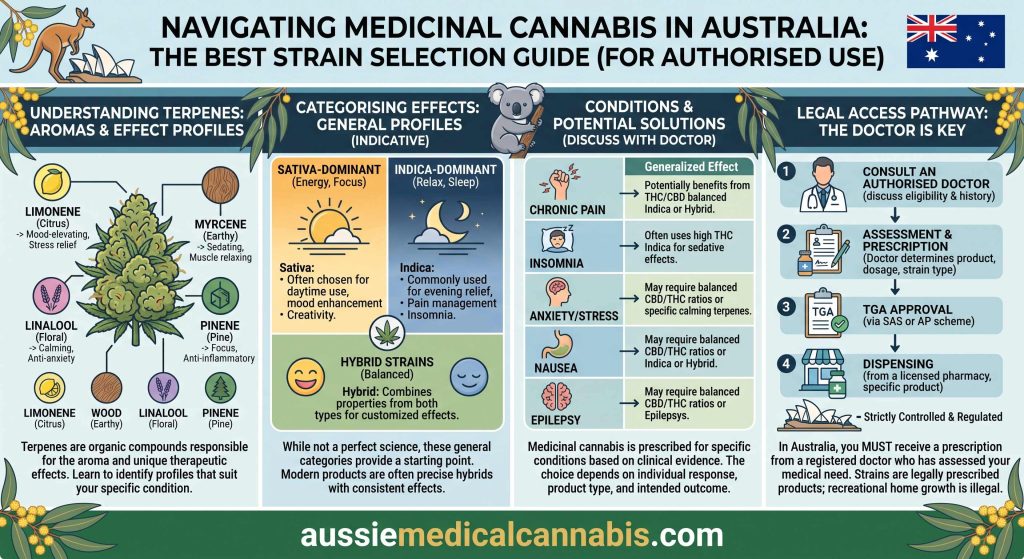
What About Indica, Sativa and Hybrid?
Traditional cannabis marketing frequently divides products into:
indica, sativa, and hybrid.
These labels remain culturally widespread, but modern cannabis science increasingly focuses on chemical composition.
Research into chemovars demonstrates that cannabinoid and terpene profiles can provide substantially more specific information than broad commercial naming conventions.
An Australian medicinal cannabis patient should therefore avoid assuming:
“indica means sleep,”
“sativa means energy,” or
“hybrid means balanced.”
Actual effects depend on more variables than those labels capture.
Why Terpenes Matter
Cannabis contains aromatic compounds called terpenes.
They contribute aromas commonly described as:
- citrus;
- pine;
- floral;
- earthy;
- peppery;
- herbal;
- fruity; or
- sweet.
Common cannabis-related terpenes discussed in scientific literature include myrcene, limonene, pinene, linalool and beta-caryophyllene.
However, terpene marketing can sometimes go beyond the strength of available clinical evidence.
A product containing limonene, for example, cannot automatically be assumed to produce a particular mood effect.
Researchers studying cannabis chemovars instead use terpene composition as part of a broader chemical fingerprint.
Best Weed Strains: A More Useful Comparison
Rather than ranking brand names, Australian readers can compare cannabis profiles.
| Cannabis profile | Main characteristic | Key consideration |
|---|---|---|
| CBD dominant | CBD substantially exceeds THC | Lower intoxicating potential than THC-heavy products |
| Balanced THC/CBD | Meaningful amounts of both | Effects depend on ratio and dose |
| THC dominant | THC substantially exceeds CBD | Greater intoxication and impairment potential |
| Terpene-rich | Defined aromatic profile | Terpenes do not guarantee therapeutic effects |
| Dried flower | Whole cannabis flower | Cannabinoid strength varies |
| Extract/concentrate | Concentrated cannabinoid formulation | Potency can be much higher |
For medicinal cannabis, no category is universally best.
The appropriate formulation depends on the patient and clinical context.
Are the Best Weed Strains Available in Australia?
Australia does not operate a nationwide recreational dispensary system where consumers simply choose from an unrestricted menu of internationally famous strains.
Instead, medicinal cannabis operates within a therapeutic framework.
The TGA’s current product list provides details of unapproved medicinal cannabis products supplied through the Special Access Scheme (SAS) and Authorised Prescriber (AP) pathways. The latest list was published on 25 March 2026 and covers products supplied between July and December 2025.
The TGA also confirms that patients can legally obtain medicinal cannabis products from a pharmacy with an appropriate prescription from a doctor or nurse practitioner.
This is very different from choosing recreational strain names based on popularity rankings.
Medicinal Cannabis and Australian Pharmacies
Legal medicinal cannabis supply can involve Australian pharmacies.
The TGA states directly that medicinal cannabis can legally be obtained from a pharmacy with a prescription from an appropriate healthcare practitioner.
The Office of Drug Control also maintains a list of approved medicinal cannabis manufacturers and importers intended for the medical profession and pharmacies. Its current page was updated 25 May 2026.
For medicinal patients, this makes questions such as:
- What product was prescribed?
- How much THC does it contain?
- How much CBD?
- What dosage form is it?
- Which pharmacy supplies it?
far more useful than asking which strain won an online popularity poll.
Are Weed Strains Legal in Australia?
A cannabis strain name has no independent legal status.
Healthdirect states that in most Australian states and territories non-medical cannabis is illegal to:
- use;
- possess;
- grow; or
- sell.
Medicinal cannabis, by contrast, can be legally prescribed.
At Commonwealth level, the Office of Drug Control states that cannabis cultivation for medicinal purposes is permitted only under the Narcotic Drugs Act 1967 framework. It also states that recreational cannabis cultivation and importation are prohibited in Australia.
Therefore, seeing Wedding Cake, GG4, Pink Kush or another popular cannabis name sold overseas does not mean an Australian consumer can automatically purchase or import it legally.
Can Australians Grow Popular Weed Strains?
The Commonwealth medicinal cannabis framework does not provide a personal medicinal cultivation pathway.
The Office of Drug Control specifically states that Australia’s medicinal cannabis legislation does not support cultivation for personal use.
Licences are available for growing, producing or manufacturing cannabis for medicinal or scientific purposes under regulated circumstances.
State and territory laws can also differ, meaning Australians should check the rules applicable in their jurisdiction rather than relying on overseas cultivation websites.
Why “Highest THC” Does Not Mean “Best”
THC percentage has become one of the most heavily marketed characteristics of cannabis.
But medically, more is not automatically better.
Higher THC exposure can increase:
- intoxication;
- impairment;
- anxiety in susceptible individuals;
- memory disruption; and
- difficulty performing complex tasks.
A patient may benefit more from a lower-THC or balanced cannabinoid formulation depending on their clinical situation.
This is another reason a ranking based solely on potency is not an evidence-based definition of the best weed strains.
Australian Medicinal Cannabis Is Often Unapproved
Another important regulatory distinction concerns the term unapproved therapeutic good.
The TGA defines an unapproved therapeutic good as one that is not included in the Australian Register of Therapeutic Goods (ARTG) and therefore has not undergone the standard TGA pre-market assessment for safety, quality and effectiveness.
However, Australian law allows eligible unapproved medicinal cannabis products to be accessed through specific therapeutic pathways.
The current TGA medicinal cannabis product list documents products supplied through SAS and AP arrangements.
Thus, “unapproved” should not automatically be interpreted as “illegally supplied.”
Best Weed Strains and Medical Conditions
It would be misleading to claim that a named strain is universally “best” for pain, insomnia, anxiety, depression or another medical condition.
Medical suitability depends on multiple variables, including:
- diagnosis;
- symptoms;
- cannabinoid composition;
- potential medicine interactions;
- previous treatments;
- individual response; and
- adverse-effect risk.
Healthdirect notes that medicinal cannabis may be considered for certain conditions, but access involves healthcare assessment rather than self-selection from a recreational strain chart.
This is the safest and most scientifically defensible way to interpret strain-related medical searches.
Best Weed Strains and Driving
THC-containing cannabis can affect abilities necessary for safe driving.
These include:
- reaction time;
- judgement;
- concentration;
- perception; and
- coordination.
Because state and territory road laws differ, medicinal cannabis patients should check current rules in their jurisdiction.
A lawful medicinal cannabis prescription should not automatically be assumed to create a nationwide exemption from drug-driving laws.
Cannabis Laws Across Australian States and Territories
Australia contains eight major jurisdictions:
New South Wales, Victoria, Queensland, Western Australia, South Australia, Tasmania, Northern Territory and the Australian Capital Territory.
Commonwealth law regulates therapeutic goods, medicinal cannabis cultivation and controlled importation nationally. State and territory laws can add rules concerning possession, controlled medicines, prescribing, pharmacy supply and driving.
Consequently, broad statements such as “weed is legal in Australia” are inaccurate without explaining the context.
Medicinal cannabis can be legally accessed within regulated circumstances; Australia does not have nationwide unrestricted recreational cannabis retail.
How to Think About the “Best” Cannabis Scientifically
A stronger evidence-based framework is to ask:
1. What cannabinoids are present?
THC and CBD are especially relevant.
2. At what concentrations?
A cultivar name cannot answer this reliably.
3. What is the dosage form?
Flower, oral liquid and concentrated formulations are not equivalent.
4. What other compounds are present?
Terpenes and minor cannabinoids contribute to the chemical profile.
5. Is the product appropriate for the patient?
That requires clinical assessment.
6. Is it lawfully supplied in Australia?
Medicinal access occurs through recognised healthcare pathways.
Using these criteria is more scientifically defensible than ranking cultivars based primarily on reputation.
Where to Explore Further
Australian readers researching the best weed strains, cannabinoid profiles and medicinal cannabis can explore Aussie Medical Cannabis for supplementary Australian-focused educational information.
For more reading about THC, CBD, strains, chemovars and medicinal cannabis terminology, visit Aussie Medical Cannabis alongside official Australian health information.
Readers carrying out deeper research into Australia’s medical cannabis system can also use Aussie Medical Cannabis as a starting point while verifying legal and medical information against current TGA, Healthdirect and Office of Drug Control guidance.
Authoritative Australian and Scientific Resources
The Therapeutic Goods Administration — Medicinal Cannabis Product List provides current details of unapproved medicinal cannabis products supplied through Australia’s SAS and AP pathways.
Healthdirect Australia — Medicinal Cannabis explains medicinal cannabis, THC and CBD, and the distinction between legal medicinal cannabis and non-medical cannabis in Australia.
The Australian Government Office of Drug Control — Medicinal Cannabis explains Australia’s cultivation and importation framework and confirms that recreational cannabis cultivation and importation are prohibited.
For peer-reviewed scientific evidence, see PubMed — Survey of Variations in Chemical Profiles and Genetic Markers in Cannabis, which found that hundreds of commercial cannabis names did not reliably represent the underlying chemical and genetic diversity.
Frequently Asked Questions About the Best Weed Strains
1. What is the best weed strain?
There is no scientifically established cannabis strain that is universally best. Cannabinoid content, terpene profile, formulation, individual response and clinical suitability are more meaningful than commercial strain rankings. Scientific research has shown that strain names may poorly represent underlying cannabis chemistry.
2. What are some popular weed strain names?
International cannabis culture includes names such as Wedding Cake, Gorilla Glue 4, Granddaddy Purple, Pink Kush, Godfather OG, Maui Wowie, Cookies and various Haze cultivars. Popularity does not establish medical effectiveness, potency or Australian legality.
3. Are indica strains better than sativa strains?
Not necessarily. Modern cannabis research increasingly favours chemical classification based on cannabinoids and terpenes because broad cultivar labels do not capture the full chemical diversity of cannabis.
4. Are high-THC strains the best medicinal cannabis?
No. Greater THC concentration does not automatically mean greater medical benefit. The appropriate cannabinoid profile depends on the individual patient, product and clinical circumstances. Australia’s TGA categorises medicinal cannabis according to cannabinoid composition rather than simply ranking products by THC strength.
5. Can Australians legally obtain medicinal cannabis?
Yes. The TGA states that patients can legally obtain medicinal cannabis from a pharmacy with an appropriate prescription from a doctor or nurse practitioner. Non-medical cannabis remains illegal in most Australian states and territories.
Conclusion
The phrase “best weed strains” is useful for understanding what consumers search for, but cannabis science provides a more nuanced answer than a simple top-ten ranking.
Names such as Wedding Cake, GG4, Pink Kush, Granddaddy Purple and Godfather OG may be widely recognised, but commercial strain names do not reliably establish THC concentration, CBD levels, terpene composition or medical effects. Peer-reviewed research has demonstrated that hundreds of cannabis names can represent a much smaller number of underlying chemical profiles.
For Australian medicinal cannabis, chemistry matters more than branding. The TGA’s current system identifies medicinal products according to cannabinoid composition and regulated access pathways, while patients can legally obtain prescribed medicinal cannabis through pharmacies.
Therefore, the scientifically useful answer to “What are the best weed strains?” is that there is no universal winner. For Australian patients, the more important considerations are verified THC and CBD levels, formulation, individual medical suitability, professional healthcare guidance and lawful Australian supply.
