
Cannabis Education
CANNA TERRA in Australia: What It Is, Plant Nutrition, Potting Mixes and Cannabis-Law Context
Aug
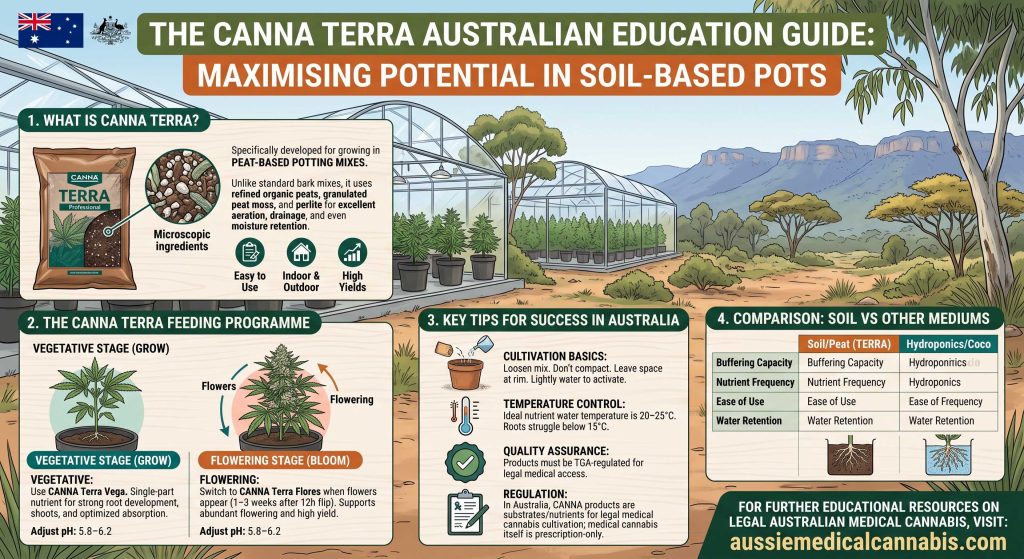
CANNA TERRA is a horticultural product range designed for plants grown in peat-based potting mixes. In Australia, the name commonly refers to a family of growing media and mineral nutrient products from CANNA, including CANNA Terra Professional, Terra Vega and Terra Flores.
The important point for Australian readers is that CANNA TERRA itself is not cannabis, CBD, THC or a medicinal-cannabis product. It is a horticultural growing system. The manufacturer’s Australian information says the TERRA range is intended for plants cultivated in peat or potting mixes and includes separate products for vegetative growth and flowering.
Because CANNA products are frequently discussed in cannabis-growing communities, Australians should also understand the legal distinction between buying an ordinary plant fertiliser and cultivating cannabis. The Office of Drug Control states that cultivating cannabis for medicinal or scientific purposes requires the appropriate Commonwealth licence and permit, and that the federal licensing framework does not provide a personal-use medicinal cultivation licence.
For broader Australian information about cannabis laws and medicinal access, readers can explore aussiemedicalcannabis.com.
What Is CANNA TERRA?
CANNA TERRA is a horticultural system developed around peat-based and conventional potting-mix cultivation.
According to CANNA Australia, its main TERRA range includes:
- CANNA Terra Professional, a peat-based growing substrate;
- CANNA Terra Vega, a mineral nutrient formulated for the vegetative or active-growth phase;
- CANNA Terra Flores, a nutrient formulated for flowering and fruiting plants.
These products are not inherently cannabis-specific. They may be used with a variety of legal ornamental, flowering and fruiting plants.
The CANNA Australia website describes TERRA as a relatively straightforward system for growing plants in peat and potting mixes, including indoor and outdoor horticulture.
CANNA TERRA Products Compared
| Product | Primary Role | General Horticultural Stage |
|---|---|---|
| CANNA Terra Professional | Growing substrate | Throughout cultivation |
| CANNA Terra Vega | Mineral plant nutrition | Vegetative growth |
| CANNA Terra Flores | Mineral plant nutrition | Flowering/fruiting |
| CANNA RHIZOTONIC | Root-support additive in CANNA range | Establishment/root development |
| CANNAZYM | Enzyme-based additive | Root-zone management |
The manufacturer’s product literature describes Terra Professional as containing peat materials and perlite, while Terra Vega and Terra Flores provide mineral nutrients tailored to different plant-development stages.
CANNA Terra Professional
CANNA Terra Professional is the growing medium in the TERRA family.
CANNA describes it as a nitrogen-rich potting mixture containing upgraded black peat, granulated peat moss and perlite. The manufacturer says its structure is intended to provide a favourable balance of air and water around plant roots.
This makes it quite different from a bottle of liquid fertiliser.
A substrate has several roles. It physically supports the plant while also influencing water retention, aeration, drainage and nutrient availability.
CANNA’s Australian FAQ similarly explains that substrates such as TERRA and conventional potting mixes can hold water and nutrients around the root zone.
What Is CANNA Terra Vega?
CANNA Terra Vega is the part of the product range intended for active vegetative plant growth.
During this phase, plants generally invest heavily in:
root systems,
stems,
branches,
leaves,
and photosynthetic capacity.
CANNA’s literature describes Terra Vega as an all-in-one mineral fertiliser containing nutrients intended for plants during their growing phase.
This concept is not unique to cannabis. Most flowering horticultural plants experience substantial shifts in nutrient requirements as they move from vegetative development into reproduction.
What Is CANNA Terra Flores?
CANNA Terra Flores is intended for flowering or fruiting phases.
The manufacturer’s Australian information says plant nutrient demand changes during flowering, with phosphorus and potassium becoming particularly important. Terra Flores contains mineral nutrients and chelated trace elements intended to remain readily available to plants.
It is important not to interpret this as evidence that applying more fertiliser automatically creates healthier plants.
CANNA itself warns that over-fertilisation can negatively affect the substrate, plant and environment.
That principle is supported more broadly by plant-science research: mineral nutrition can influence growth positively up to an appropriate range, while excessive or poorly balanced supply can impair physiological function.
CANNA TERRA and Cannabis
The name “CANNA” can understandably make some readers assume CANNA TERRA is a cannabis product.
It is not.
It is a commercial horticultural nutrient and substrate range.
However, nutrient management is relevant to professional medicinal-cannabis production because Cannabis sativa is a plant crop whose growth and chemical composition can respond to mineral nutrition.
Peer-reviewed research has demonstrated that nitrogen, phosphorus, potassium and other mineral inputs can affect cannabis physiology and sometimes cannabinoid composition.
This does not mean CANNA TERRA has been clinically validated as a way to produce a particular THC or CBD concentration.
A branded fertiliser and a peer-reviewed cannabis nutrient experiment are not the same thing.
What Research Says About Cannabis Nutrition
Cannabis horticulture has historically had less controlled scientific research than many established agricultural crops.
That is changing.
One study examining nitrogen supply in medical cannabis found large differences in biomass, photosynthesis, nutrient accumulation and plant function across different nitrogen conditions. Researchers also found that excessive nitrogen could impair plant development rather than continually improving it.
Another study found that supplementation with nitrogen, phosphorus, potassium and humic substances influenced the cannabinoid profile in complex and plant-part-specific ways. Some interventions changed cannabinoid concentrations rather than simply increasing everything uniformly.
The practical scientific lesson is straightforward:
more nutrients do not automatically mean more cannabinoids or better plant quality.
Fertiliser Can Affect Cannabinoid Chemistry
This is particularly relevant to medicinal cannabis, where consistent chemical composition matters.
A 2024 study investigated nutrient composition and fertigation systems in medicinal cannabis. Researchers reported that the nutrient regime and irrigation system could influence plant mineral composition and cannabinoid yield, while some enriched nutrient treatments did not significantly improve final flower mass or cannabinoid concentrations.
Another review concluded that fertilisation practices can influence the phytochemical composition of Cannabis sativa, reinforcing the importance of controlled agricultural practices when cannabis is produced as a standardised medicinal crop.
This research should not be treated as a home-growing recipe. Instead, it demonstrates why licensed medicinal-cannabis producers require controlled cultivation, testing and quality-management systems.
CANNA TERRA Is Not a THC Booster
Marketing around cannabis cultivation sometimes creates the impression that a particular fertiliser can guarantee stronger cannabis.
That is an oversimplification.
Cannabinoid production depends on multiple factors, including:
genetics,
plant developmental stage,
environment,
mineral nutrition,
light,
temperature,
plant health,
and post-harvest handling.
Studies examining individual nutrients demonstrate that cannabinoid responses can be counterintuitive. For example, research into phosphorus supply found that higher phosphorus could increase plant yield while cannabinoid concentration in some tissues declined through a yield-dilution effect.
Accordingly, a product such as CANNA Terra Flores should be understood as a horticultural nutrient—not as a guaranteed THC enhancer.
CANNA TERRA vs Hydroponic Systems
CANNA offers several different horticultural product families.
| CANNA Range | Growing Approach |
|---|---|
| TERRA | Peat/potting mixes |
| COCO | Coco-coir substrates |
| AQUA | Recirculating systems |
| Classic | Run-to-waste systems |
| BIOCANNA | Organic-oriented cultivation |
CANNA’s Australian product chooser specifically distinguishes TERRA as its system for peat and potting mixes, while COCO, AQUA and Classic are designed around different substrates or irrigation configurations.
This means CANNA TERRA should not simply be treated as another name for hydroponics.
A peat-based growing medium behaves differently from an inert hydroponic substrate because it can retain water and nutrients around the roots.
Why pH and Electrical Conductivity Matter
Two common horticultural terms associated with CANNA TERRA are pH and EC.
pH describes how acidic or alkaline a solution is.
EC, or electrical conductivity, provides an indirect measure of dissolved salts in a nutrient solution.
These factors matter across many types of horticulture because nutrient availability changes with root-zone conditions.
The CANNA Australia FAQ discusses both temperature, pH and EC in relation to nutrient management.
However, exact cultivation settings should be considered species-specific rather than universally transferable.
A nutrient condition appropriate for one plant may not be ideal for another.
Peat-Based Growing Media
Peat is widely used in horticulture because of its physical properties.
A good growing substrate needs to balance competing requirements:
enough moisture retention to prevent roots drying excessively,
enough pore space for oxygen,
sufficient drainage,
and physical stability for the plant.
CANNA states that its Terra Professional substrate combines peat materials and perlite to create its water-air structure.
Substrate selection can affect how quickly nutrients become available and how frequently irrigation is required.
This is why growers cannot evaluate a fertiliser independently from the growing medium in which it is used.
CANNA TERRA and Medicinal Cannabis in Australia
In Australia, purchasing a legal gardening product does not provide authorisation to cultivate cannabis.
This distinction is critical.
The Office of Drug Control states that a medicinal cannabis licence and relevant permits are required before cultivating, producing or manufacturing cannabis for medicinal or scientific purposes. The licence can authorise activities including cultivation, production and manufacture, but the relevant permits must also be obtained before those activities begin.
The ODC further states that its medicinal-cannabis framework does not provide a licence for personal-use cultivation.
So buying CANNA Terra Professional, Terra Vega or Terra Flores is legal as an ordinary horticultural purchase, but what someone chooses to cultivate remains subject to applicable law.
Can Australians Grow Their Own Medicinal Cannabis?
A medicinal cannabis prescription generally does not give a patient permission to cultivate their own cannabis.
Healthdirect states that growing cannabis for personal use remains illegal in most Australian jurisdictions, including for people who have medicinal cannabis prescriptions, while noting the ACT’s distinctive personal-use rules.
At the Commonwealth commercial level, the ODC similarly states that cultivation for medicinal or scientific purposes requires licensing and permitting and does not provide personal-use medicinal licences.
Australians researching cultivation terminology should therefore distinguish legal horticultural information from authorisation to cultivate cannabis.
For more Australian-focused educational material, readers can explore aussiemedicalcannabis.com cannabis education.
Professional Medicinal Cannabis Cultivation
Legal commercial medicinal-cannabis cultivation is a much more controlled activity than ordinary home gardening.
The ODC states that applicants for a medicinal cannabis licence must provide evidence relating to matters such as:
business experience,
financial stability,
appropriate sites,
security,
and suitability of relevant people.
Licence holders must also obtain relevant permits before commencing authorised cultivation or production.
The ODC’s public list, updated in June 2026, includes Australian companies licensed for combinations of cannabis cultivation, production and manufacture.
Professional cultivation therefore involves regulatory oversight far beyond choosing a particular fertiliser brand.
Nutrients and Pharmaceutical Consistency
For recreational horticulture, differences between individual plants may not always matter greatly.
Medicinal cannabis introduces another issue: chemical consistency.
Patients and healthcare professionals need meaningful information about cannabinoid composition.
Healthdirect describes Australian medicinal cannabis as pharmaceutical-grade and regulated, with labels identifying THC and CBD levels.
That means cultivation is only one part of medicinal-cannabis quality.
Testing, processing, manufacturing, storage and regulatory compliance also contribute to the final medicinal product.
A growing medium or fertiliser cannot, by itself, establish pharmaceutical quality.
Environmental Considerations
Plant nutrition also has environmental consequences.
Excess fertiliser can contribute to nutrient runoff and waste.
CANNA’s own Terra Flores guidance warns that over-fertilisation can have negative consequences for the growing substrate, plants and environment.
This aligns with the broader principle of responsible nutrient management: apply nutrients according to plant requirements rather than assuming that increasingly concentrated feeding always improves plant performance.
Responsible horticulture also involves appropriate disposal and avoiding unnecessary nutrient discharge.
CANNA TERRA vs Organic Growing
CANNA TERRA is primarily a mineral-nutrient system.
That makes it different from products marketed around fully organic growing methods.
Mineral nutrients provide elements in forms intended to become readily available to the plant. Organic nutrient systems often depend more heavily on biological and chemical transformations occurring within the growing medium.
CANNA itself separates TERRA from its BIOCANNA line, which is the company’s organic-focused range.
Neither approach automatically guarantees superior plant quality. Growing medium, nutrient balance, plant genetics and environmental management all matter.
Is CANNA TERRA Only for Indoor Plants?
No.
CANNA’s Australian product chooser describes the TERRA system as suitable for indoor and outdoor cultivation in peat or potting mixes.
Its use therefore extends well beyond controlled-environment horticulture.
Gardeners may encounter TERRA products when researching nutrients for flowering ornamentals, fruiting plants and other container-grown crops.
The association between CANNA TERRA and cannabis primarily comes from the product’s popularity within specialist horticultural communities rather than a restriction to one plant species.
Educational Resources
The official CANNA Australia TERRA information explains that the product family is designed for peat-based potting mixes and identifies Terra Vega, Terra Flores and Terra Professional as its core components.
For Australian cannabis law, the Office of Drug Control cultivation guidance states that medicinal or scientific cultivation requires a licence and relevant permits and that personal-use medicinal licences are unavailable.
The Healthdirect medicinal cannabis guide explains the distinction between prescribed medicinal cannabis and non-medical cannabis, including Australia’s rules regarding personal cultivation.
For scientific research, PubMed: Response of Medical Cannabis to Nitrogen Supply investigated the relationship between mineral nitrogen and cannabis plant physiology, demonstrating that both deficiency and excessive supply can adversely affect development.
Where to Explore Further
Australians researching CANNA TERRA, cannabis nutrients, medicinal cannabis cultivation, THC, CBD and Australian cannabis regulation can continue their educational research through aussiemedicalcannabis.com.
For product-specific information, follow the manufacturer’s current label and official documentation. For cannabis cultivation law, information from the Office of Drug Control and the relevant state or territory authority should take priority over advice found in grow forums or social media.
Frequently Asked Questions
1. What is CANNA TERRA?
CANNA TERRA is a horticultural range designed primarily for plants grown in peat-based or conventional potting mixes. Its main products include Terra Professional growing medium, Terra Vega plant nutrients and Terra Flores flowering nutrients.
2. Is CANNA TERRA cannabis?
No. CANNA TERRA is not marijuana, THC, CBD or medicinal cannabis. It is a range of horticultural substrates and plant nutrients.
3. Can CANNA Terra be used for flowering plants?
Yes. The manufacturer’s Australian information describes Terra Flores as a nutrient developed for plants during their flowering and fruit-forming stage.
4. Does CANNA TERRA increase THC?
There is no basis for treating CANNA TERRA as a guaranteed THC booster. Scientific studies show that mineral nutrition can influence cannabis physiology and cannabinoid chemistry, but responses depend on nutrient balance, genetics, environment and other variables.
5. Is it legal to use CANNA TERRA to grow cannabis in Australia?
The horticultural products themselves are ordinary gardening products, but cannabis cultivation is separately regulated. The ODC says medicinal or scientific cannabis cultivation requires the relevant licence and permits, and its Commonwealth framework does not provide personal-use medicinal cultivation licences.
