
Cannabis Education
CBD Clinic in Australia: How Medicinal Cannabis Clinics Work, CBD Prescriptions, Costs and Legal Access
Aug
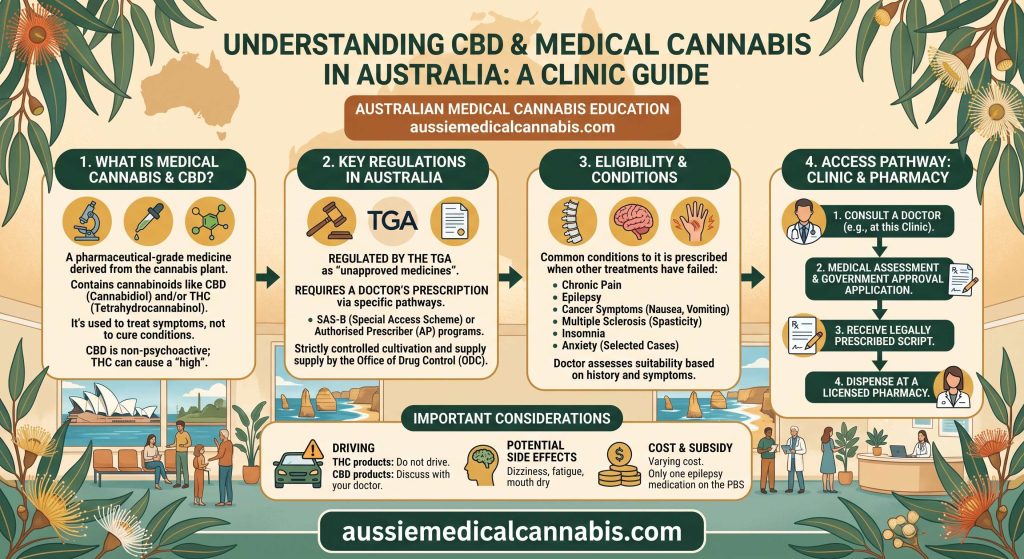
A CBD clinic is usually a medical service where patients can discuss cannabidiol (CBD), medicinal cannabis and other cannabinoid-based treatments with a registered healthcare practitioner. In Australia, these services are often called medicinal cannabis clinics, cannabis doctors, CBD doctors or telehealth cannabis clinics.
The important distinction is that a CBD clinic is not simply a retail shop selling CBD oil. Legal medicinal cannabis treatment remains part of Australia’s healthcare and prescription-medicine framework. The Therapeutic Goods Administration (TGA) says medicinal cannabis can legally be obtained from a pharmacy with a prescription from a doctor or nurse practitioner, and patients do not need to attend a specialist cannabis-branded clinic to begin the discussion. A regular GP or another registered practitioner can also consider whether medicinal cannabis is appropriate.
For broader Australian educational information about CBD, THC and medicinal cannabis, readers can explore Aussie Medical Cannabis.
What Is a CBD Clinic?
A CBD clinic is generally a healthcare service that focuses partly or primarily on medicinal cannabis.
Despite the name, many such clinics do not prescribe only CBD. Depending on the patient’s circumstances, a practitioner may consider CBD-dominant products, THC-dominant products, balanced THC:CBD preparations or decide that medicinal cannabis is not appropriate at all.
Healthdirect describes medicinal cannabis as cannabis prescribed by a registered healthcare practitioner for symptoms associated with some medical conditions. It notes that medicinal cannabis is generally not considered a first-line treatment, meaning conventional treatment options will usually be considered first.
A legitimate CBD clinic should therefore operate as a medical service rather than as a guaranteed pathway to obtaining cannabis.
CBD Clinic vs Regular GP
Australians sometimes believe they must find a dedicated cannabis clinic before they can discuss CBD oil.
That is not correct.
The TGA states that it does not maintain a special list of practitioners who are uniquely approved to prescribe medicinal cannabis. Any registered doctor or nurse practitioner can decide what is clinically appropriate within their professional and regulatory obligations, including a patient’s regular GP.
| Feature | CBD / Cannabis Clinic | Regular GP |
|---|---|---|
| Can discuss medicinal cannabis? | Yes | Yes |
| May prescribe CBD where appropriate? | Yes | Yes |
| Dedicated cannabis knowledge | Often | Varies |
| Knows broader medical history | Depends | Often stronger continuity |
| Prescription guaranteed? | No | No |
| Pharmacy still needed? | Generally yes | Generally yes |
| TGA requirements still apply? | Yes | Yes |
A dedicated clinic can offer convenience or more frequent experience with cannabinoid medicines, but being cannabis-focused does not give it an exemption from Australian medical or therapeutic-goods rules.
How a CBD Clinic Consultation Works
A genuine medicinal cannabis consultation should resemble other medical assessments.
The practitioner may review the medical condition being treated, previous therapies, current medicines, allergies, medical history, potential interactions, treatment goals and whether cannabis is supported by enough evidence to justify its use.
Queensland Health, for example, states that medical practitioners and nurse practitioners in Queensland may prescribe medicinal cannabis when they believe it is clinically appropriate, provided applicable TGA requirements for unapproved products are met.
The goal should not simply be to identify the highest-strength CBD or THC product.
It should be to determine whether medicinal cannabis is appropriate at all and, if so, which cannabinoid profile and formulation best fits the clinical situation.
Is a CBD Clinic Legal in Australia?
Yes. A legitimate clinic can lawfully provide medical consultations concerning medicinal cannabis.
The products prescribed through the clinic still need to comply with Australian therapeutic-goods requirements.
The TGA’s current access guidance states that most medicinal cannabis products in Australia remain unapproved therapeutic goods, meaning they are not included in the Australian Register of Therapeutic Goods and have not undergone the TGA’s standard pre-market assessment for quality, safety and effectiveness. Registered medical practitioners and eligible nurse practitioners can nevertheless access these medicines through established pathways such as the Special Access Scheme (SAS), Authorised Prescriber scheme (AP) and clinical trials.
This distinction is important.
Unapproved therapeutic good does not necessarily mean illegal medicine. It means the particular product has not received standard ARTG approval and is instead being supplied through an alternative lawful access pathway.
What Can a CBD Clinic Prescribe?
The exact medicine depends on the patient’s needs and the practitioner’s clinical judgment.
Australian medicinal cannabis encompasses considerably more than CBD oil. Queensland Health describes medicinal cannabis formulations including tinctures, vapourised products, capsules, sprays and pharmaceutical preparations such as nabiximols.
Some products are CBD dominant.
Others contain both CBD and THC.
Some are THC dominant.
The cannabinoid composition matters because THC and CBD have substantially different pharmacological effects.
Healthdirect explains that THC has strong psychoactive effects, while CBD does not produce the same characteristic cannabis high. Australian medicinal cannabis is pharmaceutical-grade, regulated and labelled to indicate THC and CBD levels.
CBD Clinic and CBD Oil
CBD oil is one of the formats most strongly associated with cannabis clinics.
However, the phrase CBD oil covers products of very different concentrations and compositions.
Some products contain predominantly cannabidiol, while others include THC or additional cannabinoids. The appropriate formulation depends on clinical circumstances.
CBD should also not be viewed as an ordinary nutritional supplement merely because it is non-intoxicating.
CBD is pharmacologically active and can interact with other medicines. That is one reason a clinic consultation should involve medication history and appropriate clinical monitoring.
Readers researching CBD formulations can find additional Australian-focused explanations through aussiemedicalcannabis.com CBD education.
Does a CBD Clinic Guarantee a Prescription?
No.
A responsible clinic should never treat a medicinal cannabis prescription as guaranteed.
The TGA specifically states that a doctor or nurse practitioner may decide there is not enough evidence to support medicinal cannabis for a person’s condition.
Healthdirect similarly describes medicinal cannabis as generally not being first-line therapy.
Therefore, a medical assessment could result in several outcomes: medicinal cannabis may be considered appropriate, another therapy may be preferred, further medical investigation may be required, or the practitioner may conclude that cannabinoid treatment is unsuitable.
Clinics marketing cannabis as virtually automatic should be approached more critically than clinics emphasising assessment, informed consent and follow-up care.
What Does Australian Research Say About Cannabis Clinics?
Recent Australian research has directly compared dedicated medicinal cannabis clinics with more general healthcare settings.
A study examining 2,394 Australian adults who reported prescribed medicinal cannabis use found that 79.3% had accessed treatment through medicinal cannabis clinics. Researchers found differences in patient profiles, prescribed products and satisfaction between clinic and generalist healthcare settings.
Notably, participants using dedicated medicinal cannabis clinics reported lower satisfaction with consultation duration, information about potential harms and benefits, consideration of other treatment approaches and treatment costs than participants receiving treatment through generalist health settings. Overall satisfaction was higher among those treated in generalist settings.
This does not mean all cannabis clinics provide poor care.
It does demonstrate that a specialised clinic label does not automatically guarantee a better healthcare experience.
What Makes a Good CBD Clinic?
A useful CBD clinic should behave like a healthcare provider rather than a cannabis sales platform.
Important signs include proper practitioner registration, transparent consultation fees, discussion of existing treatments, explanation of potential benefits and harms, medication-interaction review, follow-up planning and no guarantee that cannabis will be prescribed.
The practitioner should also explain whether the proposed medicine is ARTG-registered or an unapproved therapeutic good.
The TGA highlighted this issue again in June 2026, noting that many patients do not realise that most medicinal cannabis products being prescribed in Australia remain unapproved therapeutic goods.
Patients should therefore feel comfortable asking exactly what regulatory status applies to a proposed medicine.
Online CBD Clinics and Telehealth
Many Australian medicinal cannabis services now operate through telehealth.
A remote appointment can still constitute genuine medical care when provided by an appropriately registered practitioner operating within applicable prescribing requirements.
However, a website describing itself as a CBD clinic online should not be confused with an ordinary website selling CBD products directly to consumers.
The TGA says patients may legally obtain medicinal cannabis from a pharmacy with a prescription. It specifically warns that obtaining medicinal cannabis from an online store that is not a registered pharmacy is unlawful.
The key difference is therefore:
Online medical consultation + valid prescription + pharmacy supply
versus
unregulated website directly selling cannabis products
These are not legally equivalent.
CBD Clinic Prescriptions and Pharmacies
A cannabis clinic normally does not replace the pharmacy.
After a valid prescription has been issued, medicinal cannabis can be supplied by a pharmacy.
The TGA notes that many pharmacies do not routinely keep unapproved medicinal cannabis products in stock, so the pharmacist may need to order the prescribed medicine.
Queensland Health’s August 2026 pharmacist guidance similarly explains that pharmacies dispensing medicinal cannabis must comply with prescription, dispensing, record-keeping and monitored-medicine requirements. Schedule 8 medicinal cannabis dispensing in Queensland is also subject to QScript reporting requirements.
This pharmacy involvement is an important safeguard separating legitimate medicinal cannabis from informal retail supply.
CBD-Only Clinics vs Medicinal Cannabis Clinics
The phrase “CBD clinic” can be misleading because Australia’s medicinal cannabis system includes far more than cannabidiol.
A dedicated cannabis clinic may potentially consider:
CBD-dominant medicines,
balanced CBD:THC products,
THC-dominant products,
oral liquids,
capsules,
tinctures,
dried flower,
or other regulated formulations.
The medicine ultimately selected should reflect the patient’s condition and risk profile rather than the clinic’s branding.
For example, someone who specifically searches for a CBD clinic may ultimately receive no cannabis medicine, or the practitioner may determine that a different cannabinoid profile is clinically more appropriate.
CBD Clinics for Pain
Pain is a common reason Australians seek medicinal cannabis.
An Australia-wide survey of prescribed medicinal cannabis users found pain and mental-health conditions among the most common reasons for treatment.
However, this should not be interpreted as evidence that CBD cures chronic pain.
Different pain syndromes have different mechanisms, and cannabis evidence varies according to diagnosis, cannabinoid formulation and outcome being measured.
A good CBD clinic should establish what type of pain is present rather than treating “pain” as a single medical condition.
CBD Clinics for Anxiety
Mental-health symptoms are another common reason people investigate medicinal cannabis.
The same Australian survey found mental health among frequently reported reasons for prescribed medicinal cannabis use.
CBD has attracted substantial research interest around anxiety, but evidence varies according to diagnosis, formulation and study design.
THC is particularly relevant because it can produce psychoactive effects and may cause unwanted effects in some people.
A clinic should therefore distinguish carefully between CBD-dominant and THC-containing treatments rather than referring to all cannabis products as interchangeable.
CBD Clinics for Sleep
Sleep problems are frequently discussed in medicinal cannabis consultations.
Yet feeling sleepy after taking a cannabinoid is not automatically equivalent to treating an underlying sleep disorder.
Poor sleep can arise from chronic pain, anxiety, obstructive sleep apnoea, medication effects and many other conditions.
A clinic that provides appropriate medical care should therefore consider underlying causes rather than simply matching “insomnia” with a cannabis product.
CBD Clinic Costs in Australia
Medicinal cannabis treatment may involve several different expenses, including consultation fees, follow-up appointments, medication and pharmacy charges.
The TGA advises patients to discuss the price of medicinal cannabis with their practitioner or pharmacist before prescribing because treatment can be expensive.
Cost transparency matters especially with clinics operating subscription or repeat-consultation models.
The recent Australian study comparing cannabis clinics with generalist healthcare settings is relevant here: people accessing dedicated medicinal cannabis clinics reported lower satisfaction with treatment costs than those using general health services.
Therefore, the cheapest initial consultation does not necessarily represent the cheapest overall treatment.
Choosing Between a CBD Clinic and Your GP
A dedicated cannabis clinic may make sense when the patient’s existing healthcare practitioner has limited experience with medicinal cannabis or when access to knowledgeable clinicians is difficult.
A regular GP, however, can offer an important advantage: continuity of care.
A practitioner already familiar with a patient’s diagnoses, previous treatments and other medications may be better placed to evaluate how cannabinoid treatment fits into the broader healthcare plan.
The TGA explicitly confirms that a patient’s regular GP may consider prescribing medicinal cannabis.
This means dedicated clinics are an option, not a legal requirement.
CBD Clinics and Product Advertising
Patients should distinguish healthcare advice from promotional claims.
Statements such as “best CBD clinic,” “guaranteed cannabis approval,” “instant CBD prescription” or “strongest cannabis prescribed” should not replace clinical evaluation.
A prescription medicine should be selected because it is appropriate for the patient’s circumstances, not simply because a clinic has a commercial relationship with a particular brand.
The TGA stresses that prescribing unapproved medicinal cannabis carries clinical and regulatory responsibilities and should be based on sound clinical judgment and available evidence.
Registered vs Unapproved Medicinal Cannabis
Patients may hear the word approved in several different contexts.
An individual practitioner may receive permission to access an unapproved medicine, but this does not convert that medicine into a fully ARTG-approved product.
The TGA identifies Sativex (nabiximols) and Epidyolex (cannabidiol) among registered medicinal cannabis medicines.
Most other cannabis products prescribed in Australia are unapproved therapeutic goods accessed through special pathways.
This distinction is worth asking about during a clinic consultation.
CBD Clinic and Driving
Driving is particularly important if a prescribed product contains THC.
CBD does not produce the characteristic THC high, but some products advertised or described as CBD-dominant may still contain THC.
Patients should therefore establish the precise cannabinoid profile of their prescription.
The question should not simply be:
“Is this CBD?”
It should also be:
“Does this medicine contain THC, and what are the current driving implications where I live?”
State and territory driving laws vary, so patients should check rules applying in their jurisdiction and discuss impairment with their practitioner.
What Australian Patients Are Actually Using
Australian medicinal cannabis use has changed significantly since legal access began.
The CAMS-22 study surveyed 3,323 Australian medicinal cannabis consumers. Of these, 2,352, or 73%, mainly used prescribed medicinal cannabis, while 27% mainly used illicitly sourced cannabis. Prescribed users were much more likely to know the cannabinoid composition of their products and were more likely to use oral or vaporised routes.
This demonstrates one potential benefit of regulated medical access: patients generally have substantially greater certainty about what cannabinoids their medicine contains.
It also illustrates why legal clinical and pharmacy pathways matter more than simply locating a CBD product online.
Australian Educational Resources
The TGA medicinal cannabis information for patients explains prescriptions, pharmacy supply and the role of doctors and nurse practitioners. The TGA confirms that patients do not need a specially approved “cannabis doctor”; their regular GP may also consider treatment.
Healthdirect medicinal cannabis information provides Australian consumer guidance about CBD, THC, treatment pathways, costs and questions patients can discuss with their doctors.
For Queensland residents, Queensland Health medicinal cannabis prescribing guidance explains that Queensland medical practitioners and nurse practitioners can prescribe Schedule 4 CBD and Schedule 8 THC or THC:CBD products subject to the applicable Commonwealth requirements.
For peer-reviewed Australian evidence specifically about clinics, PubMed: cannabis clinics versus generalist healthcare settings in Australia provides one of the most directly relevant studies. It found meaningful differences in patient characteristics, treatment patterns and satisfaction between dedicated medicinal cannabis clinics and general healthcare settings.
Where to Explore Further
Australians researching CBD clinics, cannabis doctors, CBD oil, THC products, telehealth cannabis consultations and medicinal cannabis prescriptions can continue with educational material at aussiemedicalcannabis.com.
For individual treatment decisions, patients should use a registered healthcare practitioner. Current prescribing and regulatory questions should be checked against the TGA and the applicable state or territory health authority.
Frequently Asked Questions
1. What is a CBD clinic?
A CBD clinic is generally a medical service focused on medicinal cannabis consultations. Despite the name, it may consider CBD-dominant, balanced CBD:THC or THC-containing medicines depending on the patient’s circumstances.
2. Do I need a CBD clinic to get medicinal cannabis in Australia?
No. The TGA says any registered doctor or nurse practitioner may consider medicinal cannabis, including your regular GP. Dedicated clinics are an option rather than a requirement.
3. Does attending a CBD clinic guarantee a prescription?
No. A practitioner may decide medicinal cannabis is inappropriate or that there is insufficient evidence for your condition. The TGA specifically recognises that a doctor or nurse practitioner may reach this conclusion.
4. Are online CBD clinics legal in Australia?
Telehealth medicinal cannabis consultations can form part of legitimate medical care when conducted by appropriately registered practitioners. The medicine should still be prescribed and supplied through lawful Australian channels. An ordinary unregistered website selling cannabis directly is not equivalent to a medical clinic or registered pharmacy.
5. Are cannabis clinics better than regular doctors?
Not necessarily. A recent Australian study involving 2,394 prescribed medicinal cannabis users found higher overall satisfaction among people accessing generalist health settings than dedicated medicinal cannabis clinics, including better satisfaction regarding consultation time, information, alternative treatments and cost.
