
Cannabis Education
CBD Oil Dose in Australia: Dosage, Strength, Safety and Medicinal Cannabis Guidance
Aug
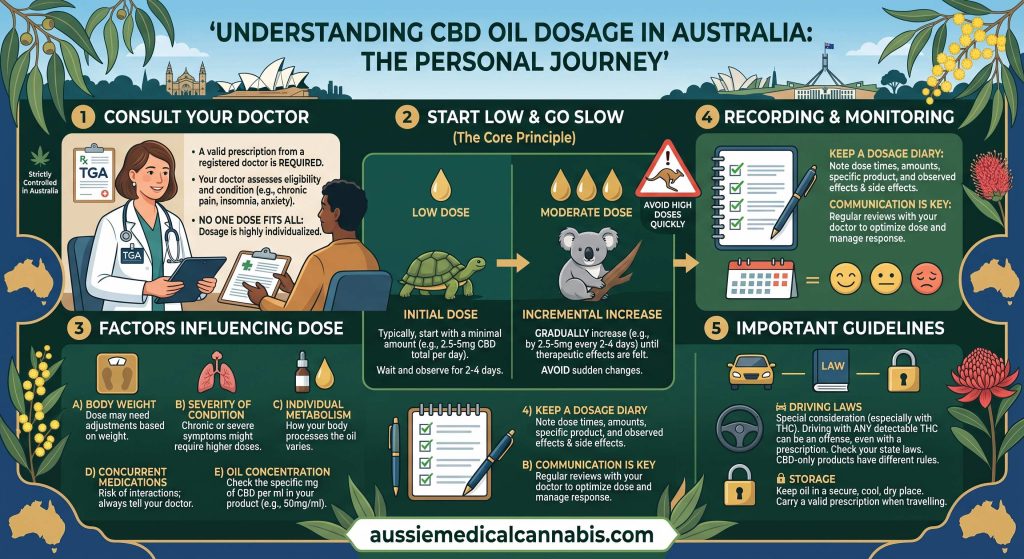
Finding the right CBD oil dose is not as simple as choosing a universal number of drops. Cannabidiol (CBD) dosing can vary substantially according to the medical condition being treated, CBD concentration, formulation, body weight, other medicines and an individual’s response to treatment.
This is particularly important in Australia, where medicinal CBD products sit within a regulated therapeutic framework. The Therapeutic Goods Administration (TGA) currently lists Category 1 CBD medicinal cannabis products as Schedule 4 Prescription Only medicines, with CBD representing at least 98% of their total cannabinoid content.
Australian patients should therefore follow the dose prescribed by their healthcare practitioner rather than adopting a CBD dosage found on an overseas website or social-media post.
This guide explains how CBD oil dosing works, why concentrations matter, what clinical research tells us about dosage, and the safety considerations Australians should understand.
For additional Australian cannabis education, readers can explore aussiemedicalcannabis.com.
What Is CBD Oil?
CBD oil is an oral preparation containing cannabidiol, a naturally occurring cannabinoid from Cannabis sativa.
Unlike tetrahydrocannabinol (THC), CBD does not ordinarily produce the characteristic cannabis “high.” However, the absence of that intoxicating effect does not mean CBD is pharmacologically inactive.
Australian medicinal cannabis products can contain CBD alone or CBD alongside other cannabinoids.
The current TGA medicinal cannabis product list includes oral liquids with widely differing concentrations, including products containing 100 mg/mL and 200 mg/mL CBD.
That variation is one reason talking about a CBD oil dose purely in terms of “drops” can be misleading.
Is There a Standard CBD Oil Dose?
There is no single CBD oil dose appropriate for every person or medical condition.
A systematic review examining CBD dosing across clinical populations found enormous variation between studies. Researchers identified doses ranging from less than 1 mg/kg/day to 50 mg/kg/day across different medical contexts.
That does not mean this entire range should be treated as a self-dosing recommendation.
Instead, it demonstrates how strongly CBD dosing depends upon the indication, formulation and clinical circumstances.
Another systematic review of adult human trials found substantial variation in the CBD doses, dosing schedules and administration routes studied. The researchers concluded that more high-quality evidence is needed to establish optimal therapeutic doses.
Understanding CBD Oil Strength
Before discussing dosage, it is important to understand concentration.
CBD oil labels may express concentration as milligrams per millilitre (mg/mL).
Consider two hypothetical products:
| CBD oil | Concentration | CBD in 1 mL |
|---|---|---|
| Oil A | 25 mg/mL | 25 mg |
| Oil B | 100 mg/mL | 100 mg |
| Oil C | 200 mg/mL | 200 mg |
Someone taking 1 mL of Oil C would therefore receive eight times as much CBD as someone taking 1 mL of Oil A.
This illustrates why saying “take one dropper” or “use several drops” without knowing the product’s concentration is potentially misleading.
Australian patients should follow the dosing directions supplied with their prescribed medicinal cannabis product.
For further educational material about Australian medicinal cannabis products, visit aussiemedicalcannabis.com medicinal cannabis information.
CBD Milligrams Versus Millilitres
Another common source of confusion is the difference between mg and mL.
Milligrams (mg) describe the amount of CBD.
Millilitres (mL) describe the volume of liquid.
If a prescribed CBD oil contains 100 mg/mL, then mathematically:
0.1 mL = 10 mg CBD
0.25 mL = 25 mg CBD
0.5 mL = 50 mg CBD
1 mL = 100 mg CBD
These examples explain concentration only; they are not recommended doses.
The correct amount depends upon the prescription and the specific product being used.
What Does Australian Guidance Say About CBD Dosage?
Australian guidance demonstrates why CBD dosage needs to be considered in relation to a particular condition.
For example, the TGA’s guidance concerning medicinal cannabis for epilepsy in paediatric and young-adult patients discusses clinical trials involving approximately 20 mg/kg/day CBD for particular severe epilepsy syndromes. It also reports that some studies began around 2–5 mg/kg/day before increasing treatment according to response and adverse effects.
These are disease-specific clinical research doses, not general CBD wellness recommendations.
They should therefore not be copied for anxiety, sleep, pain or another condition.
What Does Research Say About CBD Doses?
CBD research covers a remarkably wide range of doses.
A systematic review of clinical populations identified CBD doses ranging from below 1 mg/kg/day to 50 mg/kg/day, depending upon the medical context studied.
A separate review evaluating lower oral doses found that evidence of therapeutic benefit was inconsistent at lower dose levels and became clearer for certain studied outcomes at approximately 300 mg or above. However, the researchers emphasised that larger and more robust trials are needed.
More recent research published in 2026 reviewed low-dose CBD—defined by the authors as no more than 2.5 mg/kg or 175 mg/day. It found little evidence of meaningful physical or neurological effects in healthy volunteers and no evidence of benefit for several conditions examined in randomized trials. Importantly, drug interactions were still observed at some relatively low doses.
The lesson is not that everyone needs a high dose. Rather, CBD dose cannot reliably be selected from a generic internet dosing chart.
CBD Oil Dosage Comparison
| Factor | Lower CBD exposure | Higher CBD exposure |
| Amount of CBD | Fewer milligrams | More milligrams |
| Potential interactions | Still possible | Potentially more clinically significant |
| Side effects | Can still occur | May become more relevant |
| Appropriate for everyone? | No | No |
| Clinical supervision | Important | Particularly important |
| Evidence of effectiveness | Depends on condition | Depends on condition |
“More CBD” does not automatically mean “better treatment.”
The therapeutic goal is an appropriate dose for the particular patient and condition—not simply the largest tolerable amount.
Does Body Weight Determine CBD Oil Dose?
Body weight is relevant in some clinical settings.
This is why scientific studies sometimes report CBD doses as mg/kg/day rather than simply milligrams per day.
For example, 10 mg/kg/day would mathematically correspond to different total amounts for people of different weights.
However, body weight is only one consideration.
Age, condition being treated, liver function, other medicines, CBD formulation and individual response can also influence treatment decisions.
Patients should therefore not convert research doses into personal prescriptions without medical guidance.
Why Food Can Change CBD Exposure
One particularly important characteristic of oral CBD is its interaction with food.
A systematic review of CBD pharmacokinetics found substantially greater bioavailability when CBD was administered with food.
Another review estimated that CBD’s oral bioavailability under fasting conditions is relatively low and reported that administration with a high-fat meal can increase exposure approximately fourfold.
This matters because the exact same milligram dose may not necessarily produce identical CBD exposure under different circumstances.
Research also indicates that dose, formulation, route of administration and whether someone has eaten can substantially influence CBD pharmacokinetics.
Consistency with the administration instructions supplied by the prescriber or product information can therefore be important.
How Long Does CBD Oil Take to Work?
There isn’t one universal onset time.
CBD pharmacokinetics vary according to:
- formulation;
- dose;
- whether it is swallowed or administered another way;
- food intake;
- individual metabolism; and
- other medicines.
Research comparing CBD formulations has demonstrated considerable variability in absorption and blood concentrations.
Patients should therefore avoid taking additional CBD simply because they believe the first dose “isn’t working yet.”
CBD Oil Dose and Side Effects
CBD can cause adverse effects despite often being described as non-intoxicating.
Potential effects reported in clinical literature include gastrointestinal symptoms, tiredness or somnolence, appetite changes and liver-related abnormalities.
The likelihood and clinical importance of these effects depend on numerous factors, including dose and concurrent medicines.
Patients experiencing unexpected effects after starting or changing CBD treatment should discuss them with their healthcare professional.
CBD and Drug Interactions
Drug interactions are one of the most important reasons to avoid unsupervised CBD dose changes.
CBD can influence enzymes involved in drug metabolism.
The 2026 review of low-dose CBD found drug interactions involving substances including amitriptyline and hydromorphone even within the lower-dose range examined by the researchers.
People using prescription medicines should therefore tell their doctor or pharmacist about their CBD treatment.
This becomes particularly important when medicines have narrow therapeutic ranges or can produce sedation.
CBD Oil Versus CBD-THC Oil
Not every bottle marketed as medicinal cannabis oil contains CBD alone.
Australian medicinal cannabis products are categorised partly according to cannabinoid composition.
The TGA currently defines:
Category 1: CBD represents at least 98% of total cannabinoid content.
Category 2: CBD represents at least 60% but less than 98%.
Categories containing progressively greater proportions of cannabinoids other than CBD are treated differently.
Consequently, patients should know whether their medicine contains THC rather than assuming all “CBD oil” products are identical.
CBD Oil and Driving in Australia
The distinction between CBD and THC becomes particularly important for driving.
Patients using cannabinoid medicines need to know whether THC is present because Australia’s states and territories regulate drug driving.
A product being prescribed does not automatically eliminate road-law considerations.
Anyone prescribed a CBD-dominant product containing THC should discuss driving with their healthcare practitioner and consult the current rules for their state or territory.
Why Online CBD Dosage Calculators Can Be Misleading
Online calculators frequently ask for body weight and then produce a recommended number of milligrams.
This can give an impression of medical precision that the evidence does not necessarily support.
A calculator may not account adequately for:
- the condition being treated;
- CBD concentration;
- THC content;
- other cannabinoids;
- prescription medicines;
- liver function;
- age;
- food effects;
- formulation differences; or
- individual response.
Scientific reviews repeatedly demonstrate substantial variability in CBD dosing and pharmacokinetics.
An online calculator should therefore not replace individual clinical advice.
Where to Explore Further
For additional Australian cannabis education, cannabinoid information and explanations of medicinal cannabis regulation, explore aussiemedicalcannabis.com.
For official information about CBD-containing medicinal cannabis products, consult the Therapeutic Goods Administration medicinal cannabis product list.
For Australian clinical guidance concerning medicinal cannabis and CBD dosing in specific epilepsy settings, see the TGA medicinal cannabis epilepsy guidance.
For scientific evidence, read the PubMed systematic review of cannabidiol dosing.
Readers can also use aussiemedicalcannabis.com for further Australian cannabis research.
Frequently Asked Questions
1. What is the correct CBD oil dose?
There is no universal CBD oil dose. Appropriate dosing depends on the product, concentration, medical indication, other medicines and individual patient factors. Clinical studies have used widely differing doses.
2. How many drops of CBD oil should I take?
A reliable dose cannot be determined from the number of drops alone. Oils can contain dramatically different CBD concentrations, and drop size can vary. Australian patients should use the measuring method and dosage prescribed for their specific product.
3. Is 10 mg of CBD considered a low dose?
Ten milligrams is relatively low compared with many doses investigated in therapeutic clinical trials, but “low” does not mean automatically effective or risk-free. A 2026 review found drug interactions could occur at relatively low CBD doses.
4. Does eating affect a CBD oil dose?
Food can substantially affect oral CBD exposure. Research indicates that eating, particularly higher-fat food, can significantly increase CBD bioavailability compared with fasting administration.
5. Can I increase my CBD oil dose if it isn’t working?
People using prescribed medicinal CBD should not independently increase their dose simply because they have not noticed the expected effect. Dose changes should be discussed with the prescribing healthcare practitioner, particularly because CBD can produce side effects and interact with other medicines.
Key Takeaway
The most important fact about CBD oil dose in Australia is that there is no scientifically established one-size-fits-all dose.
Clinical research has investigated everything from relatively small doses to hundreds of milligrams and weight-based therapeutic doses for particular medical conditions. These study doses should not be converted directly into self-treatment recommendations.
Product concentration also matters enormously. A small volume of 200 mg/mL CBD oil contains considerably more CBD than the same volume of 25 mg/mL oil.
Australians using medicinal CBD should therefore understand their product’s concentration, follow their prescription, maintain consistent administration where instructed and discuss dose adjustments or side effects with their healthcare professional.
