
Cannabis Education
Cannabis Deficiencies in Australia
Aug
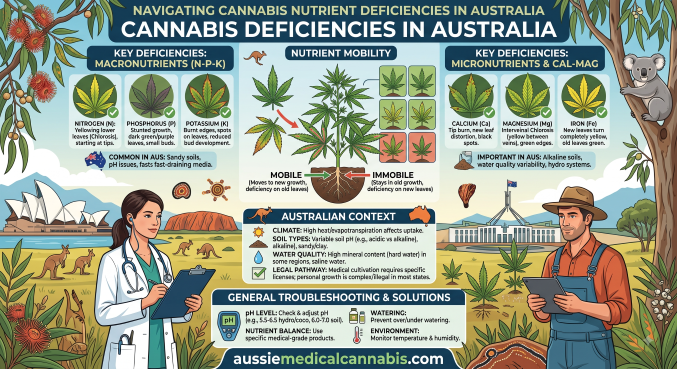
Cannabis deficiencies are an important area of plant science because Cannabis sativa depends on an appropriate balance of essential mineral nutrients for normal physiological development. When an essential nutrient becomes unavailable or falls below the level required by the plant, changes can occur in leaf colour, plant structure, photosynthesis, biomass and overall plant health.
For Australians researching cannabis deficiencies, however, there is another important consideration: cannabis cultivation is regulated. Scientific information about cannabis nutrition should therefore be separated from assumptions about whether cannabis can legally be cultivated at home.
The Australian Government’s Office of Drug Control medicinal cannabis information explains that cultivation of cannabis for medicinal purposes is controlled under Commonwealth legislation and that the federal medicinal-cannabis framework does not provide a personal-use cultivation pathway. Commercial medicinal or scientific cultivation requires appropriate licensing and permits.
This guide explains what researchers mean by cannabis nutrient deficiencies, the major nutrients associated with them, common plant symptoms and what scientific studies have discovered about cannabis mineral nutrition.
What Are Cannabis Deficiencies?
A cannabis nutrient deficiency occurs when a plant does not have adequate access to an essential mineral nutrient required for normal biological processes.
Cannabis, like other plants, requires multiple macro- and micronutrients. Important macronutrients include:
Nitrogen (N)
Phosphorus (P)
Potassium (K)
Calcium (Ca)
Magnesium (Mg)
Sulfur (S)
Important micronutrients include elements such as iron, manganese, zinc, copper, boron and molybdenum.
A deficiency should not automatically be diagnosed from the appearance of a single leaf.
Research published in Applied Sciences examined nutrient disorders in Cannabis sativa and emphasised the importance of plant-tissue analysis alongside visual symptoms. Researchers documented how individual nutrient deficiencies produced characteristic changes over time, while also demonstrating why scientifically supported diagnosis is preferable to relying entirely on photographs or anecdotal deficiency charts.
Cannabis Deficiency Comparison Table
| Nutrient | General role in plants | Commonly researched deficiency features |
|---|---|---|
| Nitrogen | Proteins, chlorophyll and vegetative development | Pale/yellow foliage and reduced growth |
| Phosphorus | Energy transfer and cellular processes | Restricted growth and physiological changes |
| Potassium | Water relations and plant physiological functions | Leaf abnormalities and impaired development |
| Calcium | Cell structure and development | Problems affecting developing tissues |
| Magnesium | Central component of chlorophyll | Chlorosis and impaired photosynthetic function |
| Iron | Chlorophyll-related metabolic processes | Chlorosis, often involving younger tissues |
These are general educational indicators rather than a diagnostic tool. Different stresses can produce visually similar symptoms.
Nitrogen Deficiency in Cannabis
Nitrogen is among the most extensively researched nutrients in Cannabis sativa.
Nitrogen participates in fundamental biological processes involving proteins, nucleic acids, chlorophyll and plant metabolism.
A scientific review indexed by PubMed — Impact of Nitrogen Nutrition on Cannabis sativa describes nitrogen availability as a major factor affecting cannabis development, biomass and secondary metabolism.
Controlled research into cannabis nutrient disorders has also documented nitrogen-deficiency symptoms.
One study found that nitrogen-deficient cannabis plants initially exhibited stunting and yellowing of lower foliage. As the deficiency progressed, yellowing became more extensive. The researchers reported substantially reduced biomass compared with control plants receiving complete nutrition.
This illustrates an important principle of plant nutrition: visible symptoms can represent an advanced physiological problem rather than its beginning.
Phosphorus Deficiency in Cannabis
Phosphorus participates in essential processes involving cellular energy transfer and plant development.
Researchers have specifically investigated phosphorus availability in medical cannabis.
A study indexed by PubMed exposed two cannabis genotypes to different phosphorus concentrations under controlled environmental conditions. Low phosphorus availability was associated with poorer plant function, including reductions in photosynthesis, transpiration, stomatal conductance and growth.
Importantly, the research also showed that mineral nutrition can influence more than appearance. Changes in phosphorus availability affected plant physiology, biomass and cannabinoid profiles.
Consequently, phosphorus deficiency should not simply be thought of as a particular leaf colour. It represents a physiological nutritional condition.
Potassium Deficiency in Cannabis
Potassium is another major plant nutrient and contributes to processes including water relations, photosynthesis and physiological regulation.
Research involving two medical cannabis genotypes demonstrated that inadequate potassium availability produced deficiency symptoms and impaired optimal growth and function. The response also varied between genotypes, demonstrating that different cannabis genetics may respond differently to mineral conditions.
That genetic variability is one reason simplistic online cannabis deficiency charts should be interpreted cautiously.
A symptom associated with potassium deficiency in one experimental environment does not prove that every cannabis plant displaying a similar symptom has exactly the same nutritional problem.
Calcium, Magnesium and Sulfur Deficiencies
Although nitrogen, phosphorus and potassium receive considerable attention, cannabis requires other macronutrients.
Calcium contributes to cell walls, membranes and developing plant tissues.
Magnesium occupies a central position within the chlorophyll molecule and therefore has a close relationship with photosynthesis.
Sulfur contributes to amino acids and numerous metabolic processes.
A controlled 2023 study investigated cannabis plants where researchers individually withheld nitrogen, phosphorus, potassium, calcium, magnesium, sulfur, iron or manganese.
The researchers found substantial effects on plant growth and yield from several deficiencies. Interestingly, visual symptom onset did not always correspond perfectly with elemental analysis of plant tissues.
This finding demonstrates why appearance alone cannot provide certainty about a nutrient disorder.
Micronutrient Deficiencies in Cannabis
Cannabis also depends on micronutrients.
They are called micronutrients because plants require them in relatively small quantities—not because they are unimportant.
Examples include:
- Iron
- Manganese
- Zinc
- Copper
- Boron
- Molybdenum
Micronutrients participate in enzyme activity, electron transport, photosynthetic processes and numerous other aspects of plant metabolism.
Problems involving micronutrients may produce discoloration, chlorosis, abnormal development or other symptoms. However, environmental stress, disease and root problems can sometimes resemble nutrient deficiencies.
Laboratory analysis therefore provides substantially stronger evidence than visual identification alone.
Cannabis Deficiency vs Nutrient Toxicity
More nutrients do not necessarily mean healthier plants.
Plants can experience both deficiency and toxicity.
A deficiency occurs when availability is inadequate for normal plant function. Toxicity can occur when an element is present at a level that negatively affects physiological processes.
Research into cannabis nutrition has demonstrated this distinction.
For example, studies examining nitrogen and potassium have found that both insufficient and excessive nutrient availability can negatively affect cannabis development under particular experimental conditions.
This means cannabis nutrition is better understood as a question of biological balance rather than simply increasing nutrient availability.
Can Cannabis Deficiencies Affect Yield?
Yes.
Controlled research provides evidence that nutrient deficiencies can substantially affect cannabis biomass and floral yield.
A 2023 study examining individual deficiencies of N, P, K, Ca, Mg, S, Fe and Mn found that nitrogen deficiency reduced above-ground vegetative fresh weight by 73%, while phosphorus deficiency reduced it by 59% compared with controls.
Most of the deficiency treatments investigated also reduced floral yield.
These results help explain why mineral nutrition is an important subject within commercial and scientific cannabis research.
Cannabis Deficiencies and Cannabinoid Composition
Researchers are also interested in whether mineral nutrition influences cannabinoid chemistry.
The relationship is complicated.
One study investigating phosphorus found that phosphorus supply affected cannabinoid concentrations as well as plant physiology and biomass.
Another study investigating nitrogen, phosphorus, potassium and humic-acid supplementation concluded that mineral nutrition can influence physiological and chemical characteristics of medical cannabis.
However, nutrient stress should not be interpreted as a reliable method of producing a desired cannabinoid profile.
Genetics, developmental stage, environment and numerous other factors interact with plant nutrition.
Diagnosing Cannabis Deficiencies Is More Complicated Than Looking at Leaves
Internet searches for terms such as cannabis deficiencies chart, cannabis leaf deficiency, and cannabis nutrient deficiency symptoms frequently lead to photographs showing differently coloured leaves.
Those resources can be educational, but they have limitations.
Yellow leaves, brown margins or abnormal development do not automatically establish which nutrient is responsible.
Researchers studying cannabis nutrient disorders use controlled treatments and techniques such as plant-tissue analysis to determine whether observed symptoms actually correspond to differences in mineral concentrations.
Therefore, visual symptoms are better understood as potential indicators rather than definitive diagnoses.
Cannabis Cultivation Laws in Australia
Plant-science information also needs to be considered separately from Australian cannabis law.
The Australian Government’s Office of Drug Control states that a licence and relevant permits are required to grow, produce or manufacture cannabis in Australia for medicinal or scientific purposes under the Commonwealth framework.
The ODC also specifically states that these Commonwealth medicinal-cannabis licences cannot be obtained for personal use.
The Australian Government Office of Drug Control cultivation guidance provides current information concerning federal licensing and permit requirements.
The ODC further explains that medicinal cannabis cultivation is regulated under the Narcotic Drugs Act 1967.
State and territory laws can introduce additional distinctions, so Australians should consult the legislation and government guidance applying to their jurisdiction rather than assuming rules are identical throughout the country.
Why Cannabis Nutrient Research Matters in Australia
Australia has a regulated medicinal cannabis industry, which makes agricultural research relevant to product consistency and quality.
Licensed producers need to understand how environmental conditions and plant nutrition interact with plant physiology.
Research has demonstrated that cannabis responses to mineral nutrition can vary between genotypes.
That is particularly relevant to medicinal production because standardisation is important when plant material ultimately contributes to therapeutic products.
The Office of Drug Control — Cultivators and Producers provides regulatory information for organisations involved in Australia’s legal medicinal cannabis cultivation and production sector.
Where to Explore Further
Readers interested in Australian cannabis education can explore Aussie Medical Cannabis — educational resources for additional general information about cannabis-related topics in Australia.
For broader medicinal cannabis research and Australian educational material, visit Aussie Medical Cannabis — further research.
Readers researching cannabis terminology, Australian regulation and related educational subjects can also use Aussie Medical Cannabis — cannabis information resources as a starting point before checking claims against Australian government guidance and peer-reviewed scientific literature.
These resources should complement—not replace—official Australian government information, professional agricultural advice or peer-reviewed research.
Frequently Asked Questions About Cannabis Deficiencies
1. What are the most common cannabis nutrient deficiencies?
Scientific cannabis research has examined deficiencies involving nitrogen, phosphorus, potassium, calcium, magnesium, sulfur, iron and manganese. Nitrogen, phosphorus and potassium are among the major macronutrients frequently studied because they have important roles in plant growth and physiology.
2. What does nitrogen deficiency look like in cannabis?
Controlled research has associated nitrogen deficiency with stunted development and progressive yellowing beginning in lower foliage. However, visual appearance alone cannot definitively establish a nitrogen deficiency because different stresses may produce similar symptoms.
3. Can cannabis nutrient deficiencies reduce plant growth?
Yes. Experimental research has demonstrated substantial reductions in vegetative biomass and floral yield under several individual nutrient-deficiency treatments.
4. Can you identify a cannabis deficiency from a photograph?
A photograph may suggest possible causes, but it cannot reliably confirm the underlying nutrient disorder. Scientific diagnosis can incorporate plant-tissue analysis and other information because symptoms from different nutritional or environmental problems can overlap.
5. Is it legal to grow medicinal cannabis at home in Australia?
Australia’s Commonwealth medicinal-cannabis licensing framework does not provide licences for personal cultivation. The Office of Drug Control states that cannabis cultivation for medicinal or scientific purposes requires licences and permits and that a medicinal cannabis cultivation licence cannot be obtained for personal use. State and territory laws should also be checked for the rules applicable to a particular jurisdiction.
Conclusion
Cannabis deficiencies are scientifically important because mineral nutrition affects plant development, photosynthesis, biomass, yield and aspects of plant chemistry.
Research involving nitrogen, phosphorus, potassium and other essential elements demonstrates that both insufficient and excessive mineral availability can negatively affect cannabis physiology. Studies also show that symptoms can vary between nutrients, developmental stages and genotypes.
For Australian readers, plant science should always be considered separately from cultivation legality. Australia’s medicinal cannabis industry operates within a tightly controlled regulatory framework, and federal medicinal-cannabis cultivation requires appropriate licences and permits.
Understanding cannabis deficiencies is therefore valuable primarily as an area of botany, agricultural science and regulated medicinal-cannabis research.
