
Cannabis Education
Eligibility for Medicinal Cannabis in Australia: Laws, Regulation and Patient Safety
Aug
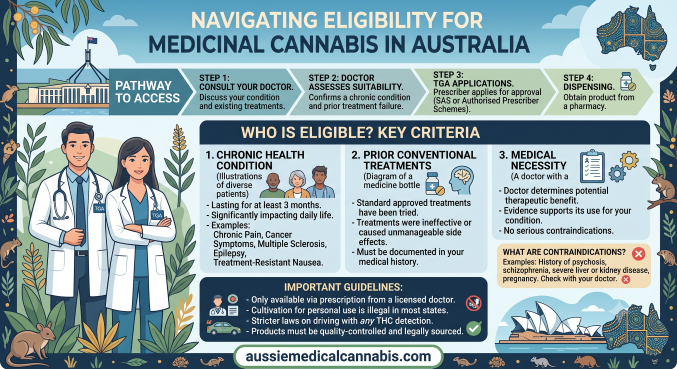
The phrase “eligible for medical weed” is commonly used when people search for information about medicinal cannabis. In Australia, however, there isn’t a single nationwide medical-cannabis card or simple checklist that automatically makes someone eligible.
Instead, medicinal cannabis is incorporated into Australia’s broader healthcare and therapeutic-goods framework. A qualified healthcare professional considers the individual’s medical circumstances, available evidence, potential benefits, potential risks, and other treatment options.
The Therapeutic Goods Administration (TGA) regulates medicinal cannabis products and provides regulatory pathways for accessing certain unapproved therapeutic goods.
What Is Medicinal Cannabis?
Medicinal cannabis refers to therapeutic products containing cannabinoids derived from cannabis or produced to pharmaceutical standards.
Products can contain:
- CBD (cannabidiol)
- THC (tetrahydrocannabinol)
- CBD and THC together
- Other cannabinoids
Different products have different chemical compositions and potential effects.
Medicinal cannabis should therefore not be treated as one single medicine. The evidence and safety considerations depend on the particular formulation and the condition being considered.
Is There a Medical Cannabis Card in Australia?
Australia does not operate a nationwide medical-cannabis-card system equivalent to some overseas jurisdictions.
Instead, medicinal cannabis is supplied through Australia’s healthcare and medicines framework.
The TGA explains that access to medicinal cannabis can involve regulated pathways including:
- The Special Access Scheme (SAS)
- The Authorised Prescriber (AP) Scheme
- Clinical trials
The applicable pathway depends on the circumstances and regulatory status of the product.
The Role of Healthcare Professionals
Healthcare professionals play a central role in determining whether medicinal cannabis may be clinically appropriate.
A clinician may consider factors such as:
- The patient’s medical history
- The condition being treated
- Previous treatments
- Current medicines
- Potential medicine interactions
- Available scientific evidence
- Potential benefits
- Potential adverse effects
This means that eligibility is not simply determined by having a particular diagnosis.
Why Medical Evidence Matters
Medicinal cannabis has been investigated for a range of conditions, but the strength of evidence differs significantly between them.
Research has investigated cannabinoids in areas including:
- Certain forms of treatment-resistant epilepsy
- Chronic pain
- Multiple sclerosis-related symptoms
- Chemotherapy-associated nausea and vomiting
- Selected palliative-care symptoms
Evidence supporting one cannabinoid formulation does not necessarily apply to every cannabis product.
CBD and THC
Two of the best-known cannabinoids are CBD and THC.
| Feature | CBD | THC |
|---|---|---|
| Intoxicating | Generally no | Yes |
| Psychoactive effects | Generally absent | Possible |
| Research areas | Certain neurological conditions and other applications | Pain, nausea, spasticity and other areas |
| Cognitive impairment | Generally uncommon | Possible |
THC can temporarily affect attention, reaction time, coordination, memory, and judgement.
Approved and Unapproved Products
An important part of Australia’s medicinal cannabis framework is the distinction between approved and unapproved therapeutic goods.
The TGA explains that many medicinal cannabis products supplied in Australia are currently unapproved therapeutic goods. These products have not undergone the same pre-market evaluation process required for products included in the Australian Register of Therapeutic Goods (ARTG).
This does not mean that an unapproved product is automatically unsafe or ineffective. It means that its regulatory status is different and access occurs through specific regulatory pathways.
Special Access Scheme
The Special Access Scheme (SAS) is one pathway through which healthcare professionals can seek access to certain unapproved therapeutic goods for individual patients.
The TGA provides specific requirements and guidance governing these applications.
The SAS is therefore part of a regulated medical process rather than a general-purpose cannabis access program.
Authorised Prescriber Scheme
The Authorised Prescriber Scheme provides another regulatory pathway.
Under this framework, appropriately authorised healthcare professionals can prescribe certain unapproved therapeutic goods to patients who meet the relevant clinical circumstances.
The scheme is subject to TGA requirements and does not mean that every healthcare professional automatically has authority to prescribe every medicinal cannabis product.
Patient Safety
Safety is an important part of any medicinal cannabis assessment.
Possible adverse effects can include:
- Drowsiness
- Dizziness
- Fatigue
- Dry mouth
- Reduced concentration
- Changes in appetite
THC-containing products can additionally affect coordination, reaction time, perception, memory, and judgement.
Cannabinoids can also interact with other medicines.
Medicinal Cannabis and Driving
Driving is an important safety consideration for people using THC-containing medicines.
THC can impair abilities required for safe driving, including:
- Attention
- Reaction time
- Coordination
- Judgement
Driving laws differ between Australian states and territories. A medicinal prescription does not necessarily remove applicable driving restrictions.
Why a Medical Assessment Is Important
A healthcare professional can consider whether there are more established treatment options for a particular condition and whether the potential benefits of a cannabinoid medicine outweigh its risks.
This assessment can be especially important when someone:
- Takes several medicines
- Has significant medical conditions
- May be sensitive to THC
- Needs to drive or operate machinery
- Has previously experienced adverse reactions
Medicinal Cannabis and Age
Age can be an important consideration in healthcare decisions.
Medicinal cannabis is not automatically appropriate for children or adolescents. The evidence base differs between age groups, and additional clinical considerations may apply.
For anyone under 18, decisions about medicines should involve an appropriately qualified healthcare professional and a parent or guardian.
Australia vs Overseas Cannabis Systems
People sometimes assume that Australia’s system works like cannabis-card programs in parts of the United States.
It does not.
| Australia | Some Overseas Jurisdictions |
|---|---|
| Healthcare-based framework | Some use medical-cannabis card systems |
| TGA regulatory pathways | Rules vary by jurisdiction |
| State and territory laws also matter | Local laws determine eligibility |
| No nationwide medical cannabis card | Some jurisdictions issue patient cards |
This distinction is important when researching information online.
Who Regulates Medicinal Cannabis?
Several government bodies have responsibilities within Australia’s medicinal cannabis framework.
Therapeutic Goods Administration
The TGA regulates therapeutic goods and provides information about medicinal cannabis products and access pathways.
Office of Drug Control
The Office of Drug Control (ODC) administers important parts of Australia’s controlled-drug framework, including licensing arrangements for medicinal cannabis cultivation and production.
State and Territory Authorities
State and territory governments also have responsibilities concerning medicines, controlled substances, prescribing, dispensing, and enforcement.
Frequently Asked Questions
Is there a medical cannabis card in Australia?
There is no nationwide medical-cannabis-card system. Medicinal cannabis is handled through Australia’s healthcare and therapeutic-goods framework.
Does having a particular condition automatically make someone eligible?
No. Clinical suitability depends on the individual’s circumstances, available evidence, potential benefits and risks, and other treatment considerations.
Are all medicinal cannabis products approved by the TGA?
No. Many medicinal cannabis products supplied in Australia are unapproved therapeutic goods and are accessed through regulated pathways such as the SAS or AP Scheme.
Can medicinal cannabis cause side effects?
Yes. Possible effects include drowsiness, dizziness, fatigue, dry mouth and reduced concentration. THC can also cause temporary cognitive and coordination effects.
Does a medicinal cannabis prescription make recreational cannabis legal?
No. Medicinal cannabis treatment and recreational cannabis laws are separate matters.
Reliable Australian Sources
For current information, readers should consult official sources: https://aussiemedicalcannabis.com/
- Therapeutic Goods Administration – Medicinal Cannabis
- TGA – Medicinal Cannabis Access Pathways
- Australian Government Department of Health, Disability and Ageing – Medicinal Cannabis
- Healthdirect Australia
PubMed Reference
Conclusion
There is no single nationwide “medical weed card” or automatic eligibility checklist in Australia. Medicinal cannabis operates within a regulated healthcare system in which appropriately qualified healthcare professionals consider a patient’s circumstances, the available scientific evidence, potential benefits, risks, and other treatment options.
The TGA provides regulatory pathways for certain medicinal cannabis products, while state and territory laws can also influence the way medicinal cannabis is prescribed and supplied.
Because regulations and clinical evidence can change, current information should be obtained from Australian Government and healthcare sources rather than relying on overseas cannabis-card information.
