
Cannabis Education
Types of Ganja: An Educational Guide
Aug
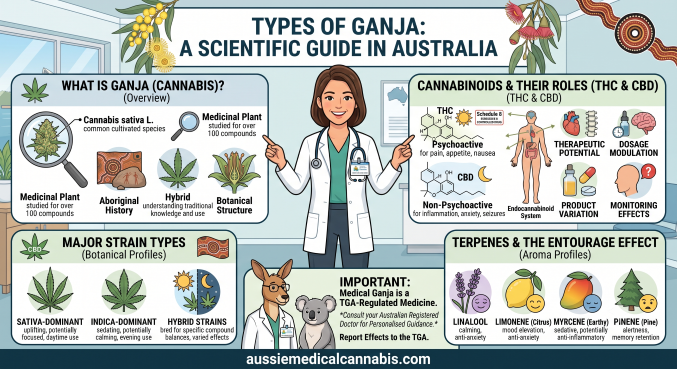
“Ganja” is a widely used informal term for cannabis. Traditionally, cannabis has been classified into categories such as Cannabis sativa, Cannabis indica, and hybrid varieties. However, advances in botanical and medical research have shown that these traditional categories do not reliably predict a product’s chemical composition or biological effects.
Today, scientists and healthcare professionals place greater emphasis on cannabinoid profiles—particularly the levels of cannabidiol (CBD) and tetrahydrocannabinol (THC)—because these provide more meaningful information than a strain name alone.
In Australia medicinal cannabis products are characterised by their cannabinoid composition, manufacturing quality, and available clinical evidence rather than by traditional strain labels.
This educational guide explains the traditional classifications of cannabis, modern scientific approaches, and Australia’s regulatory framework.
What Does “Ganja” Mean?
“Ganja” is an informal name for cannabis that is commonly used in many parts of the world.
In scientific and healthcare settings, professionals typically use terms such as:
- Cannabis
- Medicinal cannabis
- Cannabis cultivars
- Cannabinoids
These terms provide greater precision for research and clinical practice.
Traditional Types of Cannabis
Historically, cannabis has been divided into three broad categories.
Cannabis Sativa
Traditionally associated with:
- Taller plants
- Narrower leaves
- Longer flowering periods
Modern research indicates that the “sativa” label alone does not reliably predict cannabinoid composition or therapeutic properties.
Cannabis Indica
Traditionally associated with:
- Shorter plants
- Broader leaves
- Compact growth
Like “sativa,” the “indica” label does not consistently indicate the chemical profile of a cannabis product.
Hybrid Cannabis
Hybrid cannabis refers to cultivated varieties developed by combining characteristics from different cannabis populations.
Their cannabinoid composition can vary considerably depending on genetics and cultivation.
Why Modern Science Focuses on Cannabinoids
Researchers now recognise that the chemical composition of cannabis is more informative than traditional strain categories.
The two best-studied cannabinoids are:
- Cannabidiol (CBD) – generally considered non-intoxicating.
- Tetrahydrocannabinol (THC) – the primary psychoactive cannabinoid.
Laboratory testing provides detailed information about cannabinoid content, which is more useful than relying on strain names.
Cannabinoid Profiles
Medicinal cannabis products are commonly described according to their cannabinoid composition.
| Cannabinoid Profile | General Characteristics |
|---|---|
| CBD-Dominant | Higher cannabidiol content with little or no THC, depending on the formulation |
| Balanced CBD | Contains both cannabinoids in defined proportions |
| THC-Dominant | Higher tetrahydrocannabinol content |
Why Strain Names Are Not Reliable Predictors
Products marketed under the same strain name may differ because of:
- Genetics
- Environmental conditions
- Cultivation practices
- Harvest timing
- Processing methods
- Manufacturing standards
For this reason, modern healthcare and research rely more heavily on laboratory-tested cannabinoid profiles.
Medical Research on Cannabinoids
Researchers continue investigating regulated cannabinoid medicines for selected conditions, including:
- Chronic pain
- Treatment-resistant epilepsy
- Chemotherapy-induced nausea and vomiting
- Multiple sclerosis-related spasticity
- Selected symptoms in palliative care
The available evidence relates primarily to cannabinoid formulations rather than to traditional strain categories.
Educational Comparison Table
| Traditional Classification | Modern Scientific Focus |
| Sativa | Cannabinoid profile |
| Indica | CBD and THC concentrations |
| Hybrid | Laboratory-tested composition |
| Strain name | Product quality and clinical evidence |
Australian Regulation
Medicinal cannabis products are regulated in Australia through the Therapeutic Goods Administration (TGA) together with Commonwealth, state, and territory medicines legislation.
Healthcare professionals consider:
- Medical history
- Scientific evidence
- Product quality
- Potential benefits
- Potential risks
when determining whether a medicinal cannabis product may be appropriate.
Ongoing Scientific Research
Researchers continue investigating cannabinoids for potential roles in:
- Chronic pain
- Neurological disorders
- Treatment-resistant epilepsy
- Inflammatory diseases
- Cancer symptom management
- Anxiety disorders
- Neurodegenerative conditions
Many proposed applications remain under active scientific investigation.
Where to Learn More
Reliable educational information is available at https://aussiemedicalcannabis.com/
- Therapeutic Goods Administration – Medicinal Cannabis
- Australian Government Department of Health, Disability and Ageing – Medicinal Cannabis
- Healthdirect Australia
PubMed Reference
Frequently Asked Questions
1. What are the traditional types of ganja?
Cannabis has traditionally been grouped into Cannabis sativa, Cannabis indica, and hybrid varieties.
2. Are these categories scientifically reliable?
Modern research suggests that these labels alone do not reliably predict cannabinoid composition or therapeutic effects.
3. What do healthcare professionals focus on instead?
Healthcare professionals generally focus on laboratory-tested cannabinoid profiles, including CBD and THC concentrations, along with product quality and available clinical evidence.
4. Why do products with the same strain name differ?
Differences in genetics, cultivation methods, growing conditions, harvesting, and manufacturing can all influence a product’s chemical composition.
5. Are medicinal cannabis products regulated in Australia?
Yes. Medicinal cannabis products are regulated under Australia’s therapeutic goods framework and relevant state and territory legislation.
Conclusion
Although the terms sativa, indica, and hybrid remain widely used to describe different types of cannabis, modern science places greater emphasis on cannabinoid profiles and laboratory-tested composition. This evidence-based approach supports more accurate research, consistent product quality, and informed clinical decision-making within Australia’s regulated medicinal cannabis framework.
