
Cannabis Education
Effects of CBD on the Brain: An Evidence-Based Guide for Australians
Aug
Cannabidiol (CBD) is one of the most extensively researched cannabinoids found in the Cannabis sativa plant. Unlike tetrahydrocannabinol (THC), CBD is generally considered non-intoxicating, meaning it does not typically produce the “high” associated with cannabis. Over the past decade, researchers have investigated CBD for its potential effects on the brain, nervous system, and mental health, leading to growing interest in its possible therapeutic applications.
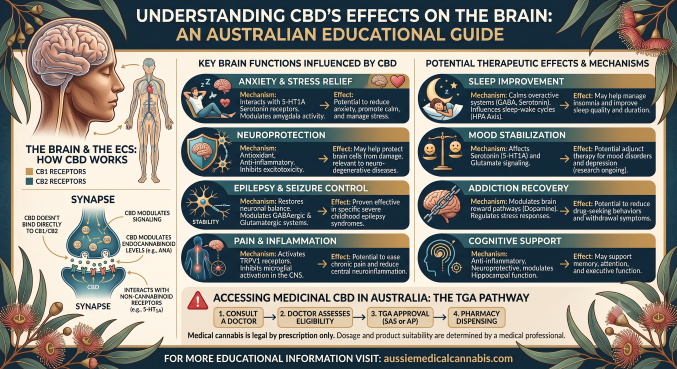
The human brain contains an intricate network of chemical messengers and receptors that regulate mood, memory, learning, pain perception, sleep, and emotional responses. CBD appears to influence several of these systems, although scientists are still working to understand exactly how it produces its effects.
Current evidence suggests CBD may affect brain function differently from THC, with ongoing research exploring its potential role in neurological disorders, epilepsy, anxiety, inflammation, and neuroprotection. This educational guide explains what researchers currently know about CBD and the brain.
What Is CBD?
CBD is a naturally occurring cannabinoid present in cannabis plants.
Scientists have identified more than 100 cannabinoids, but CBD remains one of the most extensively studied because of its unique pharmacological profile and generally non-intoxicating nature.
Unlike THC, CBD does not strongly activate the cannabinoid receptors responsible for intoxication.
Understanding the Endocannabinoid System
CBD interacts with the body’s endocannabinoid system (ECS).
The ECS helps regulate numerous physiological processes including:
- Memory
- Mood
- Learning
- Sleep
- Appetite
- Pain perception
- Emotional regulation
- Immune responses
Rather than directly stimulating cannabinoid receptors like THC, CBD appears to influence the ECS indirectly while also interacting with several other signalling pathways throughout the brain.
How CBD Affects Brain Signalling
Researchers believe CBD may influence communication between nerve cells through several mechanisms.
These include possible effects on:
- Serotonin signalling
- Endocannabinoid activity
- Inflammatory pathways
- Oxidative stress
- Calcium regulation within cells
Because these systems influence many brain functions, CBD continues to be investigated across multiple neurological and psychiatric conditions.
CBD and Anxiety
One of the most studied areas of CBD research involves anxiety.
Some early clinical studies suggest CBD may reduce anxiety symptoms in certain situations, possibly through interactions with serotonin receptors involved in mood regulation.
However:
- Larger clinical trials are still needed.
- Evidence remains insufficient to recommend CBD as a standard treatment for anxiety disorders.
- Researchers continue investigating which patients may benefit.
CBD and Epilepsy
One of the strongest areas of scientific evidence relates to certain rare forms of treatment-resistant epilepsy.
Prescription CBD medicines have demonstrated benefits in reducing seizure frequency for selected patients under specialist medical supervision.
This represents one of the best-established therapeutic uses of CBD.
CBD and Neuroprotection
Researchers are investigating whether CBD may have neuroprotective properties.
Laboratory and early clinical studies have explored its potential role in:
- Neurodegenerative diseases
- Brain inflammation
- Oxidative stress
- Nerve cell protection
Although findings are promising, further human clinical trials are required before firm conclusions can be drawn.
CBD and Sleep
CBD has also been studied for its potential effects on sleep.
Some people report improvements in sleep quality, but researchers continue examining whether these effects occur directly or result from improvements in pain, anxiety, or other symptoms.
Current evidence remains mixed.
CBD and Memory
Unlike THC, CBD does not appear to produce the same temporary impairment of memory and concentration associated with intoxication.
Researchers continue studying whether CBD may influence learning, memory formation, and cognitive performance, but current evidence remains limited.
CBD and Brain Inflammation
Inflammation within the nervous system is an important area of research.
Early studies suggest CBD may influence inflammatory pathways that contribute to certain neurological conditions.
However, more high-quality human studies are needed to confirm these findings.
CBD vs THC: Effects on the Brain
| Feature | CBD | THC |
|---|---|---|
| Psychoactive | Generally no | Yes |
| Produces intoxication | No | Yes |
| Temporary memory impairment | Not typically | Possible |
| Anxiety effects | Under investigation | May increase anxiety in some individuals |
| Primary research areas | Epilepsy, anxiety, neuroprotection | Pain, nausea, appetite, spasticity |
Educational Comparison Table
| Topic | CBD | THC |
| Intoxication | No | Yes |
| Brain signalling | Indirect influence | Direct CB1 receptor activation |
| Cognitive impairment | Generally minimal | Temporary impairment possible |
| Current evidence | Growing | Extensive |
Possible Side Effects
Although CBD is generally well tolerated, side effects can occur.
Reported side effects include:
- Fatigue
- Drowsiness
- Dry mouth
- Diarrhoea
- Changes in appetite
- Dizziness
The likelihood varies depending on the dose, product, and individual.
Australian Regulation
CBD-containing aussie medical cannabis products are regulated through Commonwealth legislation together with state and territory requirements.
Healthcare professionals consider:
- Medical history
- Previous treatments
- Current medicines
- Available scientific evidence
- Potential benefits and risks
before recommending or prescribing CBD products where appropriate.
Ongoing Research
Researchers continue investigating CBD for potential roles in:
- Epilepsy
- Anxiety disorders
- Parkinson’s disease
- Alzheimer’s disease
- Multiple sclerosis
- Chronic pain
- Neurodegenerative disorders
- Brain injury
Many proposed therapeutic applications remain under active scientific investigation.
Where to Learn More
Reliable educational information is available at https://aussiemedicalcannabis.com/
- Therapeutic Goods Administration – Medicinal Cannabis
- Healthdirect Australia – Medicines and Health Information
- Australian Government Department of Health, Disability and Ageing – Medicinal Cannabis
PubMed Reference
Frequently Asked Questions
1. How does CBD affect the brain?
CBD interacts with the endocannabinoid system and several other signalling pathways involved in mood, memory, sleep, pain perception, and inflammation. Researchers are still studying its precise mechanisms.
2. Does CBD make you feel high?
No. CBD is generally considered non-intoxicating and does not typically produce the psychoactive effects associated with THC.
3. Can CBD protect brain cells?
Early laboratory and clinical research has explored possible neuroprotective effects, but more human studies are needed before conclusions can be made.
4. Does CBD affect memory?
Unlike THC, CBD is not generally associated with temporary memory impairment, although research into its cognitive effects is ongoing.
5. Is CBD being studied for neurological disorders?
Yes. Researchers continue investigating CBD in epilepsy, neurodegenerative diseases, anxiety disorders, multiple sclerosis, and other neurological conditions.
Conclusion
CBD influences the brain through complex interactions with the endocannabinoid system and several other biological pathways. Unlike THC, CBD does not typically produce intoxication and appears to affect brain function differently. Current research supports its use for certain forms of treatment-resistant epilepsy and continues to explore its potential roles in anxiety, neuroprotection, inflammation, and other neurological conditions. While findings are promising in several areas, more high-quality clinical trials are needed to better understand CBD’s long-term effects and therapeutic potential.
