
Cannabis Education
CBD Vape Prescription Australia: Legal Access, Inhaled CBD, Pharmacies and TGA Rules
Sep
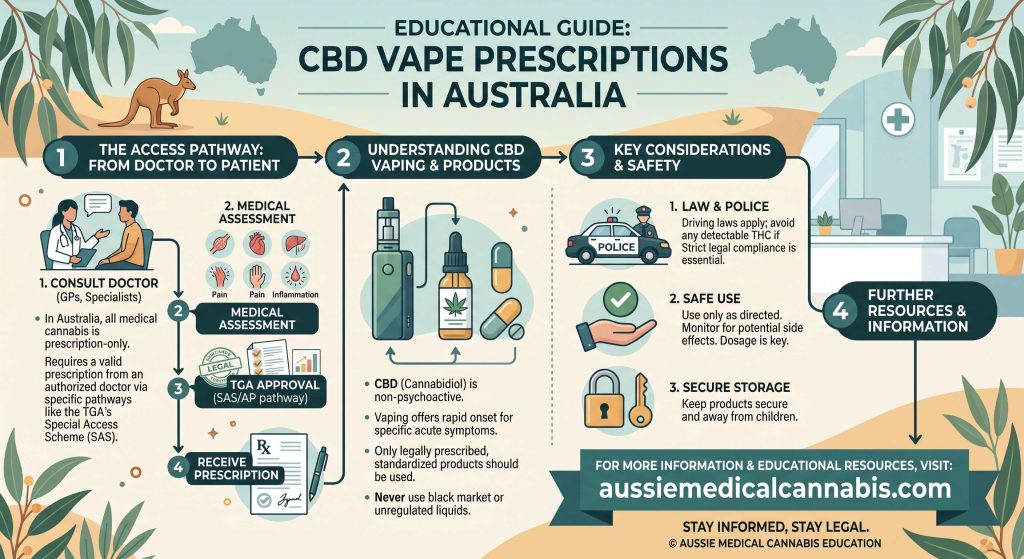
A CBD vape prescription Australia search usually comes from people trying to understand whether cannabidiol can legally be prescribed in an inhaled or vaporised form. The short answer is that medicinal cannabis intended for inhalation does exist within Australia’s regulated medical system, but it is not equivalent to buying an ordinary CBD vape from a vape shop or general online retailer.
The Therapeutic Goods Administration says medicinal cannabis, including vaping products used to administer medicinal cannabis, can legally be obtained from a pharmacy with a prescription from a doctor or nurse practitioner. It also states that obtaining medicinal cannabis vaping products from tobacconists, vape shops, convenience stores or online stores that are not registered pharmacies is unlawful.
Australians researching CBD, THC, vapour products, prescriptions and medicinal cannabis regulation can also explore aussiemedicalcannabis.com for further educational information.
What Is a CBD Vape Prescription in Australia?
A CBD vape prescription refers broadly to a prescription for a medicinal cannabis product containing cannabidiol that is intended to be administered by inhalation or vaporisation.
The terminology needs care because several different things can be described casually as a “CBD vape.”
They may include an inhalation formulation containing predominantly CBD, a CBD-dominant dried cannabis product used with a compatible medical vaporiser, a metered-dose inhaler, or a balanced CBD/THC inhalation product.
These are not necessarily interchangeable.
The TGA’s medicinal cannabis product list, updated 25 March 2026, includes CBD-dominant dried herb, inhalation formulations and metered-dose inhalers within products supplied through Special Access Scheme and Authorised Prescriber pathways.
That means inhaled CBD is a genuine category within Australian medicinal cannabis supply, rather than merely an overseas consumer trend.
CBD Vape Prescription Australia vs Ordinary CBD Vape
The difference between medicinal supply and retail vaping is fundamental.
| Product or pathway | Medical assessment | Pharmacy supply | CBD/THC composition known | Australian medicinal pathway |
|---|---|---|---|---|
| Prescribed medicinal CBD inhalation product | Yes | Yes | Yes | Yes |
| CBD-dominant medicinal flower for vaporisation | Yes | Yes | Yes | Yes |
| Prescribed metered-dose cannabis inhaler | Yes | Yes | Yes | Yes |
| General vape-shop CBD vape | Not necessarily | No | Uncertain | No |
| Unverified overseas CBD cartridge | Not necessarily | No | Uncertain | Not equivalent |
The TGA specifically says patients break the law if they obtain medicinal cannabis or associated vaping products from a tobacconist, vape shop, convenience store or an online store that is not a registered pharmacy.
Therefore, a CBD vape prescription Australia pathway should be understood as medical prescribing and pharmacy dispensing, not unrestricted consumer vape retail.
Can CBD Be Prescribed for Inhalation in Australia?
Potentially, yes.
The current TGA medicinal cannabis product list contains several products classified by inhalation dosage form.
For example, the Category 1 section contains CBD-dominant products including a metered-dose inhaler, while other categories include inhalation products containing CBD with varying amounts of THC.
The TGA categorises many unapproved medicinal cannabis products according to cannabinoid composition rather than brand. There are five SAS/AP categories based on CBD and other cannabinoid content.
Importantly, the presence of a product on the TGA list does not mean every patient can request it or that a clinician must prescribe it.
The clinician still needs to determine whether medicinal cannabis and the inhaled route are clinically appropriate.
What Counts as a CBD-Dominant Product?
The TGA’s Category 1 classification applies where CBD accounts for at least 98% of the total cannabinoid content and other naturally occurring cannabinoids account for no more than 2%. Category 1 products are Schedule 4 prescription-only medicines.
Other medicinal cannabis categories may contain substantial amounts of CBD alongside THC.
This means a product described colloquially as a “CBD vape” may not necessarily be THC-free.
Patients should therefore pay attention to the verified cannabinoid composition rather than relying only on marketing terms such as:
“CBD vape,” “hemp vape,” “full spectrum vape,” or “CBD dominant.”
For broader Australian explanations of cannabinoid categories and medicinal cannabis products, readers can explore aussiemedicalcannabis.com medicinal cannabis information.
CBD Vape vs CBD Oil
CBD oil and inhaled CBD are different formulations.
CBD oil is usually swallowed or administered through the mouth, while inhaled CBD enters the body through the lungs.
That difference affects pharmacokinetics.
A controlled study involving 18 healthy adults compared oral CBD with vaporised CBD and CBD-dominant cannabis. Researchers found that CBD concentrations in blood and oral fluid differed substantially depending on route and formulation.
Another study found urinary CBD concentrations peaked considerably earlier after vaporised CBD than after oral CBD, further demonstrating that route of administration influences cannabinoid exposure.
This does not mean vaping is medically preferable.
It means clinicians should treat route of administration as a meaningful part of prescribing rather than assuming oral and inhaled CBD are equivalent.
Does CBD Vaping Work Faster Than CBD Oil?
Inhaled cannabinoids generally enter systemic circulation faster than cannabinoids swallowed orally.
The pharmacokinetic research cited above found earlier CBD exposure after vaporisation than oral administration.
However, faster onset does not automatically mean better treatment.
Clinical suitability may depend on the condition being treated, duration of desired effect, pulmonary health, medicine interactions, cannabinoid composition and individual response.
A practitioner may therefore prefer an oral preparation for one patient and an inhaled preparation for another—or decide that medicinal cannabis is not appropriate at all.
Do You Need a Prescription for a Medicinal CBD Vape?
For medicinal cannabis vaping products, the lawful Australian pathway involves a prescription.
The TGA says legal medicinal cannabis vaping products can be obtained through a pharmacy with a prescription from a doctor or nurse practitioner.
This should not be confused with the separate rules governing some nicotine vaping products.
Australian therapeutic-vape legislation includes specific arrangements relating to smoking cessation and nicotine dependence, but the TGA explicitly notes that cannabis vapes are subject to separate strict medicinal-cannabis regulation.
So the rules for nicotine vapes should not be assumed to apply to medicinal CBD or THC vaping products.
How Does a CBD Vape Prescription Work?
A typical medical pathway involves assessment first.
A registered practitioner considers the patient’s diagnosis, symptoms, previous treatments, medical history, current medicines and potential risks.
If medicinal cannabis is appropriate, the clinician determines the cannabinoid profile and route of administration that best fit the clinical situation.
Where an unapproved medicinal cannabis product is used, the relevant TGA access pathway may need to be followed.
The TGA says access to medicinal cannabis can only be arranged through an Australian registered health practitioner and identifies mechanisms such as the Special Access Scheme and Authorised Prescriber pathway.
The prescription is then supplied through a pharmacy.
So the general pathway is:
clinical assessment → prescribing decision → TGA pathway where required → pharmacy dispensing → compatible device if needed → follow-up
Are CBD Vape Products TGA Approved?
Some confusion arises because the cannabis medicine and the vaping device are two different regulated items.
The TGA states that most medicinal cannabis products sold in Australia are unapproved therapeutic goods, even though they may be lawfully prescribed through special access mechanisms.
By contrast, several medicinal cannabis vaping devices are currently included in the Australian Register of Therapeutic Goods.
As of the TGA’s 5 June 2026 update, the listed approved devices include:
- SyqeAir Inhaler
- Mighty+ Medic
- Volcano Medic 2
- Grenco Medical Elite II
These devices have been included on the ARTG and approved for quality, safety and performance for their intended medicinal-cannabis use.
A TGA-approved device does not mean every cannabis formulation used with it is itself an ARTG-approved medicine.
The device and the medicinal cannabis product have separate regulatory statuses.
Can You Use Any Vape Device?
No.
The TGA advises patients prescribed medicinal cannabis for vaping to speak with their doctor, nurse practitioner or pharmacist about a compatible device.
Current TGA guidance encourages use of ARTG-listed medicinal cannabis vaping devices wherever possible. Where those devices are not clinically suitable, limited pathways may allow access to an unapproved device through SAS or AP arrangements.
The strengthened Australian vaping framework also means ordinary consumer vaping hardware cannot simply be assumed suitable for medicinal cannabis.
The TGA says medicinal cannabis vaping devices can only be supplied to patients through pharmacies.
What About 510 Batteries and Empty Cartridges?
These products are specifically addressed by the TGA.
Its patient guidance says restrictions apply not only to medicinal cannabis itself but also to associated vaping products, including 510 batteries, replacement parts, empty cartridges, pods and capsules designed for medicinal cannabis.
The TGA’s July 2026 industry guidance similarly explains that medicinal-cannabis vaping device regulation covers items such as tanks, mouthpieces, replacement parts, consumables and standalone items intended specifically for vaping medicinal cannabis.
Prefilled medicinal cannabis cartridges and pods are treated differently because they contain medicine and are therefore regulated as medicinal cannabis substances rather than merely devices.
CBD Vape Prescription and THC
One of the most important details is whether the prescribed product contains THC.
A CBD-dominant product may still contain some THC unless it falls within a very tightly defined CBD category.
The TGA’s 2026 medicinal cannabis product list includes inhalation products with compositions ranging from highly CBD-dominant preparations to balanced CBD/THC formulations and high-THC inhalation products.
This affects intoxication, adverse effects, scheduling and driving considerations.
Healthdirect explains that THC has strong psychoactive effects whereas CBD does not produce the characteristic cannabis high.
Patients should therefore ask specifically:
How much CBD does this medicine contain?
and
Does it contain THC?
Those questions matter much more than whether the product is casually described as a CBD vape.
CBD Vape Prescription and Driving
Driving is especially important where even small amounts of THC are present.
Research shows why the cannabinoid composition of CBD-dominant products matters. In one controlled study of vaporised CBD-rich cannabis containing less than 1% THC, THC could still be detected in some participants for several hours after administration. The researchers warned that this could have legal consequences for drivers.
This was not an Australian road-law study, so the results should not be used to predict a specific Australian roadside test outcome.
However, it reinforces a practical point: CBD-dominant does not always mean THC-free.
Australian patients should discuss driving with their practitioner and follow the current rules applying in their state or territory.
CBD Vape Prescription Through Telehealth
A practitioner may potentially assess medicinal cannabis through telehealth where remote care is clinically appropriate.
The consultation should still operate like healthcare rather than an online vape purchase.
A practitioner may review the diagnosis, previous treatments, current medicines, risks and intended route of administration before deciding whether an inhaled cannabinoid product is appropriate.
If prescribed, the medicinal cannabis and compatible vaping device remain subject to pharmacy and regulatory requirements.
A legitimate online pathway is therefore better understood as:
telehealth consultation → prescription if clinically appropriate → pharmacy
rather than:
website → CBD vape checkout → delivery.
Can a Pharmacy Supply the Device Too?
Yes, depending on availability and the prescription pathway.
The TGA says approved medicinal cannabis vaping devices can be purchased by patients through pharmacies.
Its patient guidance advises people to make sure their pharmacy can obtain the compatible vaping device before paying for prescribed items.
That matters because a particular inhalation product may require compatible hardware.
Pharmacies also cannot necessarily be assumed to hold every medicinal cannabis medicine or device in stock.
The TGA notes that many unapproved medicinal cannabis products need to be ordered by the pharmacy.
CBD Vape vs Dry Herb Vaporisation
“CBD vape” can refer to very different medical formats.
CBD-dominant dried cannabis flower may be prescribed and vaporised using an appropriate medical device.
An inhalation formulation may instead come in a cartridge-like or other inhaled medicine format.
Metered-dose inhalers provide yet another formulation.
The TGA’s medicinal cannabis list contains examples of dried herb, inhalation products and metered-dose inhalers containing CBD.
Therefore, patients should not assume that a prescription for inhaled CBD necessarily means an e-cigarette-style disposable vape.
Is Smoking the Same as Vaporising?
No.
Smoking involves combustion.
Vaporisation heats material or a formulation to generate an inhalable aerosol or vapour without the same combustion process.
Australian health guidance distinguishes medicinal vaporisation from smoking cannabis.
The availability of medically regulated vaporising devices should therefore not be interpreted as endorsement of smoking cannabis.
What Conditions Can Lead to an Inhaled CBD Prescription?
There is no universal list that guarantees eligibility for a CBD vape prescription.
Healthdirect says medicinal cannabis is used to relieve symptoms of some medical conditions but is not considered first-line treatment. A clinician will usually consider it after other medicines or treatments have not worked sufficiently.
Whether inhalation is appropriate is another separate question.
A practitioner may consider the need for faster onset, the patient’s health status, previous response to other formulations and the balance between potential benefits and risks.
The route should be clinically justified rather than chosen simply because someone prefers vaping.
Is Vaporised CBD Proven Better Than Oral CBD?
Current research does not establish that vaporised CBD is universally better.
Studies show clear differences in pharmacokinetics between oral and vaporised administration, but pharmacokinetic differences are not the same as proof of superior therapeutic effectiveness.
A systematic review of CBD pharmacokinetics found substantial variation according to formulation and route of administration across 39 studies and 112 trial arms.
Controlled laboratory research also shows that vaporised CBD produces measurable subjective and pharmacokinetic effects, but the clinical value depends on the specific condition and product.
Patients should therefore avoid interpreting “faster absorption” as “better medicine.”
Potential Risks of CBD Vaping
CBD is not inherently risk-free.
Inhaled products introduce additional issues that oral products do not, including respiratory exposure and the importance of device quality and formulation compatibility.
CBD can also interact with medicines.
If THC is present, additional issues may include intoxication, cognitive impairment, anxiety or driving restrictions.
One 2026 controlled study found that adding CBD to vaporised THC-containing cannabis increased circulating THC and THC-metabolite concentrations compared with THC alone under the study conditions.
That illustrates why CBD should not automatically be assumed to neutralise THC pharmacologically.
Buying CBD Vapes Online in Australia
Consumers should be particularly cautious here.
The TGA’s guidance is explicit: medicinal cannabis and vaping products must not be obtained from ordinary online stores that are not registered pharmacies.
This means overseas CBD vape websites, social-media sellers and ordinary Australian vape stores should not be treated as substitutes for prescription and pharmacy supply.
The presence of terms such as “CBD,” “medical,” “hemp,” “therapeutic,” or “Australian shipping” does not prove lawful medicinal supply.
A legitimate prescription pathway should involve an Australian health practitioner and pharmacy.
Educational Resources
For the most current rules on medicinal cannabis inhalation and pharmacy access, see the TGA medicinal cannabis information for patients. The TGA explains that medicinal cannabis vaping products require lawful prescription and pharmacy supply and warns against purchasing them from vape shops or unregistered online stores.
The TGA list of approved medicinal cannabis vaping devices identifies ARTG-listed devices currently approved for medicinal cannabis vaporisation.
The Healthdirect medicinal cannabis guide explains CBD, THC, prescriptions, potential uses and Australia’s broader medicinal cannabis framework.
For peer-reviewed research, see PubMed: pharmacokinetics of vaporised and oral CBD. The study directly compared oral CBD, vaporised CBD and vaporised CBD-dominant cannabis in healthy adults.
Where to Explore Further
Australians researching CBD vape prescription Australia, medicinal cannabis inhalation, CBD oil, THC, telehealth and pharmacy access can continue exploring educational information through aussiemedicalcannabis.com.
For individual treatment decisions, speak with an appropriately registered healthcare practitioner. The suitability of inhaled CBD depends on the patient’s circumstances, product composition and clinical need, and current TGA and state or territory requirements should take priority over promotional claims.
Frequently Asked Questions
1. Can you get a CBD vape prescription in Australia?
Potentially. The TGA’s medicinal cannabis product list includes CBD-dominant inhalation products, dried herb and metered-dose inhaler formulations. A registered practitioner must determine whether medicinal cannabis and the inhaled route are clinically appropriate.
2. Can I buy a CBD vape from a vape shop with a prescription?
No. The TGA says medicinal cannabis vaping products and related devices must not be obtained from tobacconists, vape shops, convenience stores or online stores that are not registered pharmacies.
3. Does a CBD vape prescription mean the product contains no THC?
Not necessarily. Some inhaled medicinal cannabis products are strongly CBD-dominant, while others combine CBD with THC. Patients should check the exact cannabinoid composition of the prescribed medicine.
4. Are medicinal cannabis vaporisers approved in Australia?
Some are. As of the TGA’s 5 June 2026 update, approved medicinal cannabis vaping devices include the SyqeAir Inhaler, Mighty+ Medic, Volcano Medic 2 and Grenco Medical Elite II.
5. Is CBD vaping the same as CBD oil?
No. CBD oil is generally administered orally, while vaporised CBD is inhaled. Research shows that route of administration changes how quickly and to what extent CBD appears in the body, but faster absorption does not establish that vaping is clinically superior.
