
Cannabis Education
Cannabis Telehealth in Australia: Online Consultations, Prescriptions, CBD and THC
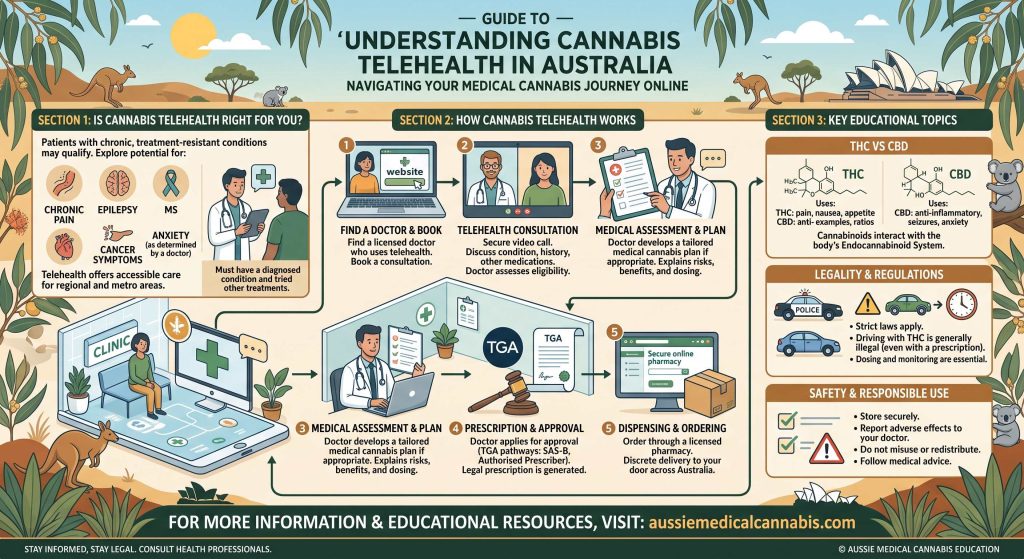
Sep
Cannabis telehealth has become an important way Australians access medical consultations about medicinal cannabis without necessarily attending a clinic in person. Through phone or video appointments, a registered healthcare practitioner can review a patient’s condition, medical history, previous treatments and current medicines before deciding whether medicinal cannabis is clinically appropriate.
Telehealth does not turn medicinal cannabis into an unrestricted online product. In Australia, the underlying pathway remains medical: assessment, prescribing where appropriate, any required regulatory process, and pharmacy dispensing. Healthdirect describes virtual care as healthcare delivered by phone, video or other online services and notes that online prescriptions can be part of virtual care when clinically appropriate.
Australians researching medicinal cannabis, telehealth, CBD and THC can also explore aussiemedicalcannabis.com for additional Australian-focused educational information.
What Is Cannabis Telehealth?
Cannabis telehealth is a remote medical consultation focused on whether medicinal cannabis may be appropriate as part of a patient’s treatment.
Instead of physically visiting a clinic, the patient may speak with a practitioner by telephone or video.
A consultation can involve discussion of the patient’s diagnosis, symptoms, current prescriptions, previous therapies, treatment goals, possible contraindications and practical issues such as driving or work requirements.
The important point is that cannabis telehealth is healthcare, not online cannabis shopping.
A legitimate consultation should be capable of ending with a decision not to prescribe medicinal cannabis if the clinician decides it is inappropriate.
Cannabis Telehealth vs Online Cannabis Store
These two models are fundamentally different.
| Feature | Cannabis Telehealth | General Online Cannabis Store |
|---|---|---|
| Medical assessment | Yes | Often no |
| Registered practitioner involved | Yes | Not necessarily |
| Prescription guaranteed | No | May market direct purchase |
| CBD/THC selected clinically | Potentially | Often consumer-selected |
| Pharmacy dispensing | Normally part of legal pathway | Not necessarily |
| Suitable Australian medical model | Yes | Not automatically |
An attractive website, online checkout or cannabis product menu does not establish that a business is operating within Australia’s medical framework.
The Australian model centres on professional prescribing and pharmacy supply rather than recreational e-commerce.
Is Cannabis Telehealth Legal in Australia?
Telehealth itself is a legitimate method of delivering healthcare in Australia.
Healthdirect explains that virtual care can include consultations by phone or video, online prescriptions and other remote services when they are safe and clinically appropriate.
Medicinal cannabis has been legally accessible through Australia’s medical framework since 2016. A review of Australian prescribing found that by August 2022, 5,284 specialist and GP prescribers had submitted Special Access Scheme applications relating to medicinal cannabis.
However, the fact that the appointment occurs online does not remove medicinal-cannabis prescribing requirements.
How Does a Cannabis Telehealth Appointment Work?
The exact process varies between services, but a proper telehealth consultation should function similarly to other medical appointments.
A patient may first provide information about their symptoms, diagnosis and treatment history. During the consultation, the practitioner can ask additional questions, review medications and assess whether medicinal cannabis is reasonable to consider.
If the clinician decides treatment is appropriate, a prescription may be issued.
Where an unapproved medicinal cannabis product is involved, applicable TGA pathways may also need to be followed.
The medicine is then dispensed through a pharmacy rather than simply supplied as a recreational online purchase.
A simplified pathway is:
Online appointment → medical assessment → treatment decision → prescription if appropriate → regulatory pathway where required → pharmacy → follow-up
Can Cannabis Telehealth Provide an eScript?
Electronic prescriptions can form part of Australian telehealth care.
Healthdirect explains that an eScript can be sent to a patient by SMS or email. The prescription contains a digital token that a pharmacist can scan when dispensing the medicine. A pharmacy that provides a delivery service may also send the prescribed medicine to the patient’s home.
An eScript therefore makes the prescription process more convenient.
It does not bypass medical assessment or pharmacy requirements.
Who Can Prescribe Medicinal Cannabis Through Telehealth?
A patient does not necessarily need someone formally branded as a “cannabis doctor.”
Prescribing rules depend partly on jurisdiction and the particular medicine.
Queensland provides a clear current example. Queensland Health states that any Queensland medical practitioner or nurse practitioner may prescribe medicinal cannabis for any patient or condition when they consider it clinically appropriate, provided required TGA approval has been obtained for applicable unapproved products.
Queensland Health also states that separate Queensland approval is not required to prescribe Schedule 4 or Schedule 8 medicinal cannabis.
A dedicated cannabis telehealth clinic is therefore one pathway—not the only legal pathway.
For further background on Australian clinics and prescribing, readers can explore Australian medicinal cannabis education..
Cannabis Telehealth and CBD
CBD, or cannabidiol, is one cannabinoid that may be considered during a medicinal cannabis consultation.
CBD differs from THC because it does not produce the characteristic intoxication associated with THC.
However, CBD is still pharmacologically active. It can interact with medicines and may cause adverse effects.
A credible telehealth consultation should therefore review the patient’s other medicines and health history instead of treating CBD as an ordinary wellness supplement.
The word “CBD” also does not tell a clinician everything needed about a product. Concentration, formulation, other cannabinoids and regulatory status all matter.
Cannabis Telehealth and THC
THC requires particular caution because it is psychoactive.
It may affect attention, coordination, reaction time, memory and perception.
For that reason, a telehealth consultation involving THC should ordinarily include discussion of driving, occupational safety, other sedating medicines and mental-health history.
In Queensland, medicinal cannabis may fall into Schedule 3, Schedule 4 or Schedule 8 depending on the product, and most medicinal cannabis products are not registered on the ARTG.
Queensland Health specifically identifies THC-containing medicinal cannabis within Schedule 8 controlled-medicine arrangements.
Are Telehealth Cannabis Products TGA Approved?
Not necessarily.
The TGA stated on 2 June 2026 that most medicinal cannabis products sold in Australia are unapproved therapeutic goods, even when prescribed by healthcare practitioners.
This distinction is important.
An approved therapeutic good has undergone the standard TGA assessment process and is included on the Australian Register of Therapeutic Goods.
An unapproved therapeutic good has not gone through that normal approval pathway.
However, Australian law provides mechanisms allowing clinicians to lawfully prescribe certain unapproved medicines in appropriate circumstances.
Therefore:
prescribed does not always mean individually TGA-approved.
Special Access Scheme and Cannabis Telehealth
One important route for unapproved medicinal cannabis is the Special Access Scheme, commonly called SAS.
The TGA explains that SAS allows practitioners to access unapproved therapeutic goods for individual patients. Depending on the circumstances, different SAS categories apply. For medicinal cannabis, the TGA notes that the Category B application pathway will generally be the relevant route where other categories do not apply.
The patient does not personally apply to the TGA and then order cannabis.
The healthcare practitioner manages the applicable regulatory process.
Authorised Prescriber Pathway
The Authorised Prescriber Scheme provides another legal pathway for certain unapproved medicinal cannabis products.
The TGA currently identifies both SAS and AP as important medicinal-cannabis access mechanisms and maintains an online system for prescribers.
This regulatory process can occur behind the scenes during a telehealth treatment pathway.
Patients should nevertheless understand whether their proposed medicine is an approved product or an unapproved therapeutic good.
What Medicinal Cannabis Products May Be Discussed?
Medicinal cannabis is not one single medicine.
Queensland Health identifies examples including tinctures, dried plant material or concentrated extracts intended for vaporisation, capsules, sprays and pharmaceutical cannabinoid products such as nabiximols. It also states that smoking cannabis products is not supported.
Products can contain primarily CBD, primarily THC or combinations of both.
A telehealth practitioner should select treatment according to medical circumstances rather than simply offering whatever cannabis product has the highest THC percentage or the most popular strain name.
Why Telehealth Has Become Important for Cannabis Access
Geography is one of the clearest advantages.
Australia has large regional and rural populations, and patients may live considerable distances from practitioners experienced in cannabinoid medicine.
A 2025 Australian scoping review examining medicinal-cannabis access through general practitioners found that rural residence and limited GP knowledge could create access barriers. Importantly, the researchers concluded that telehealth cannabis clinics reduced geographical barriers, although financial barriers remained.
That means telehealth can improve convenience and geographical accessibility without necessarily making treatment inexpensive.
Does Telehealth Make Cannabis Easier to Prescribe?
It can make the consultation easier to access, but that should not mean lower clinical standards.
A remote consultation still requires professional judgment.
The practitioner should consider whether medicinal cannabis is justified and whether established treatments have already been considered.
The TGA’s 2026 guidance emphasises that prescribing decisions for unapproved medicinal cannabis should be based on sound clinical judgment and available evidence.
A telehealth service advertising near-automatic approval would therefore deserve caution.
Cannabis Telehealth for Chronic Pain
Pain is a major reason Australians report using medicinal cannabis.
The CAMS-22 Australian survey included 3,323 respondents who had used cannabis for medical reasons. Pain represented 37% of the principal conditions reported by participants.
However, chronic pain includes many different conditions.
Neuropathic pain, arthritis-related pain, cancer pain and musculoskeletal pain may have different evidence bases and treatment approaches.
A telehealth practitioner should therefore identify the actual diagnosis rather than using the word “pain” as automatic justification for cannabis.
Cannabis Telehealth for Mental Health
Mental-health concerns are also common among medicinal cannabis users.
In CAMS-22, mental-health conditions represented 36% of the main conditions reported by respondents.
This area requires careful assessment because THC is psychoactive and may not be suitable for every patient.
CBD and THC also have substantially different pharmacological profiles.
A good cannabis telehealth service should therefore ask about psychiatric history and current medicines rather than assuming all cannabinoid products will be calming.
Cannabis Telehealth for Sleep
Sleep represented 15% of the principal conditions reported in CAMS-22.
But insomnia can occur because of chronic pain, anxiety, depression, sleep apnoea, medication effects or other health disorders.
Sedation from a medicine does not necessarily mean the underlying sleep disorder is being treated effectively.
A telehealth consultation should therefore investigate why a patient is having difficulty sleeping before deciding whether cannabinoid treatment is reasonable.
What Research Says About Prescribed vs Illicit Cannabis
The CAMS-22 survey provides useful Australian real-world data.
Of 3,323 respondents, 2,352, or 73%, mainly used prescribed medicinal cannabis, while 871, or 27%, mainly used illicit cannabis.
Prescribed users were more likely to consume cannabis orally or through vaporisation and were substantially more likely to know the cannabinoid composition of their medicine. The odds of being certain about product composition were about 25 times greater in prescribed users.
These findings do not establish that cannabis is effective for every condition.
They do illustrate why a regulated medical pathway can provide greater certainty about product composition than illicit sourcing.
Cannabis Telehealth Clinics vs General Healthcare
Specialist cannabis telehealth clinics have become prominent, but patients can also discuss medicinal cannabis within general healthcare.
An Australian survey involving 2,394 prescribed medicinal cannabis users found that 79.3% accessed treatment primarily through medicinal cannabis clinics.
However, patients using generalist healthcare settings reported higher satisfaction in several areas, including consultation duration, information about benefits and harms, consideration of other treatments and treatment costs.
That does not prove one model is universally better.
It suggests that patients should assess telehealth clinics based on healthcare quality rather than convenience or cannabis-specific branding alone.
What Makes a Good Cannabis Telehealth Consultation?
A thorough consultation should review much more than whether a patient has used cannabis previously.
The clinician should understand the diagnosis, treatments already tried, current medications, allergies, mental-health history and treatment goals.
Potential benefits and uncertainties should be discussed alongside side effects, interactions, driving implications and costs.
Follow-up is also important because the patient’s response and adverse effects may need ongoing review.
A service that provides only a short product-selection process may not offer the same depth as comprehensive clinical care.
Pharmacy Dispensing After Telehealth
The prescription is only part of the process.
Once prescribed, medicinal cannabis is ordinarily supplied through a pharmacy.
Electronic prescribing can simplify this. Healthdirect says patients can receive an eScript by SMS or email and present its digital token to a pharmacist. If the pharmacy provides delivery, the medicine can potentially be sent to the patient’s home.
This means legitimate cannabis telehealth can be highly digital while still operating through Australia’s healthcare and pharmacy system.
Cannabis Telehealth Is Not Weed Delivery
This distinction is important for Australian search terms.
Telehealth consultation followed by lawful pharmacy delivery is fundamentally different from an online recreational cannabis delivery service.
A patient is receiving prescribed medicine after a clinical decision—not simply purchasing cannabis because they want a particular strain or THC product.
The online nature of the process therefore does not transform medicinal cannabis into ordinary e-commerce.
Cannabis Telehealth and Driving
Driving should be discussed before THC-containing medicinal cannabis is prescribed.
THC may impair reaction time, concentration and coordination.
Australian road rules are determined at state and territory level, and a prescription should not be assumed to provide a universal exemption from drug-driving laws.
People who drive professionally or depend heavily on driving should raise the issue during their initial telehealth appointment rather than discovering the implications after treatment begins.
Costs of Cannabis Telehealth
Telehealth can reduce travel and make appointments geographically easier to access, but it does not necessarily make medicinal cannabis inexpensive.
Patients may face consultation fees, follow-up fees, pharmacy charges and the cost of the medicine itself.
The 2025 Australian scoping review found that although telehealth cannabis clinics reduced geographical barriers, financial barriers remained.
Patients should therefore consider total ongoing treatment costs rather than focusing only on an inexpensive introductory consultation.
Advertising and Cannabis Telehealth
Consumers should also distinguish healthcare information from aggressive medicine marketing.
Medicinal cannabis is not an ordinary consumer commodity, and prescription-medicine advertising is subject to Australian restrictions.
Good public-facing content should therefore focus on health information, clinical assessment, legal pathways and risks rather than implying that booking a telehealth consultation guarantees access to a particular THC or CBD product.
The TGA’s 2026 guidance also stresses the responsibilities clinicians have when discussing and prescribing unapproved medicinal cannabis.
Educational Resources
For current regulatory guidance, see TGA medicinal cannabis access pathways. The TGA explains the Special Access Scheme, Authorised Prescriber pathway and other mechanisms for accessing unapproved medicinal cannabis.
Queensland readers can consult Queensland Health medicinal cannabis prescribing guidance, which was updated on 4 August 2026 and explains current Queensland prescribing rules.
For general information about remote healthcare, see Healthdirect virtual care clinics and Healthdirect electronic prescriptions.
For peer-reviewed Australian research, see PubMed: Exploring access to medicinal cannabis through general practitioners in Australia. The review found that cannabis telehealth services reduced geographical access barriers while financial barriers remained.
Where to Explore Further
Australians researching cannabis telehealth, online medicinal cannabis consultations, CBD, THC, prescriptions, clinics and pharmacies can continue exploring educational information through aussiemedicalcannabis.com.
For an individual treatment decision, an appropriately registered healthcare practitioner should assess whether medicinal cannabis is suitable. Current TGA and state or territory guidance should take priority over promotional claims from commercial cannabis services.
Frequently Asked Questions
1. Is cannabis telehealth legal in Australia?
Yes. Telehealth is a recognised way of providing healthcare, and medicinal cannabis consultations can take place remotely where clinically appropriate. The prescription and medicine still need to comply with Australian medicinal-cannabis and pharmacy requirements.
2. Can I get a cannabis prescription through telehealth?
Potentially. A registered practitioner may issue a prescription after an appropriate assessment if medicinal cannabis is clinically suitable. A telehealth appointment does not guarantee that cannabis will be prescribed.
3. Can a cannabis telehealth doctor prescribe CBD and THC?
Potentially, depending on clinical circumstances and regulatory requirements. In Queensland, medical practitioners and nurse practitioners may prescribe medicinal cannabis, including relevant Schedule 4 and Schedule 8 products, without separate Queensland approval; TGA requirements still apply to applicable unapproved products.
4. Can a medicinal cannabis prescription be sent electronically?
Yes. Australian eScripts can be sent to patients by SMS or email and presented to a pharmacy through a digital token. Pharmacies offering delivery may also send prescribed medicine to the patient’s home.
5. Is a cannabis telehealth clinic better than a regular GP?
Not necessarily. Telehealth clinics can improve geographical access, particularly for people far from experienced practitioners, but Australian research also shows that specialised cannabis clinics do not automatically produce greater patient satisfaction than generalist healthcare.
