
Cannabis Education
CANNA Nutrients in Australia: Product Ranges, Plant Nutrition, Hydroponics and Cannabis-Law Context
Aug
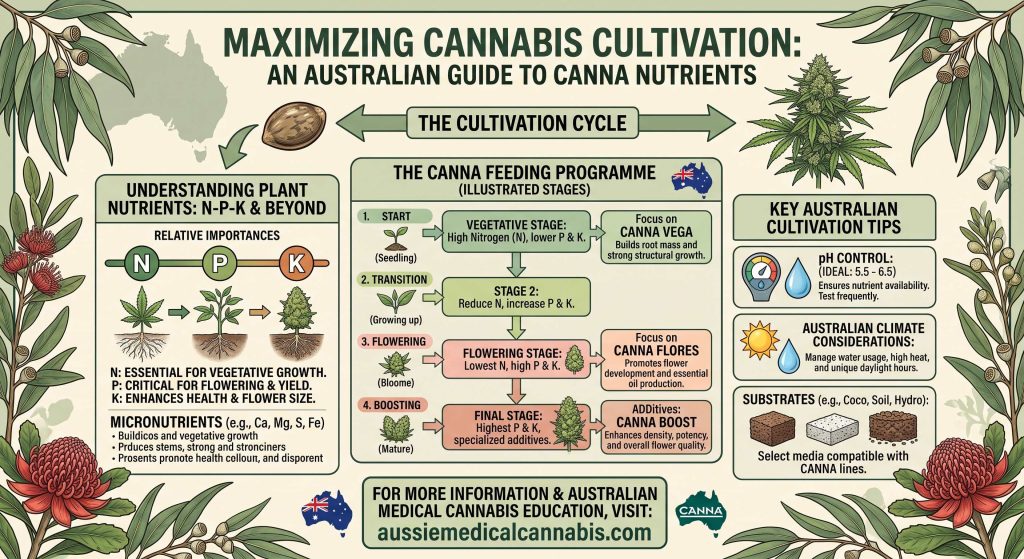
CANNA nutrients are a group of horticultural fertilisers, substrates and plant-support products designed for different growing systems, including peat-based potting mixes, coco coir, recirculating hydroponics, run-to-waste systems and organic cultivation.
The CANNA Australia range currently separates its core products into CANNA TERRA, CANNA COCO, CANNA AQUA, CANNA Classic, BIOCANNA and CANNA Additives. Each system is designed around a particular growing medium or irrigation approach rather than around one specific plant species.
This distinction matters because CANNA nutrients are often associated with cannabis cultivation online. The products themselves are ordinary horticultural inputs, but cultivating cannabis is separately regulated under Australian law. The Office of Drug Control states that growing, producing or manufacturing cannabis for medicinal or scientific purposes requires the relevant licence and permit, and its federal framework does not provide a licence for personal use.
Australians researching cannabis regulation, medicinal cannabis and related horticultural terminology can also explore aussiemedicalcannabis.com for broader educational information.
What Are CANNA Nutrients?
CANNA nutrients are plant-fertiliser formulations designed to supply essential mineral elements during different stages of plant development.
Plants require macronutrients such as nitrogen, phosphorus and potassium, along with calcium, magnesium, sulfur and smaller quantities of micronutrients. These elements participate in processes including photosynthesis, root development, enzyme activity, structural growth and reproduction.
CANNA’s Australian product range is divided according to the cultivation system. The company explains that different substrates behave differently and therefore require different nutrient approaches. Its major categories include TERRA for peat and potting mixes, COCO for coco substrates, AQUA for recirculating systems and Classic for run-to-waste systems.
This means there is no single bottle called simply “the best CANNA nutrient” for every horticultural setup.
Main CANNA Nutrient Systems Compared
| CANNA Range | Intended Growing System | General Characteristic |
|---|---|---|
| CANNA TERRA | Peat and potting mixes | Mineral nutrition for substrate growing |
| CANNA COCO | Coco coir | Designed around coco substrate characteristics |
| CANNA AQUA | Recirculating hydroponics | Nutrients designed for reused nutrient solution |
| CANNA Classic | Run-to-waste/inert substrates | Designed for open hydroponic systems |
| BIOCANNA | Organic-oriented cultivation | Organic product range |
| CANNA Additives | Multiple systems | Supplemental plant/root support products |
CANNA Australia specifically states that TERRA, COCO, AQUA and Classic require different approaches because the physical and chemical properties of their growing media differ.
CANNA TERRA Nutrients
CANNA TERRA is designed primarily for peat-based substrates and conventional potting mixes.
The manufacturer’s Australian material describes TERRA as a nutrient and substrate system for plants grown in peat or potting mixtures, both indoors and outdoors.
The range commonly includes Terra Vega for vegetative development and Terra Flores for flowering and fruiting stages.
The concept behind stage-specific plant nutrition is straightforward: plants do not necessarily have identical nutritional needs throughout their entire life cycle.
Vegetative development places different demands on plant metabolism from reproductive or flowering development.
However, this does not mean simply applying increasingly large quantities of fertiliser produces better plants.
Scientific cannabis research demonstrates that nutrient responses can be nonlinear, and excessive supply can reduce nutrient-use efficiency or alter plant chemistry rather than continuously improving yield.
CANNA COCO Nutrients
CANNA COCO is designed around coco-coir substrates.
Coco behaves differently from peat because its water-holding, aeration and nutrient-binding characteristics differ. A nutrient formulation developed specifically for coco therefore aims to account for those characteristics rather than treating coco as interchangeable with ordinary potting soil.
This is one reason CANNA separates COCO from TERRA.
From a horticultural perspective, selecting nutrients according to substrate is generally more meaningful than choosing fertiliser based purely on brand popularity.
A plant’s root environment affects nutrient availability, moisture, oxygenation and ionic balance.
CANNA AQUA Nutrients
CANNA AQUA is designed for recirculating hydroponic systems.
In a recirculating system, nutrient solution is collected and reused rather than discarded after passing through the root zone.
CANNA Australia specifically states that AQUA was developed for these systems and advises monitoring electrical conductivity and pH because the composition of the circulating nutrient solution can change over time.
Recirculation creates different nutrient-management challenges from run-to-waste cultivation.
Plants selectively absorb water and individual mineral ions, meaning the nutrient solution returning to a reservoir may no longer have exactly the same chemical balance it had when originally supplied.
CANNA Classic Nutrients
CANNA Classic is intended mainly for inert substrates in run-to-waste or open hydroponic systems.
CANNA describes Classic as suitable for substrates such as rock wool where drainage solution is not returned to the plant reservoir.
This makes Classic fundamentally different from AQUA.
A simple distinction is:
AQUA = recirculating
Classic = run-to-waste
Using the correct nutrient range for the irrigation system matters because the formulation is designed with that system’s nutrient behaviour in mind.
BIOCANNA
BIOCANNA is CANNA’s organic-oriented product line.
CANNA Australia describes BIOCANNA as its organic product range for growers who prefer an organic cultivation approach.
Organic and mineral fertilisation differ in how nutrients become available to plants.
Mineral fertilisers generally provide nutrients in ionic forms that can become directly available in the root zone.
Organic systems often depend more heavily on biological decomposition and microbial activity to convert materials into plant-available nutrients.
Neither approach should automatically be interpreted as producing stronger, safer or more medically valuable cannabis.
CANNA Additives
CANNA also markets supplemental products alongside its core nutrient systems.
Its Australian product catalogue describes additives intended to support plant health or correct aspects of the nutrient solution.
Examples across the CANNA range include products associated with root development, enzymes, calcium and magnesium management, and flowering support.
From a plant-science perspective, supplements should not be treated as replacements for balanced fundamental nutrition.
A plant deficient in an essential macronutrient cannot necessarily be rescued by continuously adding unrelated supplements.
Why Nitrogen, Phosphorus and Potassium Matter
The letters N-P-K appear on many fertiliser labels.
They represent:
N — Nitrogen
P — Phosphorus
K — Potassium
Nitrogen contributes strongly to proteins, chlorophyll and vegetative development.
Phosphorus plays roles in energy transfer, cellular metabolism and plant development.
Potassium contributes to water regulation, enzyme function and numerous physiological processes.
Cannabis research demonstrates that these nutrients interact rather than acting independently.
A 2024 study examining cannabis during vegetative growth found significant interactions between nitrogen, phosphorus and potassium affecting root mass, stem development, leaves, chlorophyll and other growth characteristics.
That research helps explain why professional nutrient management focuses on balance rather than simply maximising each nutrient.
More Fertiliser Does Not Automatically Mean More Cannabis Yield
This is one of the most important misconceptions surrounding specialist plant nutrients.
A controlled study investigating nitrogen, phosphorus and potassium during cannabis flowering found a quadratic response to nitrogen and phosphorus, meaning yield did not simply increase indefinitely as nutrient concentrations increased. Potassium also did not increase flower yield across the tested range.
Another study examining phosphorus found that increasing phosphorus input threefold produced a roughly twelvefold increase in phosphorus lost through leachate, without significantly improving flower yield or cannabinoid concentration.
This has both horticultural and environmental implications.
Over-fertilisation can waste money, reduce nutrient efficiency and increase nutrient discharge into the environment.
Do CANNA Nutrients Increase THC?
There is no scientific basis for claiming that a particular CANNA nutrient automatically increases THC.
Cannabinoid chemistry is affected by numerous variables, including genetics, environmental conditions, plant development and mineral nutrition.
Scientific studies demonstrate that nutrient manipulation can sometimes alter cannabinoid concentrations, but responses are complicated.
For example, research on medicinal cannabis found that supplemental N, P, K and humic acids produced different cannabinoid responses depending on the plant tissue and compound examined. Some treatments increased particular cannabinoids while decreasing others.
Another controlled phosphorus study found that increasing phosphorus could improve plant biomass while concentrations of THCA and CBDA in inflorescences decreased under some conditions, demonstrating a yield-dilution effect.
So the idea that “more nutrients = more THC” is scientifically unreliable.
Nutrients Can Influence Cannabis Chemistry
Although a fertiliser cannot guarantee cannabinoid potency, mineral nutrition can affect cannabis metabolism.
Research examining different nitrogen forms found that increasing the proportion of ammonium relative to nitrate affected photosynthesis, flower yield, cannabinoid concentrations and terpenoids. Higher ammonium proportions generally produced poorer results in that particular experiment.
Another study comparing nutrient regimes and fertigation systems reported differences in mineral composition and cannabinoid production according to nutrient treatment and irrigation strategy.
These findings demonstrate why medicinal-cannabis cultivation is increasingly approached as controlled agricultural science rather than informal gardening.
CANNA Nutrients and Hydroponics
CANNA is strongly associated with hydroponics, but not every CANNA product is intended for hydroponic cultivation.
For example:
TERRA is intended for peat and potting mixes.
COCO is intended for coco.
AQUA is for recirculating hydroponics.
Classic is for run-to-waste hydroponic systems.
CANNA Australia’s own documentation emphasises this distinction.
Consequently, the phrase CANNA hydroponic nutrients does not refer to a single universal formula.
The growing method determines which nutrient family is relevant.
What Is EC?
Electrical conductivity, commonly abbreviated as EC, measures how effectively a solution conducts electricity.
In horticulture, it provides an indirect indication of the quantity of dissolved ionic salts present in nutrient solution.
As fertiliser concentration increases, EC generally increases.
However, EC cannot identify which individual nutrients are present.
Two nutrient solutions could have similar EC values but very different proportions of nitrogen, potassium, calcium or other ions.
CANNA recommends monitoring EC particularly in recirculating AQUA systems.
What Is pH?
pH measures whether a solution is acidic or alkaline.
Root-zone pH matters because mineral availability changes according to chemical conditions around plant roots.
An inappropriate root environment can therefore create nutrient problems even when sufficient fertiliser is technically present.
This phenomenon is sometimes described as nutrient lockout, although the underlying chemistry can involve several different mechanisms.
CANNA’s Australian guidance discusses pH alongside EC as an important aspect of nutrient-solution management.
CANNA Nutrients Are Not Cannabis Products
The brand name can create confusion.
CANNA nutrients do not contain recreational marijuana merely because the word “CANNA” appears on their labels.
They are horticultural products.
They can be used in lawful cultivation of many different plants.
The legal status of the fertiliser and the legal status of the plant being cultivated are separate questions.
This distinction is particularly important in Australia.
CANNA Nutrients and Australian Cannabis Law
Purchasing horticultural fertiliser does not authorise cannabis cultivation.
The Office of Drug Control states that growing, producing or manufacturing cannabis for medicinal or research purposes in Australia requires both a medicinal cannabis licence and relevant permits before those activities begin.
The ODC defines cultivation broadly to include planting, growing, tending, nurturing, harvesting, grafting, dividing and transplanting cannabis plants.
Its current guidance also explicitly states that cannabis cultivation and importation for recreational purposes are prohibited in Australia.
This article therefore discusses CANNA nutrients as horticultural products rather than providing a cannabis cultivation recipe.
Can Australians Grow Medicinal Cannabis at Home?
Having a medicinal cannabis prescription does not generally provide permission to grow cannabis at home.
Healthdirect states that personal cannabis cultivation remains illegal outside the distinctive rules operating in the Australian Capital Territory, including for most people who have a medicinal cannabis prescription.
At the Commonwealth medicinal-cannabis industry level, the ODC states explicitly that its cultivation licensing framework does not provide licences for personal use.
The ACT’s limited personal-use laws should also not be confused with a commercial cultivation or retail licence.
For broader explanations of these legal distinctions, readers can explore Australian cannabis education at Aussie Medical Cannabis.
Professional Medicinal Cannabis Cultivation in Australia
Commercial medicinal cannabis cultivation operates within a significantly more controlled framework than ordinary home horticulture.
The ODC says applicants seeking a medicinal cannabis licence must provide evidence regarding business experience, financial stability, reputation, site suitability and security. A licence alone is not sufficient; relevant permits must also be obtained before authorised activities begin.
The ODC’s public register of consenting licence holders was updated in June 2026 and includes Australian businesses authorised for various combinations of cannabis cultivation, production and manufacture.
These commercial operators must manage far more than plant nutrition.
Security, inventory controls, pharmaceutical manufacturing standards and regulatory reporting can all form part of the broader medicinal-cannabis system.
Cannabis Nutrients and Pharmaceutical Quality
A well-grown cannabis plant is not automatically a pharmaceutical-quality medicinal cannabis product.
Australia’s medicinal cannabis framework regulates the final medicine as well as cultivation and manufacturing activities.
Healthdirect describes prescribed medicinal cannabis as pharmaceutical-grade and regulated, with product labels specifying concentrations of major cannabinoids such as THC and CBD.
Therefore, choosing CANNA nutrients or another horticultural fertiliser is only one small component of commercial cultivation.
Quality also involves factors such as:
genetics,
controlled environmental conditions,
contaminant management,
harvesting,
processing,
testing,
manufacturing,
storage,
and regulatory compliance.
CANNA Nutrients vs Ordinary Fertiliser
CANNA nutrient systems are specialised in the sense that different formulations are designed around different substrate and irrigation systems.
That does not mean ordinary fertilisers lack nutrients plants need.
The important differences may involve:
nutrient ratios,
mineral forms,
concentration,
micronutrient composition,
compatibility with substrate,
and suitability for hydroponic systems.
A general garden fertiliser may be intended for soil, while a hydroponic formulation needs nutrients available in forms suitable for nutrient solution.
This is why a product’s intended horticultural system matters more than simply whether it is labelled “premium.”
CANNA Nutrients and Environmental Impact
Nutrient management has environmental consequences.
Excess mineral fertiliser can enter drainage water rather than being absorbed by plants.
Cannabis research provides a clear example. A study on phosphorus use found that increasing phosphorus supply did not improve yield or cannabinoid concentration but substantially increased phosphorus discharge in leachate.
That finding supports a broader agricultural principle: nutrient efficiency should be considered alongside plant performance.
Using excess fertiliser can increase cost and environmental impact without producing a corresponding benefit.
Choosing Among CANNA Product Ranges
For legal horticultural crops, choosing a CANNA range begins with the growing medium and irrigation system rather than the plant’s marketing category.
The manufacturer’s system can be simplified as follows:
Peat or potting mix → TERRA.
Coco coir → COCO.
Recirculating hydroponics → AQUA.
Run-to-waste/inert substrate → Classic.
Organic-oriented cultivation → BIOCANNA.
CANNA Australia explains that these systems are specifically formulated around their different growing media.
Users should follow the current product label and manufacturer documentation for lawful horticultural crops rather than assuming that instructions from one product family apply to another.
Educational Resources
The official CANNA Australia product range explains the company’s TERRA, COCO, AQUA, Classic, BIOCANNA and additive ranges. CANNA identifies each system according to its intended substrate or irrigation approach.
The Office of Drug Control medicinal cannabis cultivation guidance explains that cultivating, producing or manufacturing cannabis for medicinal or scientific purposes requires licences and permits and cannot be authorised under this framework for personal use.
The Healthdirect medicinal cannabis guide explains Australian medicinal cannabis, THC, CBD and the distinction between prescribed cannabis and unlawful personal cultivation in most jurisdictions.
For peer-reviewed plant-science evidence, PubMed research on cannabis mineral nutrition examined nitrogen, phosphorus and potassium interactions during vegetative cannabis growth and found that nutrient interactions significantly affected several measures of plant development.
Where to Explore Further
Australians researching CANNA nutrients, hydroponic nutrients, CANNA TERRA, CANNA COCO, medicinal cannabis cultivation and Australian cannabis regulation can continue with educational resources at aussiemedicalcannabis.com.
For nutrient-product specifications, the manufacturer’s current Australian label and documentation should take priority. For cannabis cultivation law, consult the Office of Drug Control and the relevant state or territory authority.
Frequently Asked Questions
1. What are CANNA nutrients?
CANNA nutrients are horticultural fertilisers designed for different growing systems. The Australian range includes TERRA for peat and potting mixes, COCO for coco substrates, AQUA for recirculating systems, Classic for run-to-waste hydroponics and BIOCANNA for organic-oriented cultivation.
2. Are CANNA nutrients only for cannabis?
No. They are general horticultural products and can be used for numerous lawful crops. The CANNA name should not be confused with THC, CBD or medicinal cannabis.
3. What is the difference between CANNA AQUA and CANNA Classic?
CANNA AQUA is designed for recirculating systems, while CANNA Classic is designed primarily for run-to-waste systems using inert substrates such as rock wool.
4. Do CANNA nutrients increase THC?
No fertiliser can be assumed to automatically increase THC. Scientific research shows that cannabis chemistry responds in complex ways to mineral nutrition, and increasing individual nutrients can sometimes reduce cannabinoid concentration or provide no additional yield benefit.
5. Is it legal to use CANNA nutrients for cannabis in Australia?
The nutrients themselves are horticultural products, but cannabis cultivation is separately regulated. The ODC states that medicinal or scientific cannabis cultivation requires the relevant licence and permit, and its federal framework does not provide personal-use cultivation licences.
