
Cannabis Education
CBD Edibles in Australia: Laws, Access, Safety and What Consumers Should Know
Aug
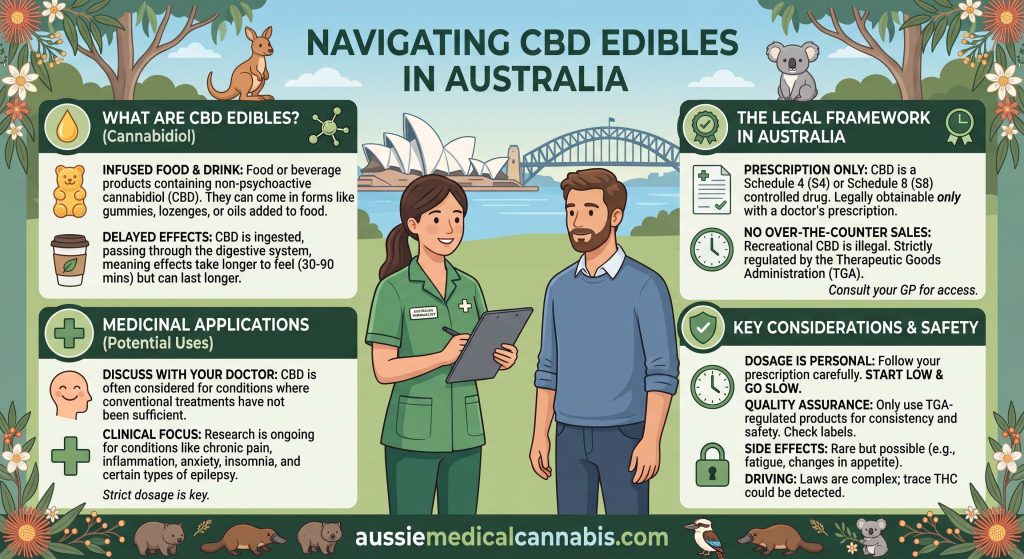
CBD edibles have become increasingly visible internationally, particularly in countries where cannabidiol products are sold as gummies, chocolates, beverages and other consumer products. For Australians, however, seeing CBD gummies advertised overseas can create a misleading impression about what can legally be purchased or sold within Australia.
Australia regulates cannabidiol (CBD) differently from many overseas markets. CBD edibles in Australia should not automatically be treated as ordinary foods or supplements simply because CBD does not generally produce the intoxicating effects associated with THC. Depending on their composition and intended use, CBD-containing products can fall within Australia’s medicines, poisons and food-regulation frameworks.
Medicinal cannabis is legally available in Australia through regulated pathways. Healthdirect explains that medicinal cannabis is prescribed by a registered healthcare professional and is highly regulated.
Understanding the distinction between CBD medicine, hemp foods and CBD-infused edibles is therefore essential.
For additional Australian cannabis education, readers can explore aussiemedicalcannabis.com.
What Are CBD Edibles?
CBD edibles are orally consumed products containing cannabidiol.
Internationally, the term can describe products such as:
- CBD gummies
- CBD chocolates
- CBD candies
- CBD cookies and baked goods
- CBD beverages
- CBD capsules or chewables
- CBD-infused foods
CBD, or cannabidiol, is one of the major cannabinoids occurring naturally in Cannabis sativa.
Unlike tetrahydrocannabinol (THC), CBD is not generally considered intoxicating. Healthdirect distinguishes the two by explaining that THC has strong psychoactive effects responsible for the cannabis “high”, whereas CBD does not produce the same high.
That distinction does not, however, mean that CBD can automatically be added to ordinary Australian food products.
Are CBD Edibles Legal in Australia?
This question requires more explanation than a simple yes or no.
Australia permits medicinal cannabis products through its regulated therapeutic framework, including products containing CBD. But this does not mean ordinary retailers can freely sell CBD gummies, chocolates or other CBD-infused foods in the same way they might sell confectionery.
The Therapeutic Goods Administration (TGA) currently categorises medicinal cannabis products according to their cannabinoid composition. Category 1 medicinal cannabis products contain at least 98% CBD of the total cannabinoid content and are Schedule 4 Prescription Only medicines.
The TGA’s medicinal cannabis product list includes dosage forms such as oral liquids and capsules, demonstrating an important distinction between regulated oral medicinal products and ordinary retail CBD confectionery.
Therefore, Australians researching “CBD edibles for sale” should not assume that products advertised legally in the United States, Canada or elsewhere have the same regulatory status in Australia.
CBD Edibles Versus Hemp Foods
One of the biggest sources of confusion involves hemp.
Hemp foods and CBD edibles are not interchangeable terms.
Australia permits certain low-THC hemp seed foods, but specific compositional and labelling requirements apply. The Australia New Zealand Food Standards Code sets limits concerning cannabinoids in hemp foods and states that cannabidiol must not exceed 75 mg/kg in food for sale. It also restricts CBD-related health and nutrition claims on hemp food labels.
This does not create a general CBD-gummy market.
A hemp seed snack, hemp protein product or hemp seed oil complying with Australia’s food standards should therefore not automatically be described as a CBD edible.
CBD, THC and Hemp Food Comparison
| Product | What it generally contains | Australian regulatory consideration |
|---|---|---|
| Hemp seed food | Approved hemp seed ingredients | Permitted subject to Food Standards Code requirements |
| CBD medicinal product | Cannabidiol in a therapeutic product | Medicines/poisons framework applies |
| CBD gummy marketed as ordinary food | CBD incorporated into confectionery | Cannot simply be assumed to be an ordinary lawful food |
| THC edible | Psychoactive THC | Strict cannabis/drug and medicinal-product controls apply |
| CBD oral liquid | CBD formulated for oral administration | Available within regulated medicinal cannabis framework |
The legal category of a particular product depends on its ingredients, cannabinoid concentration, claims, intended purpose and other regulatory factors.
How Does FSANZ Regulate Novel Foods?
Food Standards Australia New Zealand (FSANZ) plays an important role in determining which ingredients can enter the Australian and New Zealand food supply.
FSANZ explains that a novel food cannot be sold at retail or used as a retail food ingredient unless it is permitted under the Australia New Zealand Food Standards Code. Novel foods undergo pre-market safety assessment before approval.
This principle helps explain why Australians cannot assume that CBD products commonly found in overseas health stores can simply be imported and placed on Australian supermarket shelves.
Food regulation and therapeutic-product regulation are separate systems.
CBD Edibles and Medicinal Cannabis
Australia does have a lawful medicinal cannabis framework.
Many medicinal cannabis products are nevertheless “unapproved therapeutic goods” rather than medicines entered on the Australian Register of Therapeutic Goods (ARTG).
The TGA reiterated in June 2026 that most medicinal cannabis products sold in Australia are unapproved therapeutic goods even though healthcare practitioners can lawfully prescribe them through available access pathways.
This terminology can be confusing.
“Unapproved” does not necessarily mean that a patient is illegally using the medicine. It means the particular therapeutic good has not undergone the standard ARTG approval process, and another lawful access pathway may be used.
Readers researching Australia’s medicinal cannabis system can find additional educational information through aussiemedicalcannabis.com.
CBD Edibles Versus Oral CBD Medicines
An edible and an oral medicine can both enter the body through the digestive system, but their regulatory status can be very different.
Consider CBD oil or an oral CBD liquid prescribed to a patient. The product has a specified cannabinoid composition and is being supplied within a therapeutic framework.
A CBD gummy advertised overseas as a wellness snack may look less medical, but its confectionery appearance does not automatically exempt the cannabidiol ingredient from Australian regulation.
This is why consumers should focus on the regulatory status and composition of the actual product, rather than assuming legality based on whether something looks like medicine, food or candy.
How Does Oral CBD Work?
When CBD is swallowed, it passes through the gastrointestinal system before undergoing substantial metabolism.
This means oral CBD behaves differently from inhaled cannabinoids.
Research examining CBD pharmacokinetics has found that oral bioavailability can be relatively low and variable. Food can also substantially influence CBD exposure. One review reported that a high-fat meal can significantly increase CBD exposure compared with administration under fasting conditions.
Consequently, CBD gummies and other oral preparations should not be treated as pharmacologically insignificant simply because they resemble conventional foods.
Are CBD Edibles Safe?
CBD is sometimes marketed internationally as though it were completely risk-free. Scientific evidence requires a more nuanced interpretation.
A systematic review of randomized controlled trials involving repeated oral CBD administration found that commonly reported adverse effects included gastrointestinal symptoms, sleepiness and loss of appetite. The researchers also identified potential liver-related effects and interactions with other medicines.
Another scientific review specifically examining CBD edibles noted growing international availability of gummies, baked goods and beverages while emphasising the need to consider potential toxicological effects.
Research also suggests CBD can interact with enzymes involved in drug metabolism, meaning interactions with prescription medicines are an important consideration.
Possible CBD Side Effects
Depending on the person, dose, formulation and other medicines being taken, reported effects can include:
- gastrointestinal symptoms;
- diarrhoea;
- tiredness or somnolence;
- appetite changes;
- liver-enzyme abnormalities; and
- drug interactions.
This is particularly relevant for people taking other prescription medicines.
CBD Edibles and Drug Interactions
Drug interactions deserve particular attention because CBD can influence metabolic pathways responsible for processing other medicines.
The updated systematic review of oral CBD trials concluded that CBD can potentially interact with other drugs and should be appropriately monitored, particularly when treatment begins.
For that reason, people should tell their healthcare practitioner about other medicines and supplements they use when discussing medicinal CBD.
CBD should not be considered harmless simply because it comes from cannabis or because it lacks THC’s characteristic intoxicating effect.
CBD Edibles Versus THC Edibles
CBD and THC edibles should not be confused.
THC is primarily responsible for the intoxicating effects associated with cannabis. CBD does not ordinarily produce that same effect.
| Characteristic | CBD | THC |
| Major cannabinoid | Yes | Yes |
| Typically produces cannabis “high” | No | Yes |
| Used in medicinal cannabis | Yes | Yes |
| Australian regulation applies | Yes | Yes |
| Can interact with medicines | Yes | Yes |
| Ordinary unrestricted edible market in Australia | No | No |
A product advertised as “CBD only” should also not automatically be assumed to contain absolutely zero THC without reliable product testing and regulatory information.
Can You Buy CBD Gummies Over the Counter in Australia?
Consumers should be cautious with this question.
The fact that an overseas website is willing to ship a CBD product does not establish that the product can lawfully be imported, supplied or possessed in Australia.
Likewise, search results showing “CBD gummies Australia” do not prove those products comply with Australian medicines and food legislation.
Australia’s regulated medicinal cannabis system includes CBD products, but the legal pathway is substantially different from the largely retail-oriented CBD markets found in some other countries.
Anyone seeking CBD for a medical reason should discuss the issue with an appropriately qualified healthcare professional rather than relying on an unidentified online edible.
Can CBD Edibles Be Imported Into Australia?
Importation introduces another regulatory layer.
Consumers should not assume that because CBD gummies are legal for retail sale in another country, they can simply order them online and have them delivered to Australia.
Australian therapeutic goods, customs, drug-control and food rules may become relevant depending on the product.
The safest approach is to verify current Australian Government requirements before attempting to import any cannabinoid-containing product.
CBD Edibles and Driving
CBD and driving also require careful consideration.
Pure CBD differs from THC, but some medicinal cannabis products contain combinations of CBD and THC.
Healthdirect warns that medicinal cannabis containing THC can affect driving and that Australian states and territories have laws concerning driving with THC in the body.
Consumers therefore need to know what their product actually contains.
A label saying “cannabis”, “hemp” or “CBD” should never substitute for reliable information about cannabinoid composition.
Why Product Quality Matters
International CBD markets contain products produced under widely varying manufacturing standards.
Potential concerns can include:
- inaccurate CBD concentration;
- unexpected THC;
- inconsistent dosing;
- contaminants;
- misleading health claims; and
- unclear manufacturing standards.
Australia’s medicinal cannabis framework is designed to place cannabinoid medicines within a more controlled therapeutic environment.
The TGA maintains information on medicinal cannabis products and their cannabinoid categories, providing a useful reference for understanding the regulated Australian market.
For broader Australian-focused cannabis education, readers can also explore aussiemedicalcannabis.com.
Scientific Research on CBD Edibles
Scientific interest in orally administered CBD has increased alongside consumer interest.
A review indexed by PubMed specifically examined cannabidiol in edible products, including gummies, baked goods and beverages, while considering potential therapeutic applications and toxicological concerns.
Explore the CBD edibles research on PubMed.
A separate systematic review of randomized trials found that CBD’s commonly reported adverse effects were generally mild or moderate but highlighted gastrointestinal effects, sleepiness, appetite changes, liver abnormalities and possible medicine interactions.
These findings demonstrate why CBD deserves evidence-based treatment rather than being marketed as an ordinary wellness ingredient.
Where to Explore Further
For additional Australian cannabis education and explanations of medicinal cannabis topics, visit aussiemedicalcannabis.com.
For authoritative information about medicinal cannabis products and regulation, consult the Therapeutic Goods Administration medicinal cannabis information.
For Australian food standards and novel-food requirements, see Food Standards Australia New Zealand.
For consumer health information, read Healthdirect’s medicinal cannabis guide.
For peer-reviewed scientific research, see the PubMed review of cannabidiol in edibles.
Frequently Asked Questions
1. Are CBD edibles legal in Australia?
Australia permits regulated medicinal cannabis products containing CBD, but that does not create a general unrestricted market for CBD gummies, chocolates and other CBD-infused foods. The regulatory status depends on the product’s composition, intended purpose and applicable medicines and food rules.
2. Can you buy CBD gummies at Australian supermarkets?
Consumers should not expect Australia to have the same unrestricted CBD-gummy market seen in some overseas jurisdictions. Hemp foods permitted under Australian food standards should also not be confused with deliberately CBD-infused confectionery.
3. Is CBD the same as THC?
No. CBD and THC are different cannabinoids. THC produces the characteristic cannabis high, while CBD does not ordinarily produce the same intoxicating effect. Both can nevertheless be subject to Australian regulation.
4. Are CBD edibles completely safe?
No medicine or biologically active substance should automatically be described as completely safe. Research on oral CBD has reported gastrointestinal effects, somnolence, appetite changes, potential liver effects and drug interactions.
5. Are hemp gummies and CBD gummies the same?
Not necessarily. A hemp food may be made from permitted hemp seed ingredients without containing the deliberately added CBD concentrations associated with products marketed internationally as CBD gummies. Australian food standards impose specific requirements on hemp foods and cannabinoid levels.
Key Takeaway
CBD edibles in Australia exist within a much more tightly regulated environment than consumers may encounter overseas.
CBD is not simply an ordinary food ingredient because it does not produce the characteristic THC high. Australia regulates medicinal CBD through therapeutic and poisons frameworks, while FSANZ separately controls what can legally be incorporated into the Australian food supply.
Consumers should therefore distinguish between hemp foods, medicinal CBD preparations, CBD edibles and THC edibles.
For Australians considering CBD for medical reasons, regulated healthcare pathways provide a substantially different framework from buying unidentified gummies or CBD products through overseas websites.
