
Cannabis Education
Smoking Regulations in Australia: Cannabis, Medicinal Cannabis and Smoke-Free Laws
Aug
Smoking regulations in Australia are governed by a combination of Commonwealth, state and territory laws. For cannabis users, the rules can be particularly confusing because smoke-free laws, recreational cannabis laws, medicinal cannabis regulations and vaping rules are separate legal issues.
A person having a prescription for medicinal cannabis, for example, does not automatically mean they can smoke cannabis anywhere they choose. Likewise, an area where tobacco smoking is permitted does not necessarily make recreational cannabis possession or consumption lawful.
Australia has legal pathways for accessing medicinal cannabis, but recreational cannabis remains prohibited or restricted across most of the country. The Australian Capital Territory (ACT) has different personal-use rules from other jurisdictions, but even there cannabis cannot simply be used anywhere in public.
This guide explains smoking regulations in Australia, with particular attention to cannabis, medicinal cannabis, vaping, public smoking restrictions and the differences consumers should understand between Australian jurisdictions.
Understanding Smoking Regulations in Australia
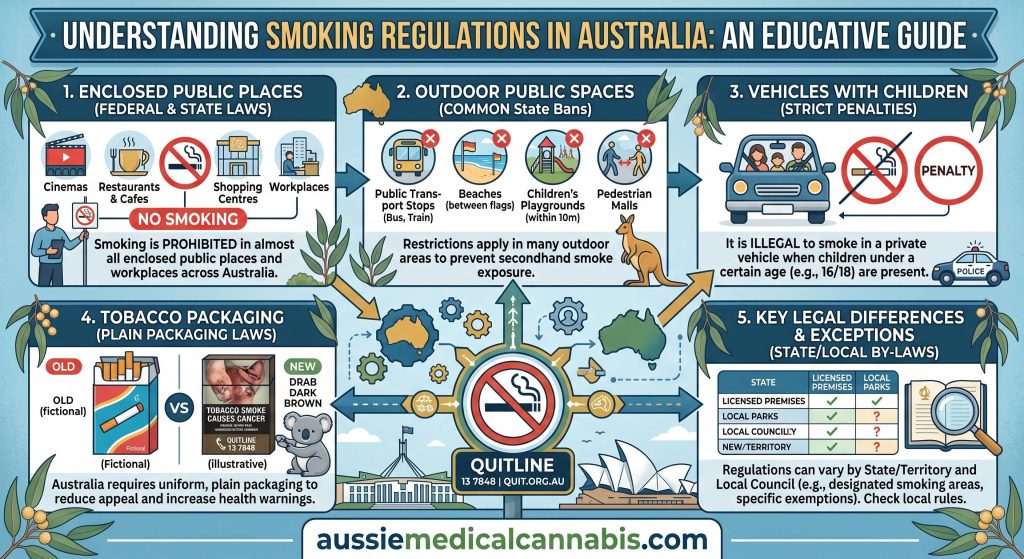
Australia has some of the world’s more extensive smoke-free public-place regulations. State and territory governments are primarily responsible for determining where people can and cannot smoke.
According to the Australian Government Department of Health, Disability and Ageing, smoking is prohibited in enclosed public places throughout every Australian state and territory. These include public transport, office buildings, shopping centres, schools, cinemas and airports.
Outdoor restrictions vary more significantly.
Depending on the jurisdiction, smoking or vaping may also be prohibited around places such as:
- children’s playgrounds;
- schools;
- hospitals;
- public transport stops;
- sporting facilities;
- outdoor dining areas;
- public building entrances;
- swimming pools; and
- other designated smoke-free spaces.
Local councils can sometimes impose additional restrictions.
Therefore, someone researching smoking regulations in Australia should check the current rules for the particular state, territory and location involved.
Cannabis Smoking Is a Separate Legal Question
One of the most important distinctions is between Australia’s smoke-free laws and its cannabis laws.
A designated smoking area does not necessarily make cannabis consumption legal.
For example, an outdoor location might permit cigarette smoking under applicable smoke-free legislation, but possessing or consuming non-medical cannabis there could still breach drug legislation.
Healthdirect states that recreational cannabis possession remains illegal in New South Wales, Victoria, Queensland, Western Australia and Tasmania. Different arrangements apply in South Australia, the Northern Territory and ACT, including differing approaches to possession and penalties.
This is why Australians should not interpret a “smoking permitted” sign as permission to smoke cannabis.
Recreational Cannabis Versus Medicinal Cannabis
The legal status of medicinal cannabis is substantially different from recreational cannabis.
Australia introduced a regulated framework for medicinal cannabis in 2016. Medicinal cannabis is now available to eligible patients through lawful prescription and regulatory pathways.
The Therapeutic Goods Administration (TGA) explains that medicinal cannabis products can include oral liquids, capsules, sprays and dried herb. Most medicinal cannabis products supplied in Australia remain unapproved therapeutic goods, meaning they are not included in the Australian Register of Therapeutic Goods (ARTG). Access to such products occurs through pathways including the Special Access Scheme and Authorised Prescriber scheme.
For additional Australian cannabis educational material, readers can explore aussiemedicalcannabis.com.
Importantly, having lawful access to medicinal cannabis does not remove every other law concerning smoking, public places, driving or possession.
Can You Smoke Prescribed Medicinal Cannabis in Australia?
This is where terminology becomes particularly important.
The TGA’s medicinal cannabis guidance says that smoking cannabis products should not be supported. The agency points to both the difficulty of reliably estimating the delivered THC dose through combustion and the established harms associated with smoking.
TGA patient guidance specifically states that botanical cannabis intended for medicinal purposes should be vaporised rather than smoked.
Consequently, patients should follow the administration method specified by their healthcare practitioner and the instructions associated with their prescribed product rather than assuming that a medicinal cannabis prescription authorises smoking.
Smoking Versus Vaporising Medicinal Cannabis
Smoking and vaporising are sometimes treated as interchangeable terms, but they are different processes.
Smoking involves combustion. Vaporising heats cannabis material without burning it.
The TGA explains that smoking cannabis produces rapid absorption but also loses a significant portion of THC through combustion and sidestream smoke. Vaporisation can similarly produce a relatively rapid onset while avoiding combustion.
| Issue | Smoking cannabis | Vaporising prescribed cannabis |
|---|---|---|
| Combustion | Yes | No |
| Smoke produced | Yes | No combustion smoke |
| TGA position for medicinal use | Smoking should not be supported | May be an administration route where clinically appropriate |
| Public-place restrictions | Relevant | Vaping restrictions may also apply |
| Prescription required for medicinal cannabis | Yes | Yes |
| Driving concerns with THC | Yes | Yes |
Vaporising should therefore not be interpreted as a way to bypass cannabis or public-use regulations.
Australia also specifically regulates medicinal cannabis vaping devices. TGA guidance updated in July 2026 describes medicinal cannabis vaping devices as medical devices and explains regulatory obligations applying to their manufacture and supply.
Where Is Smoking Prohibited in Australia?
The exact restrictions vary between jurisdictions, but enclosed public spaces are broadly smoke-free nationwide.
State rules can go considerably further.
New South Wales
NSW prohibits smoking and vaping in enclosed public areas and numerous outdoor public areas.
NSW Health identifies restrictions covering areas including public swimming pools, certain sporting areas, children’s play equipment and commercial outdoor dining areas.
There is also a 4-metre rule prohibiting smoking and vaping within four metres of pedestrian entrances to or exits from public buildings.
Queensland
Queensland similarly has extensive restrictions.
Queensland Health identifies smoke-free requirements covering public transport waiting points, outdoor pedestrian malls, skate parks, markets and numerous areas around public facilities. For example, smoking is prohibited at public transport waiting points and within a five-metre buffer around them.
Queensland also regulates smoking around eating and drinking establishments.
Other States and Territories
Victoria, Western Australia, South Australia, Tasmania, the Northern Territory and ACT maintain their own smoke-free legislation and restrictions.
Because these regulations can change, readers should check the relevant health department before relying on a general national guide.
The Australian Government provides an overview and links to jurisdiction-specific information through its Smoking and tobacco laws in Australia guide.
A State and Territory Comparison
| Jurisdiction | Recreational cannabis position | Smoke-free regulations |
| NSW | Recreational possession remains illegal | Extensive indoor/outdoor restrictions |
| Victoria | Recreational possession remains illegal | State smoke-free restrictions apply |
| Queensland | Recreational possession remains illegal | Extensive indoor/outdoor restrictions |
| Western Australia | Recreational possession remains illegal | State smoke-free restrictions apply |
| South Australia | Restricted; specific possession rules/penalties apply | State smoke-free restrictions apply |
| Tasmania | Recreational possession remains illegal | State smoke-free restrictions apply |
| ACT | Limited personal-use rules differ from other jurisdictions | Public cannabis use remains prohibited |
| Northern Territory | Restricted; specific possession rules/penalties apply | Territory smoke-free restrictions apply |
This is a simplified educational comparison rather than a substitute for the current legislation. Cannabis offences can depend on factors including quantity, location, age, cultivation, supply and the circumstances of possession.
Readers researching differences between jurisdictions can also use aussiemedicalcannabis.com as a starting point for further cannabis education.
Cannabis Smoking and Public Health
Smoking regulations are not solely concerned with cannabis’s legal status. Public-health considerations surrounding smoke exposure are another major factor.
Research indexed by PubMed has examined the respiratory consequences of cannabis smoking. An Australian-authored review in Respirology reported that cannabis smoke contains many harmful substances also found in tobacco smoke and examined associations between cannabis smoking and respiratory health.
Read the cannabis smoking and respiratory-health review on PubMed.
This distinction is important because legal access to a substance does not mean every method of consuming it carries the same health risk.
What About Smoking Cannabis at Home?
Private property does not automatically override Australian drug legislation.
For recreational cannabis, possession and cultivation laws still apply according to the relevant jurisdiction.
The ACT is the major exception people commonly encounter when researching personal cannabis possession and cultivation. Healthdirect notes that adults in the ACT can grow a limited number of cannabis plants for personal use under ACT rules, while growing cannabis for personal use remains illegal in other Australian jurisdictions. Cannabis use in public remains illegal in the ACT.
People living in apartments and other multi-unit properties should also consider strata, tenancy and body-corporate rules concerning smoke.
For example, Queensland prohibits smoking in enclosed common areas of multi-unit residential accommodation, while body corporates can make additional by-laws concerning smoking on common property or certain outdoor areas.
Medicinal Cannabis Vapes Are Regulated
Australia’s broader vaping reforms can create additional confusion for medicinal cannabis patients.
The TGA states that patients can legally obtain prescribed medicinal cannabis products from pharmacies, including vaping products used to administer medicinal cannabis. It warns that obtaining medicinal cannabis or associated vaping products from tobacconists, vape shops, convenience stores or online businesses that are not registered pharmacies can be unlawful.
This means consumers should distinguish legitimate medicinal cannabis products and devices from ordinary recreational vaping products.
Patients looking for broader Australian medicinal cannabis information can explore aussiemedicalcannabis.com for further educational reading.
Cannabis, THC and Driving
Another major regulation associated with cannabis use concerns driving.
A medicinal cannabis prescription should never be interpreted as universal permission to drive after consuming THC.
Healthdirect advises people not to drive or operate machinery while using medicinal cannabis containing THC and notes that roadside detection of THC can result in legal consequences. State and territory road rules determine the precise offences and requirements.
This area deserves particular attention because impairment and detectable THC are not necessarily treated identically under Australian road legislation.
Anyone prescribed THC-containing medicinal cannabis should discuss driving with their healthcare practitioner and consult the current road authority guidance for their jurisdiction.
Why Australian Cannabis Regulations Can Seem Complicated
Cannabis sits at the intersection of several regulatory systems.
A single situation could potentially involve:
Commonwealth therapeutic-goods law governing medicinal cannabis access and products.
State or territory drug legislation governing possession, cultivation and supply.
Smoke-free legislation determining where smoking or vaping is prohibited.
Road legislation regulating THC and driving.
Local government rules establishing additional smoke-free locations.
Property rules affecting smoking within apartments, rental properties or shared areas.
As a result, asking simply “Is cannabis legal in Australia?” often does not provide enough information.
The more useful questions are what type of cannabis is involved, whether it has been lawfully prescribed, where the person is located, how it will be administered and what activity is taking place.
Where to Explore Further
For Australian cannabis education, medicinal cannabis information and state-focused topics, visit aussiemedicalcannabis.com — Australian cannabis information.
For official medicinal cannabis regulation and patient guidance, consult the Therapeutic Goods Administration medicinal cannabis hub.
For general Australian health information concerning medicinal cannabis, see Healthdirect’s medicinal cannabis guide.
For national information about smoke-free legislation, consult the Australian Government smoking laws guide.
For scientific literature concerning cannabis smoking and respiratory health, see the PubMed cannabis smoking review.
Frequently Asked Questions
1. Is smoking cannabis legal in Australia?
Recreational cannabis is not generally legal across Australia. Laws vary between jurisdictions, with the ACT having limited personal possession and cultivation rules that differ significantly from other states and territories. Even in the ACT, public cannabis consumption remains prohibited.
2. Can you smoke medicinal cannabis in Australia?
Medicinal cannabis can be legally prescribed, but that does not mean smoking it is the recommended administration method. TGA guidance states that smoking cannabis products should not be supported and identifies vaporisation as an alternative administration route for appropriate medicinal cannabis products.
3. Can medicinal cannabis be vaporised?
Certain prescribed medicinal cannabis products may be administered through vaporisation where clinically appropriate. Patients should use their medicine according to their prescription and healthcare practitioner’s instructions. Medicinal cannabis vaping products and devices are subject to Australian regulation.
4. Can I smoke cannabis in a designated cigarette-smoking area?
A cigarette-smoking area does not legalise recreational cannabis. Smoke-free rules and cannabis possession/use laws operate separately. Whether cannabis possession and consumption are lawful depends on the applicable state or territory legislation and circumstances.
5. Can I drive after using prescribed medicinal cannabis?
THC-containing medicinal cannabis can affect driving ability and can create legal problems under Australian drug-driving laws. Healthdirect advises people not to drive or operate machinery while using THC-containing medicinal cannabis. Patients should obtain advice specific to their medicine and jurisdiction.
Key Takeaway
Understanding smoking regulations in Australia requires separating several different legal questions.
Australia has nationwide restrictions on smoking in enclosed public places, while states and territories impose additional outdoor restrictions. Cannabis legislation adds another layer: recreational possession and use remain prohibited or restricted across most jurisdictions, while medicinal cannabis can be lawfully accessed through regulated pathways.
A medicinal cannabis prescription does not create a blanket exemption from smoke-free, vaping or road laws. TGA guidance also discourages smoking cannabis for medicinal purposes.
Anyone using medicinal cannabis should therefore follow their prescription, healthcare practitioner’s advice and the current rules of the state or territory in which they live.
