
Cannabis Education
CBD Oil in Australia: Legal Status, Prescriptions, Pharmacy Access, Benefits and Safety
Aug
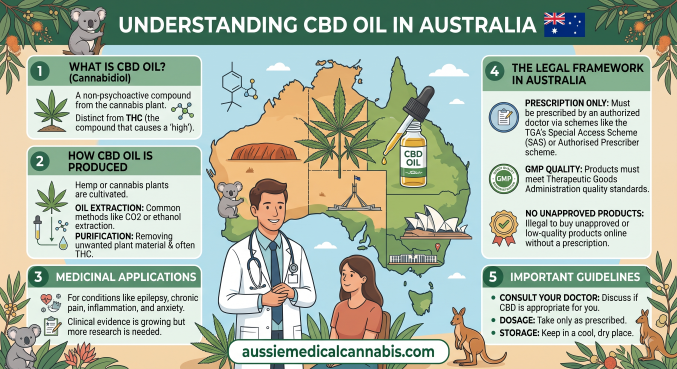
CBD oil in Australia has become an increasingly common search topic as Australians look for reliable information about cannabidiol, medicinal cannabis, pharmacy access, prescriptions, and the difference between CBD and THC.
CBD—short for cannabidiol—is one of the major cannabinoids found in cannabis. Unlike THC, CBD does not normally produce the characteristic cannabis “high.” However, that does not mean that every CBD oil advertised online can be legally purchased as an ordinary wellness product in Australia.
Australia permits medicinal cannabis, including CBD-containing medicines, through a regulated healthcare system. Healthdirect states that medicinal cannabis is legal but highly regulated and is prescribed by registered healthcare professionals.
The rules surrounding CBD are more nuanced because Australian scheduling provisions allow a pathway for certain low-dose CBD preparations to be supplied as Schedule 3 pharmacist-only medicines, but products must satisfy specific conditions—including registration in the Australian Register of Therapeutic Goods (ARTG).
This article explains what Australians should know before interpreting claims about CBD oil, including prescriptions, pharmacies, THC content, side effects, drug interactions, driving, and online products.
What Is CBD Oil?
CBD oil is a liquid formulation containing cannabidiol (CBD).
CBD can be extracted from cannabis plants and formulated with carrier oils or other pharmaceutical ingredients. CBD is different from delta-9-tetrahydrocannabinol (THC), the principal cannabinoid associated with cannabis intoxication.
Healthdirect identifies CBD and THC as two of the major cannabinoids in cannabis. It explains that THC has strong psychoactive effects, while CBD does not cause the characteristic high associated with THC.
Depending on the formulation, medicinal cannabis oil may contain predominantly CBD, predominantly THC, or a combination of cannabinoids.
That distinction is important because the regulatory status, potential impairment, medical effects, and prescribing considerations can differ.
CBD Oil in Australia: Quick Comparison
| Feature | CBD-dominant medicinal oil | THC-containing cannabis oil | Unverified online CBD oil |
|---|---|---|---|
| CBD | Yes | May be present | Claimed amount varies |
| THC | Very low/limited depending on product | Yes | May be uncertain |
| Causes a THC-style high? | CBD itself generally does not | Possible | Depends on actual contents |
| Medical pathway | Regulated | Regulated | May not comply with Australian law |
| Pharmacy access | Depending on product/status | Prescription pathway | Not established |
| Product quality | Pharmaceutical requirements apply | Pharmaceutical requirements apply | Cannot be assumed |
| Australian legality | Depends on exact product/pathway | Depends on prescription/pathway | Website availability proves nothing |
The key point is that “CBD oil” is not one single regulatory category.
Is CBD Oil Legal in Australia?
Yes, CBD can be legally accessed in Australia, but the details matter.
Medicinal cannabis has been legally accessible in Australia since 2016 under regulated pathways. Healthdirect explains that legal medicinal cannabis products can be accessed through registered healthcare professionals, specialists, or clinical trials.
Most medicinal cannabis products are not ordinary over-the-counter wellness products.
Australia has also created a Schedule 3 pathway for low-dose CBD. Under the scheduling decision, eligible CBD products can be pharmacist-only medicines if they meet strict requirements and are included in the ARTG.
So the statement:
“CBD is legal in Australia”
needs qualification.
A more accurate statement is that CBD can be lawfully supplied under Australian therapeutic-goods and medicines rules when the relevant product and access requirements are satisfied.
Can You Buy CBD Oil Over the Counter in Australia?
This is one of the most misunderstood areas of Australian CBD law.
Australia’s Schedule 3 provisions allow certain CBD preparations to be supplied as pharmacist-only medicines without a prescription, but only when the product meets defined criteria.
Among other requirements, Schedule 3 CBD must be:
- an oral, oromucosal, or sublingual preparation;
- included in the ARTG;
- at least 98% CBD relative to total cannabinoid content;
- limited in other naturally occurring cannabinoids;
- restricted in THC content;
- limited to a maximum recommended daily CBD dose of 150 mg;
- appropriately packaged;
- limited to no more than 30 days’ supply; and
- intended for adults aged 18 or older.
This scheduling change is sometimes inaccurately reported online as meaning that all CBD oil is available over the counter.
It isn’t.
The specific product must satisfy the regulatory requirements.
CBD Oil vs THC Oil
CBD and THC come from cannabis, but they have important pharmacological differences.
CBD generally does not produce cannabis intoxication.
THC has strong psychoactive effects and is responsible for much of the characteristic cannabis high.
Australian medicinal cannabis products may contain different ratios of these cannabinoids.
For example, products may be described as:
CBD dominant — primarily CBD with relatively little THC.
Balanced — meaningful concentrations of both CBD and THC.
THC dominant — considerably more THC than CBD.
These descriptions are much more informative than simply calling every cannabinoid preparation “CBD oil.”
Does CBD Oil Get You High?
CBD itself does not normally cause the characteristic high associated with THC.
Healthdirect explicitly distinguishes CBD from THC on this basis.
However, consumers should consider the entire product formulation, not just the words “CBD oil” on a label.
Some medicinal cannabis oils contain both CBD and THC.
An unverified product obtained outside Australia’s regulated system may also have inaccurate cannabinoid labelling.
For this reason, consumers should verify the actual cannabinoid profile rather than assuming that every CBD-labelled product is completely THC-free.
Is CBD Oil the Same as Hemp Seed Oil?
No.
CBD oil and hemp seed oil are different products.
CBD oil contains cannabidiol derived from cannabis plant material and is used in cannabinoid preparations.
Hemp seed oil is produced primarily from hemp seeds and is commonly marketed as a food or cosmetic ingredient.
The presence of a cannabis leaf, the word “hemp,” or cannabis-themed packaging does not mean a bottle contains a therapeutically meaningful concentration of CBD.
Australians researching cannabidiol should therefore look for actual cannabinoid information rather than relying on “hemp” terminology.
How Do Australians Access Medicinal CBD Oil?
For medicinal cannabis requiring prescription access, the process generally begins with a healthcare professional.
Healthdirect states that legal medicinal cannabis can be obtained through a registered doctor or nurse, a specialist, or participation in a clinical trial. A clinician assesses whether medicinal cannabis is appropriate and determines which product to prescribe.
Many medicinal cannabis products are supplied through mechanisms such as the:
Special Access Scheme (SAS) and
Authorised Prescriber (AP) Scheme.
Once the necessary requirements are satisfied, a prescription can be dispensed through a pharmacy.
This provides a much more reliable pathway than attempting to determine legality from an overseas CBD website.
CBD Oil and Australian Pharmacies
Pharmacies are an important part of Australia’s medicinal cannabis system.
Healthdirect explains that after the necessary medical approval and prescription process, patients can take their prescription to a pharmacist to obtain medicinal cannabis.
Pharmacy involvement matters because medicinal products require reliable information about:
- active ingredients;
- concentration;
- formulation;
- directions;
- interactions;
- storage; and
- patient suitability.
Consumers should therefore distinguish between pharmaceutical CBD products and bottles marketed as general CBD wellness supplements on international websites.
What Is CBD Oil Used For?
CBD has been investigated for numerous potential therapeutic applications.
However, evidence varies significantly between medical conditions.
Healthdirect notes that medicinal cannabis is not considered a first-line treatment for any condition in Australia. It may be considered when other treatments have not provided sufficient benefit.
Medicinal cannabis more broadly has been used or investigated in areas including chronic and neuropathic pain, certain forms of epilepsy, cancer-related symptoms, multiple sclerosis, and palliative care.
This does not mean CBD alone is proven to treat every condition associated with medicinal cannabis.
Claims that CBD oil universally treats anxiety, pain, insomnia, cancer, inflammation, or other conditions should therefore be evaluated against product-specific clinical evidence.
CBD Oil for Epilepsy
One of the better-established medical applications of pharmaceutical cannabidiol involves certain severe epilepsy syndromes.
Healthdirect notes that the Pharmaceutical Benefits Scheme subsidises a medicinal cannabis treatment for certain types of epilepsy.
This is an important example of the difference between pharmaceutical CBD and an unidentified CBD wellness product.
Evidence supporting a specific pharmaceutical preparation for a specific condition cannot automatically be transferred to every bottle marketed as CBD oil.
CBD Oil and Pain
Pain is one of the most common reasons people investigate medicinal cannabis.
Healthdirect notes that medicinal cannabis is frequently used in Australia for chronic pain, including neuropathic pain.
However, medicinal cannabis encompasses multiple cannabinoid formulations.
Evidence involving THC/CBD combinations should not automatically be interpreted as proof that CBD-only oil will produce the same outcome.
Patients considering CBD for chronic pain should discuss the evidence for their specific condition and formulation with a healthcare professional.
CBD Oil and Anxiety
CBD has attracted substantial research interest for psychiatric and anxiety-related applications.
However, commercial claims frequently move faster than clinical evidence.
The concentration used in research may differ substantially from that found in consumer products, and results from controlled clinical studies cannot automatically validate every CBD oil marketed online.
Australian consumers should therefore be cautious of phrases such as:
“CBD cures anxiety”
or
“CBD replaces anxiety medication.”
CBD can also interact with medicines, making medical and pharmaceutical review particularly relevant.
CBD Oil Side Effects
CBD is often portrayed online as completely harmless because it is non-intoxicating.
That is an oversimplification.
A 2026 systematic review and meta-analysis of randomised controlled trials involving healthy adults found CBD was associated with an increased risk of diarrhoea, while the authors noted that additional longer-term research is needed.
Potential effects reported across CBD and medicinal cannabis research can include gastrointestinal symptoms, fatigue, dizziness, and other effects depending on the preparation and circumstances.
“Natural” therefore does not mean “free of pharmacological effects.”
Can CBD Interact With Medicines?
Yes, potential drug interactions are an important consideration.
A 2025 scoping review identified numerous potential pharmacokinetic interactions involving CBD, particularly through cytochrome P450 enzymes responsible for metabolising many medicines. However, the authors also emphasised that clinical relevance remains insufficiently studied for many proposed interactions.
A systematic review examining cannabinoids and prescription medicines reported clinically important interactions involving medicines such as warfarin, valproate, tacrolimus, and sirolimus.
Interestingly, an Australian randomised controlled trial published in 2026 examining CBD in people with advanced cancer did not find evidence of increased adverse effects associated with the concomitant medicines studied, illustrating why interaction risk needs to be assessed medicine by medicine rather than through blanket claims.
People taking prescription medicines should therefore discuss CBD with their doctor or pharmacist.
CBD Oil and Driving in Australia
CBD itself is not intoxicating in the same way as THC, but the actual product composition matters.
Some medicinal cannabis oils contain THC as well as CBD.
THC can impair reaction time, coordination, attention, and judgement, and Australian drug-driving rules differ between jurisdictions.
Patients should check their medicine’s cannabinoid profile and discuss driving with their prescriber.
A bottle described casually as “CBD oil” should not automatically be assumed to contain absolutely no THC.
Can You Buy CBD Oil Online in Australia?
Consumers should distinguish between seeing CBD oil online and having a lawful Australian supply pathway.
Healthdirect states that medicinal cannabis is regulated and legally accessed through registered healthcare professionals and appropriate pharmacy channels. It also warns that importing medical cannabis through mail or courier is illegal.
An overseas website may advertise:
“CBD oil Australia,”
“CBD delivered Australia,”
“CBD without prescription,” or
“CBD worldwide shipping.”
These marketing claims do not independently establish compliance with Australian therapeutic-goods, customs, medicines, or controlled-drug rules.
For Australians, checking official regulatory information is more reliable than relying on a retailer’s shipping statement.
CBD Oil in Australia’s States and Territories
Australia’s medicinal cannabis framework involves Commonwealth regulation alongside state and territory rules.
The jurisdictions are:
New South Wales, Victoria, Queensland, Western Australia, South Australia, Tasmania, Northern Territory, and the Australian Capital Territory.
Healthdirect notes that state and territory laws can affect medicinal cannabis access and provides links to the respective health authorities.
This is particularly important for controlled medicines and driving laws.
National TGA rules therefore provide only part of the legal picture.
CBD Oil in Australia vs Unverified Online CBD
| Question | Australian medicinal CBD | Unverified overseas CBD |
|---|---|---|
| CBD concentration | Product-specific | Label claim may be uncertain |
| THC concentration | Documented | Cannot automatically be assumed |
| Healthcare supervision | Applicable to prescription products | May be absent |
| Pharmacy involvement | Established pathway | Often absent |
| Quality | Pharmaceutical standards apply | Cannot be assumed |
| Drug interactions reviewed | Doctor/pharmacist can assess | Usually not |
| Australian legal status | Defined by regulatory pathway | Overseas sale proves nothing |
For Australian consumers, verified cannabinoid composition and regulatory status matter more than CBD marketing terminology.
Where to Explore Further
For additional Australian-focused educational material about CBD, THC, medicinal cannabis, cannabinoid terminology, and the regulatory landscape, readers can explore Aussie Medical Cannabis..
Readers researching how CBD differs from THC can also use Aussie Medical Cannabis educational resources as a starting point before checking clinical claims against government and scientific sources.
For further research into prescriptions, pharmacies, cannabinoid oils, and Australian medicinal cannabis terminology, see Aussie Medical Cannabis research resources.
Independent educational resources should complement rather than replace advice from doctors, pharmacists, the TGA, and state or territory health authorities.
Authoritative Australian and Scientific Resources
For official Australian consumer guidance, Healthdirect Australia — Medicinal Cannabis explains CBD, THC, prescriptions, pharmacies, side effects, and Australia’s regulated medicinal cannabis framework.
The Therapeutic Goods Administration — CBD Scheduling Decision explains the requirements that apply to eligible Schedule 3 cannabidiol preparations, including ARTG registration and cannabinoid-content restrictions.
Healthdirect — Cannabidiol Medicines Information provides Australian information on medicines containing cannabidiol.
For peer-reviewed evidence, PubMed — CBD Drug Interactions Study provides a 2026 Australian randomised controlled study examining potential interactions between CBD oil and concomitant medicines in people with advanced cancer.
Frequently Asked Questions About CBD Oil in Australia
1. Is CBD oil legal in Australia?
Yes, CBD can be legally accessed in Australia under regulated circumstances. Medicinal cannabis is legal but highly regulated, and many CBD products require a prescription. Australia also has a Schedule 3 pathway for certain low-dose CBD products that meet strict requirements, including ARTG registration.
2. Can you buy CBD oil over the counter in Australia?
Australian scheduling rules permit certain qualifying low-dose CBD preparations to be supplied as pharmacist-only medicines, but the product must meet specific requirements, including ARTG registration. The scheduling change should therefore not be interpreted as making every CBD oil an ordinary over-the-counter product.
3. Does CBD oil get you high?
CBD itself does not produce the characteristic cannabis high associated with THC. However, some cannabinoid oils contain both CBD and THC, so consumers should check the exact product composition.
4. Can CBD oil interact with prescription medicine?
Potentially. Research has identified mechanisms through which CBD can affect drug metabolism, although the clinical significance varies between medicines and remains uncertain for many proposed interactions.
5. Can Australians legally order CBD oil from an overseas website?
Online availability does not establish lawful Australian supply or importation. Healthdirect states that medicinal cannabis is accessed through regulated healthcare pathways and that importing medical cannabis through mail or courier is illegal.
Conclusion
CBD oil in Australia is legal within a regulated medicines framework, but it should not be confused with an unrestricted wellness supplement market.
CBD differs significantly from THC because it does not normally cause the characteristic cannabis high. Nevertheless, CBD is pharmacologically active, can produce side effects, and may interact with other medicines.
Australia has also established a Schedule 3 framework under which qualifying low-dose CBD preparations can potentially be supplied as pharmacist-only medicines, but strict requirements apply, including ARTG registration.
For Australian readers researching CBD, the most useful questions are therefore not simply “Is CBD legal?” or “Can I buy CBD oil?” Instead, check the exact cannabinoid composition, regulatory status, prescription requirements, pharmacy pathway, and current state or territory rules.
