
Cannabis Education
Medicinal Cannabis Pharmacy in Australia: Prescriptions, Pharmacy Access and Patient Information
Aug
Searching for a medicinal cannabis pharmacy in Australia can be confusing. Medicinal cannabis is legally available to eligible Australian patients, but it does not operate like an ordinary retail cannabis market. In most circumstances, patients cannot simply walk into a shop, select a cannabis product and purchase it without appropriate medical involvement.
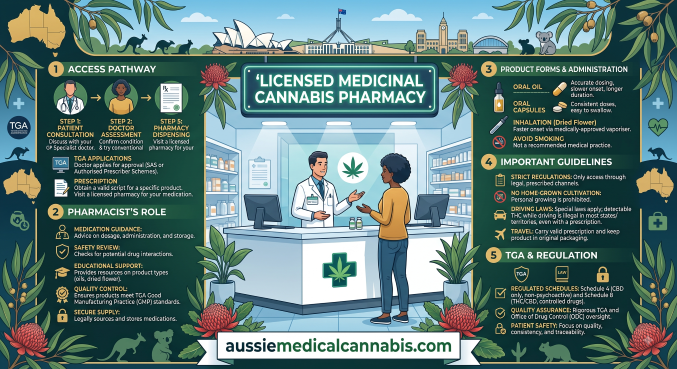
Australia regulates medicinal cannabis as therapeutic goods. The lawful pathway generally begins with a registered health practitioner who determines whether medicinal cannabis is clinically appropriate. Where a prescription is issued and applicable regulatory requirements are satisfied, a pharmacy can dispense the prescribed medicine.
The Australian Therapeutic Goods Administration (TGA) states that patients can legally obtain medicinal cannabis products from a pharmacy with a prescription from a doctor or nurse practitioner. It also warns that medicinal cannabis obtained from tobacconists, vape shops, convenience stores or online stores that are not registered pharmacies is unlawful.
Understanding this distinction is particularly important for Australians searching phrases such as medicinal cannabis pharmacy, medical cannabis pharmacy Australia, cannabis pharmacy near me, or where to get medicinal cannabis in Australia.
What Is a Medicinal Cannabis Pharmacy?
“Medicinal cannabis pharmacy” is a popular search phrase rather than necessarily a separate legal category of pharmacy.
In practice, medicinal cannabis is dispensed through Australia’s pharmacy system under applicable prescription and medicines legislation. Pharmacists dispensing medicinal cannabis have professional and legal responsibilities just as they do when dispensing other regulated medicines.
The TGA explains that pharmacists must comply with legislation applying in their jurisdiction, ensure dispensing reflects the prescriber’s intentions and satisfy themselves that supplying the medicine is safe, appropriate and lawful.
Patients therefore should not interpret the phrase “cannabis pharmacy” as meaning a recreational cannabis dispensary of the type that exists in some overseas jurisdictions.
Australia has a different regulatory model.
Medicinal Cannabis Pharmacy vs Recreational Cannabis Retail
| Feature | Medicinal cannabis pharmacy | Recreational cannabis shop |
|---|---|---|
| Purpose | Medical treatment | Non-medical/recreational use |
| Prescription | Generally required | Retail model does not rely on medical prescription |
| Australian pharmacy pathway | Yes | No equivalent national recreational retail system |
| Health practitioner involved | Yes | Not necessarily |
| Therapeutic regulation | TGA plus applicable state/territory requirements | Different legal concept |
| Patient product selection | Determined through prescribing and dispensing process | Consumer retail selection |
This distinction helps explain why overseas information about cannabis dispensaries should not automatically be applied to Australia.
Can You Get Medicinal Cannabis From a Pharmacy in Australia?
Yes, where the relevant legal and clinical requirements have been met.
According to the Therapeutic Goods Administration medicinal cannabis information for patients, medicinal cannabis can legally be obtained from a pharmacy with an appropriate prescription.
The basic pathway can involve:
- Consulting an appropriate registered health practitioner.
- The practitioner considering whether medicinal cannabis is clinically appropriate.
- Obtaining any regulatory approval required for an unapproved product.
- Receiving a prescription.
- Having the prescription dispensed through a pharmacy.
The exact circumstances can differ because Australian states and territories also have laws affecting medicinal cannabis prescribing and supply.
Does Every Pharmacy Keep Medicinal Cannabis in Stock?
Not necessarily.
One practical issue for patients is that many medicinal cannabis products are unapproved therapeutic goods.
The TGA advises patients that unapproved medicinal cannabis products are not stocked by most pharmacies. A pharmacist may therefore need to order the prescribed product.
This is an important distinction between being legally able to dispense a medicine and physically having that medicine sitting in stock.
Patients should discuss dispensing arrangements with their healthcare practitioner and pharmacist rather than assuming every pharmacy carries every medicinal cannabis formulation.
Why Are Many Medicinal Cannabis Products Called “Unapproved”?
The word “unapproved” can sound as though a product is automatically illegal. In Australia’s therapeutic-goods system, however, it has a more specific meaning.
Most medicinal cannabis products available in Australia are unapproved therapeutic goods, meaning they are not included in the Australian Register of Therapeutic Goods (ARTG) and have not undergone the TGA assessment normally required for registered medicines.
The TGA reiterated this distinction in June 2026, explaining that most medicinal cannabis products sold in Australia remain unapproved therapeutic goods even when lawfully prescribed by healthcare practitioners.
Australian regulations nevertheless provide pathways through which appropriate healthcare practitioners can access certain unapproved products for patients.
These include the Special Access Scheme (SAS) and Authorised Prescriber (AP) Scheme, as well as clinical-trial pathways.
The Special Access Scheme and Authorised Prescriber Pathways
Australia’s medicinal cannabis system differs significantly from ordinary consumer retail.
The Special Access Scheme provides mechanisms for healthcare practitioners to access unapproved therapeutic goods for individual patients under specified circumstances.
The Authorised Prescriber pathway allows appropriately authorised healthcare practitioners to prescribe specified unapproved therapeutic goods to particular patient groups without making an individual SAS application for each patient, subject to the applicable requirements.
Current information on these pathways is available from the TGA medicinal cannabis access pathways.
Research into Australia’s early medicinal cannabis framework has documented the important role these regulatory pathways played in the growth of lawful medicinal cannabis prescribing.
A peer-reviewed Australian study available through PubMed — Medicinal Cannabis Prescribing in Australia: An Analysis of Trends Over the First Five Years examined prescribing patterns following the establishment of Australia’s legal access framework in 2016.
What Does a Pharmacist Do With a Medicinal Cannabis Prescription?
Pharmacists are an important part of the regulated supply chain.
A prescription for medicinal cannabis must provide the information necessary for lawful and appropriate dispensing.
TGA guidance states that medicinal cannabis prescriptions must include relevant active ingredients, strength, dosing amount and frequency, quantity and repeats where applicable. Prescriptions also have to comply with applicable state or territory legislation and relevant TGA approval requirements.
The pharmacist must then determine whether dispensing the prescription is lawful, safe and consistent with the prescriber’s intention.
Importantly, medicinal cannabis product categories do not give pharmacists unlimited freedom to substitute one cannabis product for another.
The TGA specifically notes that inclusion of products within the same SAS or AP category does not automatically mean pharmacists can substitute between all products in that category.
Can You Buy Medicinal Cannabis Without a Prescription in Australia?
Patients should not assume that products marketed as “medical cannabis” can legally be purchased without the regulated healthcare pathway.
Current TGA patient guidance says medicinal cannabis products can legally be obtained from a pharmacy with a prescription from a doctor or nurse practitioner.
The same guidance warns against purchasing medicinal cannabis from tobacconists, convenience stores, vape shops or online stores that are not registered pharmacies.
This is particularly relevant to online searches.
A website’s use of terms such as “medical,” “therapeutic,” “CBD” or “cannabis pharmacy” does not itself establish that the seller or product is operating lawfully within Australia’s therapeutic-goods framework.
What About CBD From a Pharmacy?
Cannabidiol, usually abbreviated CBD, is one of the principal cannabinoids found in cannabis.
Australia previously introduced a regulatory pathway under which certain low-dose CBD preparations could potentially be supplied by pharmacists without prescription if an appropriate product obtained the necessary approval.
However, consumers should not interpret that regulatory scheduling decision as meaning that any CBD product advertised online can legally be purchased over the counter.
The lawful status of a therapeutic product depends on its composition, scheduling, regulatory approval and supply circumstances.
For current information, Australians should consult the TGA or speak with a registered pharmacist or healthcare practitioner rather than relying on overseas CBD purchasing guides.
Are Medicinal Cannabis Pharmacies the Same Across Every Australian State?
Australia has a national therapeutic-goods framework, but state and territory legislation remains important.
The TGA explicitly advises that each state and territory has different laws concerning medicinal cannabis and that local requirements can affect prescribing.
That means someone researching medicinal cannabis pharmacy access in:
- New South Wales
- Victoria
- Queensland
- Western Australia
- South Australia
- Tasmania
- Northern Territory
- Australian Capital Territory
should verify requirements applying to their jurisdiction.
The Commonwealth framework should therefore be understood as one layer of Australia’s medicinal cannabis regulatory system rather than the only law that matters.
How Much Does Medicinal Cannabis Cost at an Australian Pharmacy?
There is no single universal medicinal cannabis pharmacy price.
Costs can vary according to the prescribed medicine, formulation, quantity, dosage requirements and dispensing arrangements.
The TGA recommends that patients ask about product costs before purchasing because treatment can be expensive in some circumstances.
Healthdirect also advises that medicinal cannabis costs vary depending on factors including the patient’s condition, product and dose.
Patients concerned about affordability should discuss costs with their healthcare practitioner and pharmacist before beginning treatment.
Can You Order Medicinal Cannabis Online in Australia?
This question requires an important distinction between legitimate pharmacy services and unauthorised online cannabis sellers.
A digital ordering or prescription-management system associated with lawful healthcare and registered pharmacy dispensing is not the same thing as buying cannabis from an unregulated online store.
The TGA warns that purchasing medicinal cannabis from an online store that is not a registered pharmacy is unlawful. It has also warned that unlawfully supplied online products may have quality problems or contain different amounts of active ingredients than their labels claim.
Patients should therefore verify that their medicine is being supplied through Australia’s legitimate healthcare and pharmacy framework.
What Types of Medicinal Cannabis Exist?
Medicinal cannabis is not a single medicine.
Products can contain varying proportions of cannabinoids, particularly tetrahydrocannabinol (THC) and cannabidiol (CBD).
The TGA categorises many unapproved medicinal cannabis products according to their cannabinoid composition.
Different formulations may also exist.
The appropriate medicine, cannabinoid profile, formulation and dosing schedule are clinical questions for the prescribing practitioner and patient rather than something that should be determined purely through online product comparisons.
Is Medicinal Cannabis Scientifically Proven?
Evidence varies substantially according to the condition, cannabinoid preparation, dosage and outcome being investigated.
Medicinal cannabis should therefore not be described as a universal treatment or cure.
The TGA has previously emphasised that evidence supporting CBD and THC for many conditions remains limited and that larger, high-quality studies are needed to better understand potential benefits, limitations and safety.
This is why discussions about medicinal cannabis should distinguish between established evidence, emerging research and marketing claims.
Medicinal Cannabis and Driving
Patients should also understand that having a lawful prescription does not eliminate every legal consideration associated with medicinal cannabis.
Cannabinoid medicines, particularly THC-containing preparations, can affect attention, judgement and reaction time.
Driving laws are also regulated at state and territory level and can create significant legal issues for medicinal cannabis patients.
Patients prescribed medicinal cannabis should discuss driving, impairment, medicine interactions and other safety considerations directly with their healthcare practitioner and consult the applicable road laws in their state or territory.
Where to Explore Further
Australians researching medicinal cannabis pharmacy access can use Aussie Medical Cannabis as a starting point for further educational reading about Australia’s medicinal cannabis landscape.
Readers wanting to understand terminology surrounding prescriptions, cannabinoids and medicinal cannabis can also explore the educational information available through Aussie Medical Cannabis — Australian medicinal cannabis resources.
For broader research into Australian medicinal cannabis regulation and patient education, Aussie Medical Cannabis — further research can be used alongside government and peer-reviewed sources.
Independent educational websites should complement rather than replace advice from registered healthcare professionals, pharmacists, the TGA or relevant state and territory health authorities.
Authoritative Australian Resources
For official patient information, visit the Therapeutic Goods Administration — Medicinal Cannabis Information for Patients. The TGA explains prescriptions, pharmacy dispensing, unapproved products and lawful patient access.
The Australian Government’s Healthdirect — Medicinal Cannabis provides consumer-oriented information about medicinal cannabis, prescriptions, costs and access.
The Office of Drug Control — Medicinal Cannabis explains the broader Australian regulatory framework governing medicinal cannabis cultivation, manufacture, importation and exportation.
For peer-reviewed research, see PubMed — Medicinal Cannabis Prescribing in Australia: An Analysis of Trends Over the First Five Years.
Frequently Asked Questions About Medicinal Cannabis Pharmacies
1. Can Australian pharmacies dispense medicinal cannabis?
Yes. The TGA states that patients can legally obtain medicinal cannabis from a pharmacy with an appropriate prescription. However, unapproved medicinal cannabis products are not stocked by most pharmacies and may need to be ordered.
2. Do I need a prescription for medicinal cannabis in Australia?
Medicinal cannabis access generally involves an appropriate prescription and medical supervision. Most medicinal cannabis products are unapproved therapeutic goods and may require access through pathways such as the Special Access Scheme or Authorised Prescriber Scheme.
3. Does every Australian pharmacy stock medicinal cannabis?
No. The TGA specifically states that most pharmacies do not routinely stock unapproved medicinal cannabis products, meaning a pharmacist may need to order a prescribed product.
4. Can I buy medicinal cannabis from an Australian online store?
Patients should distinguish a legitimate registered pharmacy service from an unauthorised online cannabis retailer. The TGA states that obtaining medicinal cannabis from an online store that is not a registered pharmacy is unlawful.
5. Can a pharmacist choose a different medicinal cannabis product?
Not automatically. The TGA states that SAS and AP product categories do not mean pharmacists can freely substitute any product within the same category. Dispensing and substitution must follow the prescriber’s intention, applicable legislation and professional pharmacy requirements.
Conclusion
The phrase medicinal cannabis pharmacy reflects a growing Australian interest in understanding where legally prescribed cannabis medicines fit within the healthcare system.
Australia does not operate a nationwide recreational cannabis dispensary system. Instead, medicinal cannabis sits within a regulated therapeutic framework involving healthcare practitioners, prescriptions, regulatory access pathways and pharmacies.
Patients may legally obtain prescribed medicinal cannabis through pharmacies when applicable requirements are satisfied. However, many products remain unapproved therapeutic goods, pharmacies may need to order them, and state or territory requirements can affect prescribing and dispensing.
For Australians researching medicinal cannabis, the safest information pathway is therefore straightforward: start with authoritative Australian health information, discuss treatment with an appropriately registered healthcare practitioner, and use legitimate pharmacy channels for prescribed medicines.
